


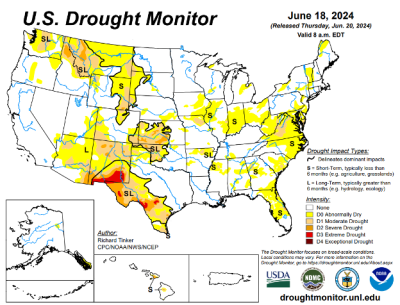
The drought monitor released on June 18 (Figure 1) shows areas of Wyoming in abnormally dry to severe drought conditions, primarily on the east side of the state. With minimal precipitation in the extended forecast, producers may want to consider potential drought mitigation strategies.
Managing drought conditions may involve purchasing supplemental feed, liquidating livestock, or early weaning, to name a few options. Marketing cull cows in late summer is one strategy to capitalize on the seasonality of the cull cow market and reduce stress on pastures.
Diligent record keeping can help producers identify and locate cull cows. Unpregnant females are typically the main and first group to cull as they still require feed (inputs) but will not produce a calf.
For most Wyoming producers, pregnancy status is typically evaluated at the time of weaning, later in the fall. In short, rectal palpation (35-50 days post breeding), ultrasound (30 days-post breeding), and blood tests (30 days-post breeding) are effective tools to identify open cows roughly 30 days after breeding. To learn more about early pregnancy detection methods, visit bit.ly/3ROnTLB for an article by Nebraska Extension.
Temperament is another reason cows may be culled. Calving season is a true test of a cow’s temper, and cows deemed unsafe to be around are typically added to the culling list several months prior to weaning for spring calving herds. Health or structure-related issues affecting legs, feet, udders, and eyes are additional reasons to cull. Records of identification, reasons for culling, and pasture location can help reduce the emotion in deciding which cows to cull as well as the time and labor required to locate and gather culls when drought strikes.
Some of the cows identified for culling may have a calf on their side and management of the calf is an important consideration. In August, calves born in March would be approximately 150 days old and considered early weaned. If these cows were culled, it would be necessary to provide the calves with a high-quality nutrient-dense feed to replace their mothers’ milk. Introducing calves to supplements and high-quality hay prior to weaning can help with the transition. More information on feeding and managing (early) weaned calves can be found at bit.ly/4cFaWvL.
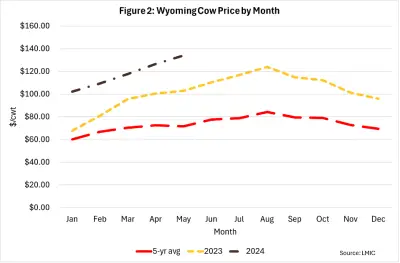
Production traits mentioned above are adequate reasons to cull, but seasonality of markets should also be considered. The chart in Figure 2 shows the average 5-year (2019-2023) price, the average price in 2023, and the price for the first five months in 2024 for a 75-80% breaking cow in Wyoming. Historically, cow prices trend upward from January, peaking in August and declining throughout the fall. Prices typically trend down throughout the fall, generally due to the increased supply of cows on the market as producers evaluate pregnancy status of their herds and sell opens. So far, the price in 2024 has followed the historical trend and is on track for record highs this August.
So, what does this mean for producers dealing with possible drought conditions? If a producer can pregnancy check their cows in the summer and sell culls, they could save pasture and capitalize on seasonality of the cull cow market. Capturing this seasonal high could add $11 to $20 per hundredweight (Figure 2) to cull sale revenues. The price advantage could be greater if producers liquidate more cows than usual in response to drought.
However, these possible benefits must be weighed against potential added costs associated with working the cows earlier and managing early weaned calves. Contact your local UW Extension office or UW livestock production and marketing specialist Rob Ziegler at rziegle3@uwyo.edu with questions.