


If you ask someone on planet Earth what their favorite food is, lettuce probably isn’t the most common answer. But for astronauts aboard the International Space Station, fresh lettuce is a delicacy.
NASA’s vegetable of choice grows rapidly and can be cut back and grown again, yielding more fresh produce with fewer inputs than other plants. In addition to its nutritional benefits, the cheerful, leafy green may also boost astronaut morale.
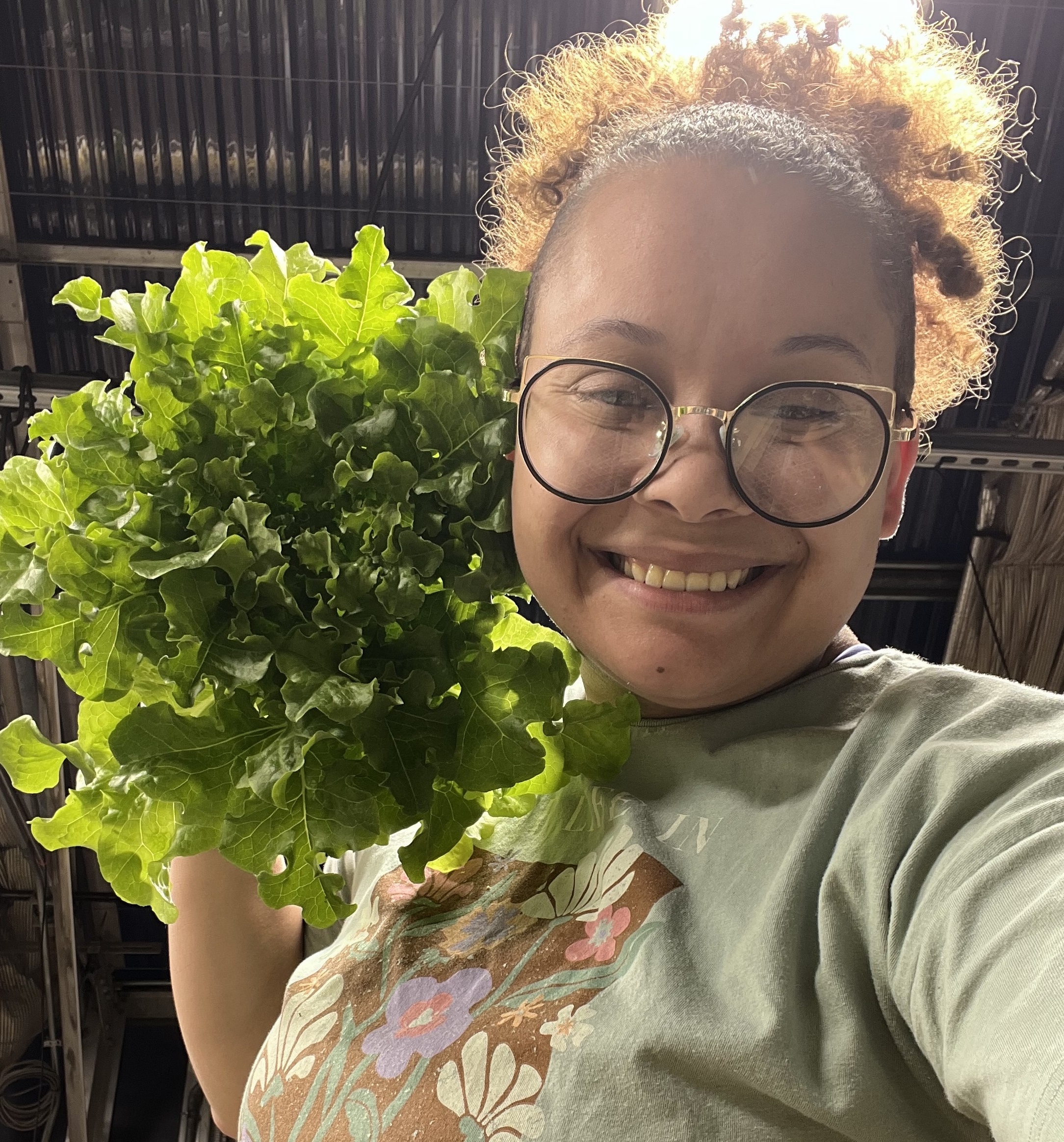
While lettuce production aboard the space station has proved successful (and popular among astronauts), there’s room for improvement.
As a NASA research fellow, UW undergraduate Bree Drew tested which lettuce varieties and harvest methods might be most efficient—and yield the tastiest product—to better serve astronauts far from home.
From studio art to NASA research
Drew is one of the first students in UW’s plant sciences department to receive a fellowship through the Wyoming NASA Space Grant Consortium.
But when she first arrived at UW, Drew wasn’t planning to conduct scientific research, let alone venture into NASA’s space plant biology program. An artist and musician, she’d earned an associate of arts from Northwest College before moving to Laramie to pursue a studio art degree at UW.
Like many of her peers in the art department, Drew took courses in illustration, printmaking, and metalsmithing. But she also signed up for classes in agroecology, landscape design, and plant breeding.
“As an art major, I really enjoyed the art, but I wished that I could get my hands back out in nature,” she says. “I like the idea of combining art and landscape because you have to design things just how you would design an art piece. The more technical side of breeding, what cultivars go together in order to breed successful generations, has been super fun [too].”
Drew credits Liz Moore, instructor of her horticultural sciences class, and plant breeder Donna Harris with inspiring her to double major in plant sciences. Along the way, Drew also connected with JJ Chen, an assistant professor of plant sciences who ultimately encouraged her to apply for the NASA fellowship program.
“No matter where you come from or what your background is, as long as you are interested and passionate about plant sciences, we have a pretty good supporting team here to help you succeed,” Chen says. “Even though we’re in the College of Ag, that doesn’t mean you can only work on the Earth. You can also chase dreams with NASA.”
One of Drew’s long-term dreams is helping the Laramie community achieve food security. “Overall, I want to be able to feed my community, so I started to look for similar topics to that with NASA,” she explains. “One of them was trying to figure out how to increase their yield of lettuce…It’s very similar to what I want to do with the community I live in now—how can I increase yield for people to eat and grow stronger?”
With Chen and Moore’s help, Drew successfully navigated the Wyoming NASA Space Grant Consortium grant proposal process, securing a yearlong fellowship that began in May 2024.
“I was a bit unsure, because I’m not always confident in myself,” Drew admits. “And then I got awarded that [NASA] award. It was mind-blowing.”
Growing “space lettuce”
Moore and Chen served as co-advisers for Drew’s NASA research, which involved testing different lettuce varieties and harvest techniques to improve yield and quality.
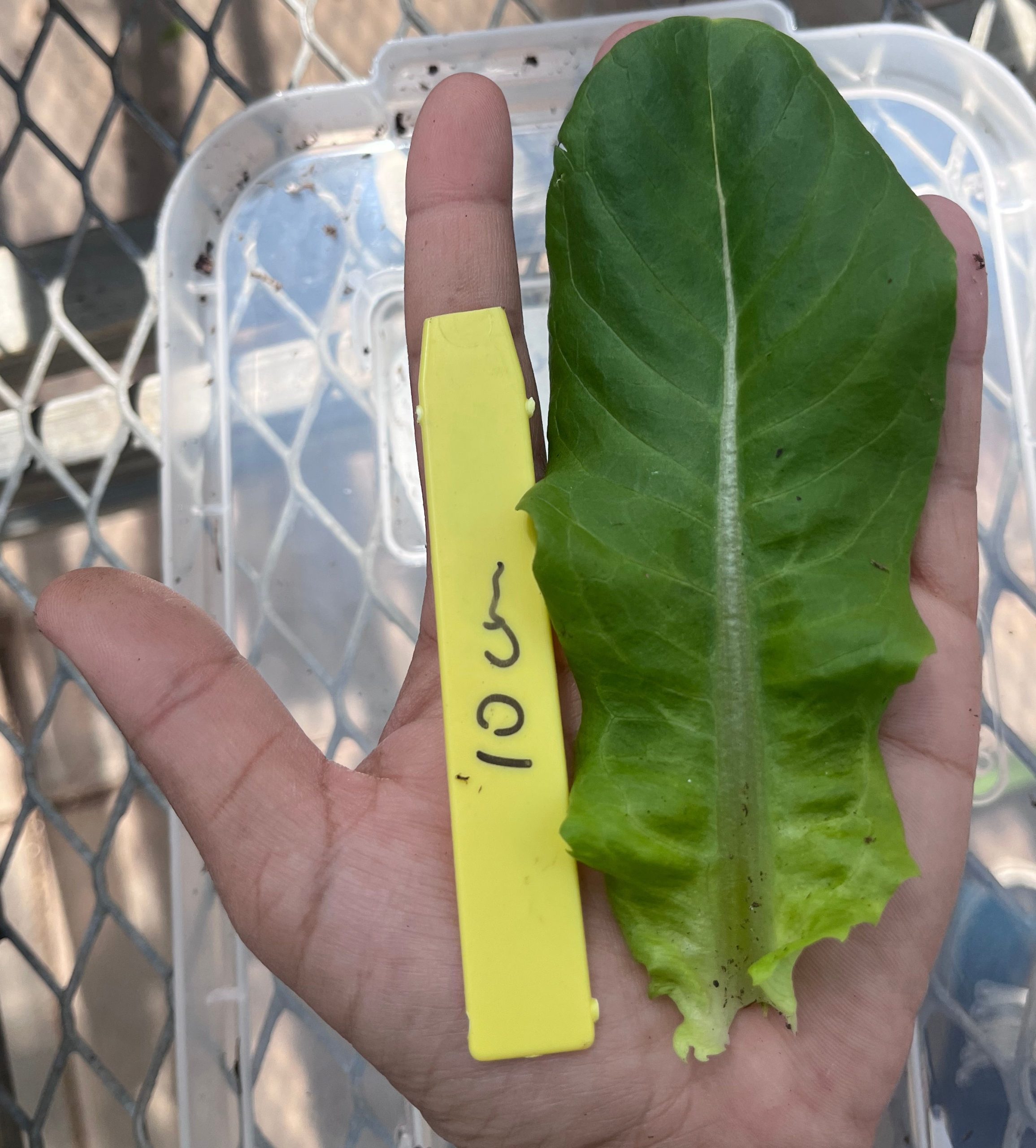
Currently, astronauts use what’s called the “cut and come again” harvest technique. This practice involves sowing a lettuce seed, harvesting two to five 10-centimeter-long leaves, then letting the plants continue to grow. Once the leaves reach 10 centimeters in length again, the astronauts reap another harvest, repeating the process a total of three times.
In the current model, the astronauts plant new seeds after the third harvest (about 60 days after initial planting). After three harvests, the lettuce plant’s reproductive cycle begins, meaning it devotes less energy and resources to producing tasty leaves.
Drew wondered if an alternative harvest method, known as “cut and sow,” might produce higher (and maybe even tastier) yields. Using the cut-and-sow process, lettuce plants are allowed to grow all the way to maturity before harvest takes place. Immediately after all the aboveground growth is harvested, a new lettuce seed is sown right where the original plant grew.
In summer 2024, Drew launched her experiment. She planted, watered, and monitored hundreds of lettuce plants in a greenhouse at the Laramie Research and Extension Center.
To replicate the astronauts’ three-harvest procedure, Drew tracked the plants’ growth for a 60-day period. Some of the plants were harvested using the traditional cut-and-come-again procedure, while others received cut-and-sow treatment.
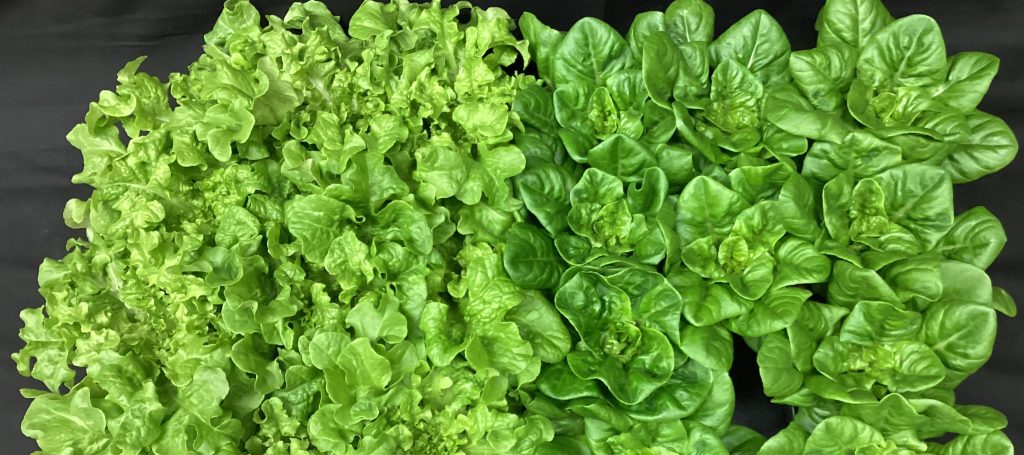
Drew tested two varieties of lettuce—‘Little Gem’ and ‘Salad Bowl’—to see how different varieties interacted with different harvest techniques. She also experimented with different growing substrates and watering techniques (by hand, overhead irrigation, and subirrigation).
The latter is a promising avenue for further study, Drew notes. All of the growing substrates contained slow-release fertilizer, but different combinations of irrigation and harvest methods resulted in different pH, nitrate, and salinity levels. Using overhead irrigation and the cut-and-sow method, for instance, resulted in higher pH, nitrate, and salinity levels, likely because the fertilizer was reactivated each time water poured onto the soil from above.
What worked (and tasted) best?
In addition to tracking harvest yield, Drew collaborated with Jill Keith, an associate professor of human nutrition and food, to assess consumer preferences for different lettuce varieties and harvest techniques.
“Come to find out, it [the cut-and-sow method] doesn’t exactly provide the high yield I proposed, but the palatability—how it tastes, how it feels in the mouth—was much more pleasant than the cut and come again,” Drew notes. “I think this was due to the high nutrient levels.”
Keith and Drew conducted eight rounds of sensory testing with more than 30 consumers. Volunteers included local community members as well as UW students and faculty.
The testing wasn’t just about whether the lettuce tasted good, Drew explains. Participants were also asked about each sample’s appearance, smell, and “mouth feel.” Overall, ‘Little Gem’ lettuce harvested using the cut-and-sow method was most popular.
That was Drew’s favorite, too. “It just had that bright crispness,” she says.
A whole new world
For Drew, the NASA project has been a transformative adventure—her first foray into self-guided scientific research with real-world implications.

“As an undergrad, it can be very intimidating to step into what seems like a whole new world,” she says. “You’re having to go from little studies that you do one test round on to having to do multiple [trials], while keeping up with the graduate students in an actual lab. I hope if I go forward with more studies, I have a similar lab like this, where everyone was willing to help everyone.”
As Drew prepares her results for publication, she can’t help but think of different possibilities for future research, especially when it comes to irrigation techniques for improving veggie production in outer space. But she also hasn’t forgotten her goal to help improve food security on her home planet.
“There’s a lot of ways for me to go,” Drew says. “I don’t know exactly what I want to do, but I know it has to do with plants.”
This article was originally published in the 2025 issue of Roots & Ranges, an annual magazine published by the UW College of Agriculture, Life Sciences and Natural Resources.