

A University of Wyoming faculty member wants to help college students become better writers of science by giving academics the tools necessary to do so.
Bethann Garramon Merkle, a professor of practice in the UW Department of Zoology and Physiology, co-wrote “Teaching and Mentoring Writers in the Sciences: An Evidence-Based Approach” with Stephen Heard, an honorary research professor at the University of New Brunswick. The book was published by University of Chicago Press Dec. 31.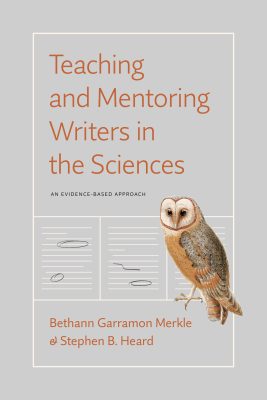
“Teaching or mentoring scientific writing is difficult, but it doesn’t have to be so hard. Helpful tools and research insights exist, but most scientists don’t know where to access them,” says Merkle, who also is director of the UW Science Communication Initiative. “We provide evidence-based advice that will help scientists teach writing more efficiently and more effectively—and less painfully, too.”
The 256-page book includes 10 chapters and nine tables. Priced at $115 in cloth cover, $22.50 in paperback and $21.99 in e-publication format, the book is available at the University of Chicago Press website. Use the code UCPNEW for a 30 percent discount. To order a copy of the book, go here.
According to a University of Chicago Press excerpt, the authors “offer evidence-based advice that draws on their own extensive experience as well as on proven tactics from writing studies, science studies, and rhetoric and composition. Shorn of the unfamiliar and off-putting jargon that much pedagogy literature adopts, their advice is engaging and accessible to scientists.”
“This book is not for students directly. It is for faculty, staff, and instructors inside academia and mentors beyond academia who are involved with helping students and early career professionals get better at writing,” Merkle says. “This is a book about helping students write, not a book for students about how to write.”
Most of the insights shared in the book are drawn from research in the fields of writing studies, rhetoric and composition, and pedagogy. These are fields that science faculty aren’t typically familiar with, which makes it hard to find the relevant research and harder still to understand it, Merkle says.
“Our book translates these research-based takeaways into examples, terminology, and contexts that science instructors can immediately understand and use,” Merkle says.
She says most students are acutely aware that they need to be good at writing, that they aren’t, and that they do not know how to get better at it on their own. Simultaneously, most science degree programs do not emphasize students getting better at the kinds of writing science-trained professionals will need to be able to execute.
“Worse still, most of our science instructors don’t have any training in how to effectively teach writing and are in despair over how much time it takes,” Merkle says. “So, we have a big skill development/training gap when it comes to transferable writing and communication skills in science degrees, and I hope our book can help fix it.”
The book has received some early positive reviews.
Terry McGlynn, author of “The Chicago Guide to College Science Teaching,” says, “While scientists are taught how to write, how many of us have learned how to teach science writing? This eminently pragmatic guide can rectify that situation, and I recommend it to all of us to improve our craft as teachers and mentors.”
“This book offers something rare: guidance for scientists who teach and mentor students in writing without much formal training in it themselves,” says Faith Kearns, author of “Getting to the Heart of Science Communication.” “In a clear and engaging way, the authors offer practical, evidence-based strategies on everything from giving feedback to using artificial intelligence.”
“A treasure trove … As someone who teaches writing to scientists and lots of other people, I can confidently say this book gets it,” says Inger Mewburn, a professor and director of researcher development at The Australian National University and creator of The Thesis Whisperer blog. “… Merkle and Heard understand that writing in the sciences doesn’t happen in a vacuum: It’s shaped by mentorship, institutional pressures, what’s happening in the wider world—and now AI.”
The Ellbogen Center for Teaching and Learning, Communication Across the Curriculum and the Graduate School will host a book launch event from 3-5 p.m. Thursday, Jan. 29, in Room 511 of Coe Library. The event is open to the UW community and the public. To attend in person or online via Zoom, register here.
This story was originally published on UW News.