


As summer arrives in Wyoming, warmer weather means it’s time to switch from the felt hat to straw, open the windows to let in the air and, most importantly for ranchers, turn cattle out to graze and start thinking about haying season.
However, with cold temperatures leaving, it also means the return of our least favorite neighbors—the bugs.
From mosquitoes to ticks, there are plenty of insects to annoy both humans and livestock, but horn flies in particular can take a toll on herds.
Horn flies
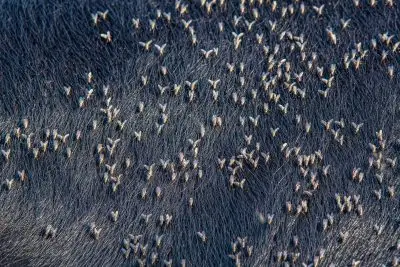
Horn flies, or Haematobia irritans, are blood feeding parasites frequently found on cattle in large numbers, where they can feed 24 to 38 times a day. These pesky insects reproduce by laying eggs in manure piles of cattle.
Horn flies can hatch and grow into adults within 10 to 20 days when it’s warm, and horn fly levels usually peak in late summer.
Introduced to the U.S. in the 1800s, these pests are now found across the nation, including in Wyoming.
Horn fly infestations are uncomfortable and annoying for cattle at best and can become extremely stressful, even leading to blood loss when numbers are high enough. This can lead to sacrificed herd productivity, where weight gain, milk production, and grazing patterns are all negatively impacted.
Pest impact
Studies have shown horn flies can decrease weaning weights by up to 15 percent in calves and cause up to an 18 percent impact on weight gain in stockers and replacement heifers. Horn flies cause an estimated loss of $1 billion to $2 billion annually across the U.S. beef industry.
Studies from the University of Wyoming have shown herds at higher elevations have much lower infestation rates than those at lower elevations, which is good news for many operations across the Cowboy State, in particular those at or above around 7,000 feet.
However, for those running cattle in lower elevations, such as the northeast corner of the state, horn flies are still capable of causing economic loss through stress caused to cattle.
Control options
At about 200 horn flies per head of cattle, the value of sacrificed production exceeds the cost of controlling the flies. The key is to prevent the fly population form reaching this economic threshold.
Ranchers seeking to mitigate horn fly levels may use several control methods.
One of the simpler forms of control is to break up manure piles with machinery to expose eggs and larva to dry air and insect predators. However, this is only practical on smaller acreages or in other limited operations.
For chemical control, back rubbers, oilers, and dust bags have been used for many years and can be effective at applying insecticidal dust or oil to cattle.
It is important to remember, however, these are often voluntary—unless cattle are forced through at a collection point—and will not be effective on animals that do not use them.
Ear tags impregnated with insecticides can also be effective, but the class of insecticide should be rotated every year to prevent insecticide resistance from developing in the fly population.
Adult animals typically need two tags, one on each side, to be effective. Ear tags should also be timed to ensure peak efficacy coincides with high fly populations.
Spray and pour-ons can work to reduce fly numbers on cattle, and there are several forms of application. It is important to be aware these usually are only effective for one to three weeks, so reapplication is usually needed.
These two methods are great when introducing new animals to a herd from off of the property or another pasture, which can introduce flies which weren’t present before, such as at bull turnout.
Before introducing bulls or other new animals, consider using a pour-on or spray on newcomers to reduce the risk of spreading horn flies to the rest of the cow herd.
Finally, oral larvicides—also known as insect growth regulators—can be fed to cattle. These larvicides prevent horn fly larvae from surviving in cows’ manure when the eggs hatch.
New alternatives are also becoming available. These include organics, garlic-infused feeds, and even predatory insects which prey on horn flies.
These options are still undergoing study but may prove effective in the future.
Be sure to consider the cost per head of treatment. Each treatment method has varying costs, efficacy, and ease of use.
By Dagan Montgomery, Agriculture & Natural Resources Extension Educator, Sublette County, Wyoming. Reprinted with permission from the Wyoming Livestock Roundup.