



UW Graduate Student Honored for Research on Insects and Wind Turbines

A recent University of Wyoming graduate student has received the 2023 Graduate Student Award for the Great Plains Cooperative Ecosystem Studies Unit (CESU).
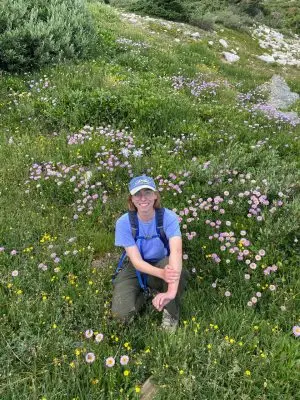
An image of a white woman wearing hiking clothes kneeling in a meadow. She has short blonde hair and large glasses.
Michelle Weschler

Michelle Weschler, of Orlando, Fla., who completed her UW master’s degree in zoology and physiology earlier this year, was honored for her work in investigating and reporting interactions between insects and wind turbines.

Her project was funded through a Great Plains CESU agreement between UW and the U.S. Fish and Wildlife Service. CESUs are a result of cooperative agreements between federal agencies and universities, and this award was selected among graduate students from multiple states.

“Michelle’s thesis is a novel compilation of information estimating interactions between insects and wind turbines,” says Lusha Tronstad, lead invertebrate zoologist with UW’s Wyoming Natural Diversity Database, who served as Weschler’s graduate adviser. “Only a handful of studies have addressed this topic directly, and Michelle’s work represents the most complete information on the subject.”

Interactions between vertebrate wildlife and wind turbines are well known; however, almost nothing is known about insects at these locations. Weschler’s project—“Wind Energy and Insects: Reviewing the State of Knowledge and Identifying Potential Interaction”—resulted in a master’s thesis that compiled knowledge about these interactions and identified knowledge gaps. The work is important as wind power grows rapidly across the globe, Tronstad says.

Among Weschler’s findings are that wind turbine placement, coloration, shape, heat output, and lighting likely attract insects; insects that fly at elevations within the diameter of turbine rotors are more likely to strike turbines, which can decrease the turbines’ energy output; and insects attract insectivorous animals, which may be killed by the turbines.
Share the Post:

Related Posts

Amy Storey, a University of Wyoming third-year master’s student in zoology and physiology, completes a field survey for a collection site in Grand Teton National Park. This included taking habitat measurements about the floral and bee community as well as collecting environmental data, such as wind speed and land use. Storey’s presentation, titled “Parasites and Bumble Bee Decline in Wyoming,” was named the winning entry for a master’s student at the Wyoming Chapter of the Wildlife Society meeting in Sheridan April 8. (Rebecca Armentrout Photo)

UW’s Storey Makes Winning Presentation at Wyoming Chapter of Wildlife Society Meeting

Wild bumble bees are in decline, and various parasites may be a major cause. But there hasn’t been any data on whether Wyoming bees have parasites and to what degree—until now.
Amy Storey, a University of Wyoming third-year master’s student in zoology and physiology, shed light on her research when she took center stage at the recent Wyoming Chapter of the Wildlife Society meeting in Sheridan.

Read More
Collin Porter

Four UW Students Receive NSF Graduate Research Fellowships

Four University of Wyoming graduate students have been awarded prestigious National Science Foundation (NSF) Graduate Research Fellowships.
Alex Kurtt, Collin Porter, and Lena Wigger, all graduate students in the UW Department of Zoology and Physiology, and Josephine Walton, a UW master’s student in molecular biology, will each receive one of the nation’s most highly competitive awards for graduate studies. The fellowships are awarded to graduate students who are pursuing research-based degrees in science, technology, engineering, and mathematics (STEM).

Read More

Help us improve this website!

We’re working to make AgNews easier to use and more useful for you. This quick survey takes about 1–2 minutes.