

Wyoming State Vet Lab Conducts First Disease Investigation in New Necropsy Facility

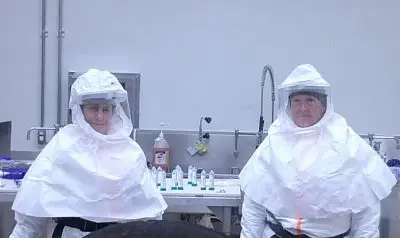
two people wearing personal protective equipment, including white hoods and clear face shields stand in a biosafety level three laboratory space in front of a metal counter containing test tubes and other instrumentation.
Wyoming State Vet Lab technicians outfitted in the personal protective equipment required for safe work in the BSL-3 necropsy facility.

In early July, the Wyoming State Veterinary Laboratory’s biosafety level 3 (BSL-3) necropsy facility was used to conduct a disease investigation for the first time.

The BSL-3 facility, designed for diagnosing serious animal infections that can be transmitted to humans, was used extensively during the pandemic to conduct COVID-19 testing. However, its intended function is animal disease diagnosis.

“The unit was designed to necropsy animals suspected of having diseases with high zoonotic potential, like brucellosis, anthrax, plague, or tularemia,” says Kerry Sondgeroth, a veterinary bacteriologist and associate professor at the Wyoming State Vet Lab. “There are very few veterinary diagnostic laboratories in the U.S. that have this type of facility, and we are fortunate to be able to utilize this facility going forward.”

In addition to the large animal necropsy facility, the BSL-3 certified space includes three laboratory spaces used for research.

To learn more about the Wyoming State Vet Lab, visit www.uwyo.edu/wyovet or call (307) 766-9925.
Share the Post:

Related Posts

Two deer in a sagebrush steppe landscape overlooking some houses.

New Research Shows How Much Space Between Houses Keeps Big Game Moving

Housing development is expanding, pushing homes into wild landscapes at an unprecedented pace.
Yet, as residential development moves into previously undeveloped areas, those same species face more than the direct loss of land under a building’s footprint—they also can lose access to the habitat surrounding those homes, multiplying the effective impact of each new structure. Without clear guidance on how much open space must be maintained between homes to conserve habitat for wildlife, new housing developments risk shrinking available habitat and fragmenting the movement pathways animals depend on to move between seasonal ranges.

Read More
Scott Shaw holds up a plastic bottle.

Shaw Receives UW’s George Duke Humphrey Award

When it comes to University of Wyoming faculty recognition, it’s hard to beat the past two years for Department of Ecosystem Science and Management Professor Scott Shaw.
After receiving the 2025 John P. Ellbogen Lifetime Teaching Award that recognizes the long, distinguished, and exemplary career of one senior faculty member who has excelled as a teacher at UW, Shaw has been selected as the recipient of the 2026 George Duke Humphrey Distinguished Faculty Award, the university’s top faculty honor.

Read More

Help us improve this website!

We’re working to make AgNews easier to use and more useful for you. This quick survey takes about 1–2 minutes.