

Thanks to a new federal grant and a generous private donation, the University of Wyoming’s Rocky Mountain Herbarium will be able to update and expand its current facilities as well as support a graduate student in the botany department.
With more than one million specimens in its collection, the Rocky Mountain Herbarium is one of the largest public university herbaria in the U.S.
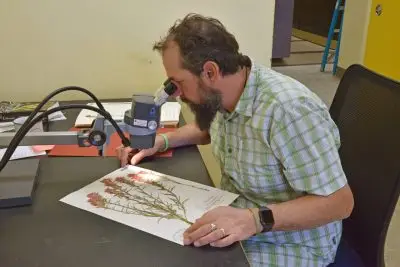
“But it’s in dire need of expansion,” says David Tank, a professor in the botany department and director of the herbarium. “About 400,000 specimens are currently inaccessible to researchers and at risk of destruction.”
To address these issues, Tank and his team recently received a National Science Foundation (NSF) grant for more than $900,000. This funding will allow UW to expand the herbarium’s footprint, properly curate currently inaccessible specimens, and continue to digitize the collection.
The three-year grant will also support a summer internship program designed to train undergraduate students in both traditional and modern approaches to collections management and collections-based research.
The Rocky Mountain Herbarium is not just for university scientists and students, Tank says. Public outreach—through educational programs and access to physical and digitized specimens—is also a key part of its mission.
In order to serve the public, it’s imperative to nurture the next generation of botanists working to conserve biodiversity, says Brent Ewers, head of the botany department and director of the UW Biodiversity Institute.
A recent gift from the family of Aven Nelson, founder of the Rocky Mountain Herbarium, will help achieve that goal. The family’s gift, after being matched by the University of Wyoming Foundation, added nearly $300,000 to the Aven Nelson Fellowship in Systematic Botany, an endowment supporting a graduate student in the botany program.
“The gift is the first private source to completely fund a graduate student in the botany department and it complements our successes in federal grants,” Ewers says. “It’s a story of the lasting impact a person can have and of generational pride and connection.”
Combined with the NSF grant, the Aven Nelson Fellowship in Systematic Botany will advance botanical research and help launch the herbarium into the 21st century.
“Often people think of an herbarium as a thing of the past,” Ewers says. “But this new support is helping us move into the future by embracing the digital revolution.”
To learn more about the Rocky Mountain Herbarium, visit www.rockymountainherbarium.org or contact Tank at dtank@uwyo.edu.