

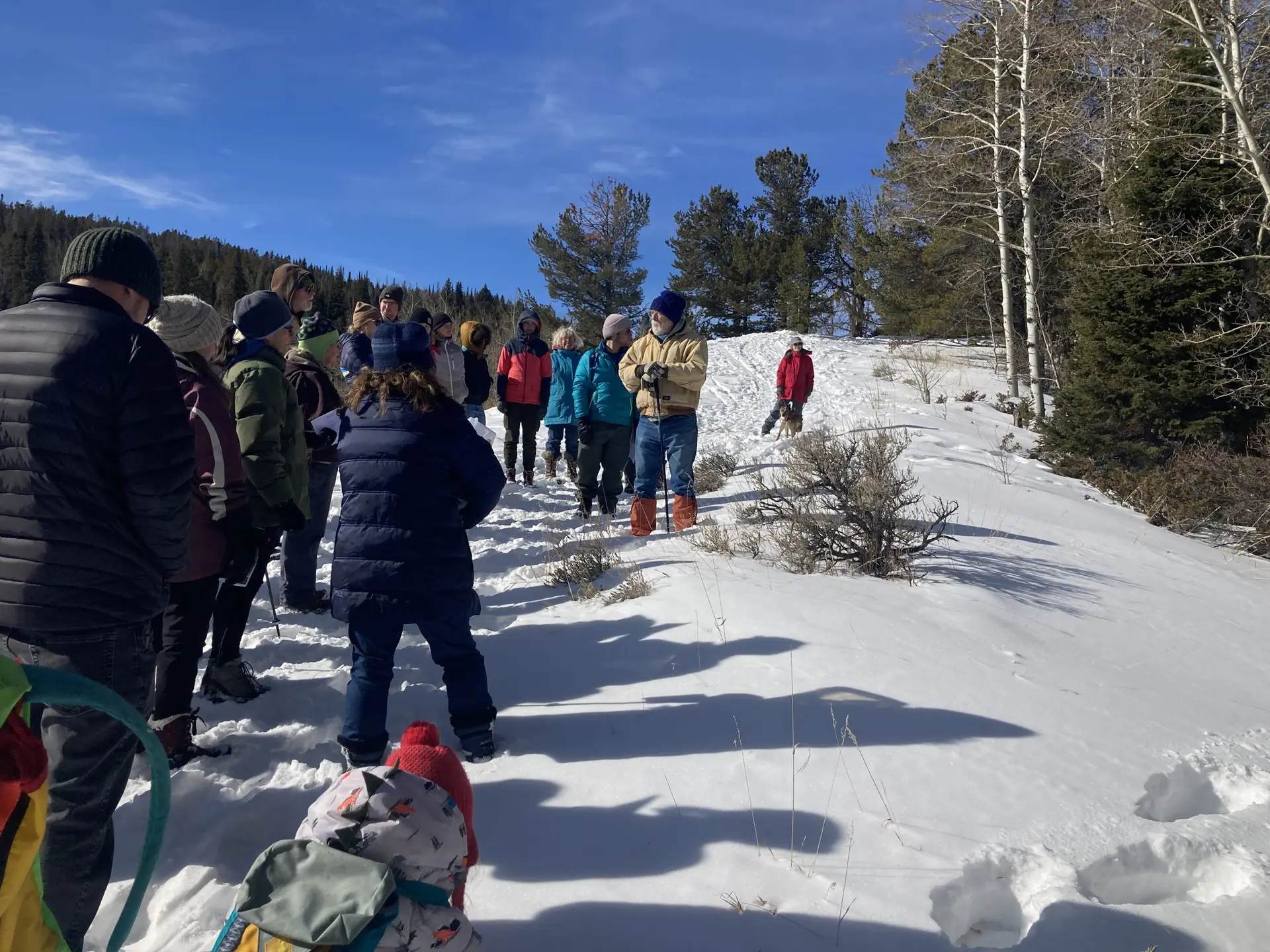
Specialists from UW Extension, the Rocky Mountain Herbarium and the UW Biodiversity Institute led a “Tree and Shrub Walk” on Sunday, January 30, in the Medicine Bow National Forest at the Happy Jack Trailhead. More than 30 people gathered to identify evergreen trees and shrubs on a cold winter day. “The goal of our plant walks is to give everyone opportunities to learn the species visible at different times of year,” said Dr. Kristina Hufford in the UW College of Agriculture and Natural Resources. Dr. David Tank, who recently joined the Rocky Mountain Herbarium as a UW Botany Professor and Herbarium Director, enjoyed the walk. “For me,” said Tank, “it was great to meet other plant enthusiasts in the area.”
Anyone interested should keep an eye out for future plant walks advertised through the UW Biodiversity Institute Facebook page and other social media accounts. More information can be found at the following website: https://www.wyobiodiversity.org/
Looking for additional information for helping ID trees and shrubs as well as advice for helping grow plants in our challenging landscapes? UW Extension offers the following resources:
- Landscaping: Recommended Trees for Wyoming
- Landscaping: Recommended Shrubs for Wyoming
- Rangeland Plants: Wyoming Tough
- Barnyards & Backyards-Trees & Shrubs: http://www.uwyo.edu/barnbackyard/resources/trees.html#irrigation
The Rocky Mountain Herbarium and the UW Biodiversity Institute also have some great tree and shrub resources and many of the herbarium specimens are available online in their digital collection:
- Key to Conifer Trees of WY: https://wyomingbiodiversity.org/application/files/2415/8898/3035/Key_to_conifers_folding.pdf
- Herbarium homepage: https://www.rockymountainherbarium.org/index.php
- Herbarium digital collection: http://rmh.uwyo.edu/data/browse_scientific.php