

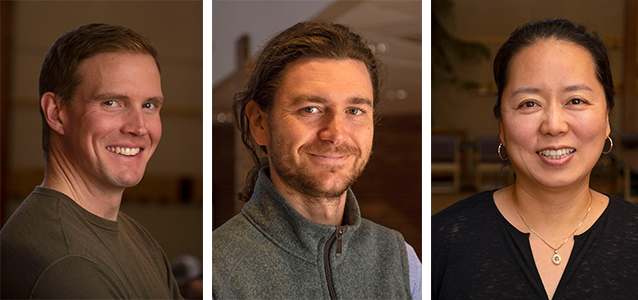
Three new faculty members have brought new expertise and are using a variety of experimental techniques in the Department of Molecular Biology at the University of Wyoming, according to the department head.
Professor Peter Thorsness said assistant professors Eunsook Park, Todd Schoborg and Thomas Boothby had already made significant contributions to their respective fields before arriving at the College of Agriculture and Natural Resources.
“We feel both fortunate and proud to have recruited three such accomplished young scientists,” said Thorsness. “Their willingness to come here stems in part from their desire to live in a place that allows them to live a great life and use the great resources UW provides, which gives them every opportunity to succeed in the broader world of science.”
Park did her graduate work and postdoctoral training in the U.S., but most recently was an independent and funded research scientist in South Korea working on describing molecular details of plant-microbe interactions.
Schoborg earned a prestigious K22 grant (National Heart, Lung, Blood Institute transition award) from the National Institutes of Health for his work in modeling human diseases using the Drosophila melanogaster model system.
Boothby has won large research grants from DARPA (Defense Advanced Research Projects Agency) and NASA for his work in understanding how the microscopic animal tardigrades can survive in extreme environments.
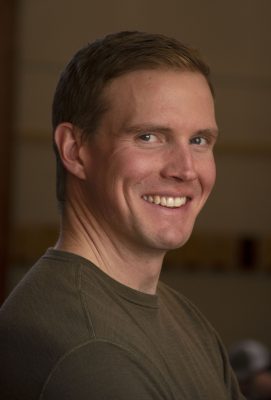
“We were not at all surprised that Eunsook, Todd and Thomas hit the ground running, increasing the energy and scientific critical mass in the department,” Thorsness said.
They’ve already begun to contribute in significant ways to the education and training of undergraduate and graduate students, he said. All three have presented updates on their work in a small seminar format for students, staff and faculty members.
“I particularly enjoyed seeing students eagerly asking questions and cornering them after their talks to ask for more details about their experiments,” he said.
The three have also met with students in Thorsness’ student seminar in which students are investigating model organisms for biomedical research.
“They’ve proven invaluable in explaining the nuances of their respective model systems and helped students formulate excellent presentations on the topics,” he said.
They’re also actively engaged in planning a curriculum update to assure students receive an up-to-date education in molecular biology, Thorsness said.
“We’re more excited and optimistic about the future of the department and molecular biology research and education at UW than at any other point in the past 20 years,” said Thorsness.