

The University of Wyoming Extension has released a new publication describing a problem with market-based conservation programs where companies pay landowners to meet certain conservation goals.
The publication is titled “Credit Failure Risk in Market-Based Conservation Programs: What Is It and Can It Be Helped?” Authors include Kristi Hansen, Chris Bastian, Chian Jones Ritten, and Amy Nagler of the UW Department of Agricultural and Applied Economics as well as Karsyn Lamb, former UW graduate student.
This publication may be especially relevant for any agency or private firm involved in setting up a market-based conservation program.
Market-based conservation strategies can lead to more conservation of ecosystem services, provide additional income for landowners, and offer opportunities for developers to offset environmental damages caused by their projects.
However, “Market-based conservation strategies can involve financial risks for participating landowners,” says Kristi Hansen, Extension water resource economics specialist and associate professor in the Department of Agricultural and Applied Economics. “If these risks are not well understood and compensated, conservation managers may not get the participation they had hoped for.”
A market-based conservation program is one way that agencies could encourage conservation on private land. For example, in a market-based conservation system, a developer could pay a landowner to maintain 60% sagebrush cover on five acres of land for five years. This might involve an up-front cost for the landowner, such as buying herbicides to control cheatgrass within the sagebrush habitat.
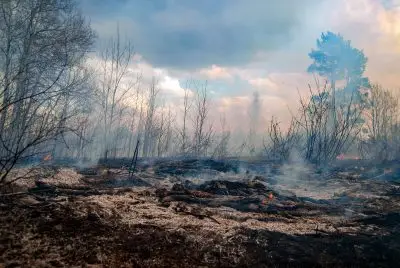
However, if a wildfire occurred and the sagebrush habitat burned two years into the five-year contract, the landowner might not be reimbursed for this input cost of buying herbicides or the opportunity cost of not doing something that would generate more income on this land for two years. They would not recoup these costs at the end of the five years, as they did not fulfill the terms of the contract.
This is an example of credit failure. A “credit” is the land the landowner agrees to conserve, while “failure” is what happens when the landowner is not able to conserve the land due to factors outside their control, and thus receives no compensation for their input and opportunity costs.
The authors found that reimbursing landowners for this credit failure risk dramatically improved how much land was conserved and how much landowners and developers profited from the conservation market.
For a free downloadable copy of the new publication, visit https://bit.ly/credit-failure. Contact Hansen at (307) 766-3598 or kristi.hansen@uwyo.edu with questions.