
Most of the foods humans eat come from just a handful of plants. In fact, more than half the plant-based calories humans consume come from wheat, maize, and rice — and all of these plants are annuals, which must be re-planted every year.
In contrast, almost all native ecosystems around the globe rely heavily on perennial plants, which grow for multiple years, protecting the soil from too much agitation and providing a reliable harvest.
Thirty years ago, the Land Institute, a Kansas-based nonprofit, had an idea: What if we developed perennial grain crops, which combine the environmental benefits of native plants with the agricultural needs of modern humans? One of the first plants the Land Institute developed was Kernza, a perennial grain crop originating from intermediate wheatgrass.
Soil scientists investigate Wyoming Kernza
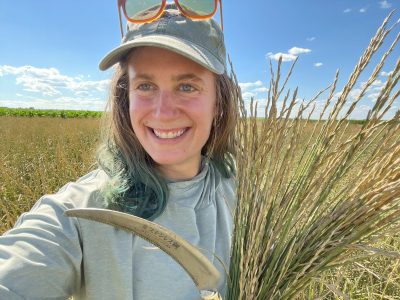
Kernza is exactly what graduate students Hannah Rodgers and Alex Fox set out to research in Linda van Diepen’s soil microbial ecology lab. Rodgers’ project focuses on the impact of Kernza on soil health in southeast Wyoming wheat farms.
In southeast Wyoming, wheat farms use a wheat-fallow system. Farmers plant a field of wheat; after harvest, they do not plant anything in that field for 14 months so as to store soil water for the next crop.
Rodgers compared wheat-fallow fields, wheat-fallow fields that were planted to Kernza at the beginning of the study in 2021, and wheat-fallow fields that were planted to perennial grasses 10 years ago. These final re-planted perennial grass fields serve as a proxy for healthy native grasslands. “There’s been a ton of studies that show that within about 10 years, perennial grasses can improve soil health to about 90% of native ecosystems,” says Rodgers.
Though Rodgers’ study did not demonstrate a change of that magnitude within a year of planting Kernza, she did find some early indications that the Kernza crop had healthier soil than the annual wheat it was planted next to.
Soil health findings
First, the researchers observed a higher ratio of fungi to bacteria in the Kernza fields relative to the wheat fields. More fungi is an indicator of healthier soil, because more fungi means more hyphae (thin tendrils similar to plant roots). The hyphae help the soil stick together and allow it to hold onto water more effectively. This water retention is especially important in a dry environment like southeast Wyoming.
Rodgers also found there was greater depth stratification in the Kernza fields. Depth stratification means that the soil built up a surface layer with more organic matter, higher fertility, and higher microbial activity. Rodgers explains, “In the native system, you can even see a thin thatch layer on the soil surface that’s protecting the soil beneath it.” This surface layer improves water filtration, helps young plants start growing, and prevents erosion.
In contrast, conventional wheat often requires tillage, which mixes up this surface layer with deeper, less productive layers and leaves the soil vulnerable to erosion. Even just one year in, Kernza had started to form a surface layer, making the soil less vulnerable.
Rodgers also looked at the amount of organic matter, particularly labile (mobile) organic matter pools. Labile pools can be an early indicator of changes in soil health. Higher organic matter pools also indicate more stored carbon. Rodgers found higher labile organic matter pools in the soil around Kernza roots than in the soil around wheat roots.
Strong roots
One of Rodgers’ most interesting findings was that Kernza had greater root biomass than both the wheat and perennial grass plants nearby. “We often breed plants that put energy into seeds, and we really don’t know how that affects the roots,” says Rodgers. “It’s very hard to study that, because our food plants don’t have a close comparison to wild species.”
Kernza’s large roots could present a fascinating opportunity to quantify just how crops’ roots adapt as researchers change their fruit and seeds. Microbes associated with plant roots help plants access nutrients and water in tough times, so any adaptations or selection for root-associated microbes might be especially relevant in difficult terrain like Wyoming.
Kernza’s future in the West
Difficult terrain is one of the biggest reasons that Kernza might present a meaningful opportunity for Wyoming farmers. “We’re really thinking about it more in this region as a crop for risk management,” says Rodgers.
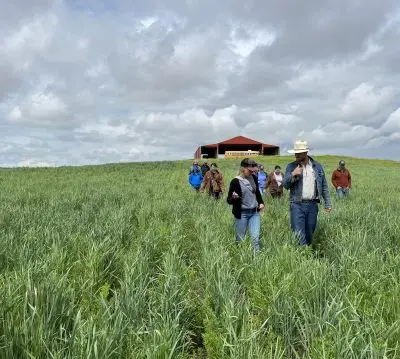
Wheat is expensive up front — it requires that farmers buy seed every year, then spend time planting and managing weeds. Meanwhile, Kernza requires fewer passes with a tractor and competes with weeds better than wheat. In a dry year, Kernza can provide good-quality forage for livestock even if it does not produce many seeds.
In recent years, variability in precipitation and volatile markets have led to crop abandonment and made wheat-fallow systems less viable. Kernza may not produce as much good-quality seed as wheat in a good year, but it’s more flexible, costs less to implement, and is better for the soil.
Though Rodgers’ study is complete, Kernza is just getting started. “Kernza acreage is increasing year after year — more and more groups are starting to market products that include Kernza,” Rodgers comments. “A brewery in Fort Collins has a Kernza beer; small bakeries are starting to use it. It’s getting better and better, and with the really rapid progress on the breeding side, I think that’ll really push it forward.”
A new study in Colorado will continue to examine Kernza in dry Mountain West conditions. There are even efforts to get Kernza added to the USDA’s Conservation Reserve Program, which pays farmers to plant fields with crops that are more sustainable. From roots this strong, Kernza is bound to keep on growing.
For more information about Kernza in Wyoming, visit Kernzawyoming.org or follow @kernzawyoming on Instagram.
This article was originally published in the 2024 issue of Reflections, the annual research magazine published by the UW College of Agriculture, Life Sciences and Natural Resources.