
UW’s Biodiversity Institute to Host Bee Jubilee June 29

Native bees in Wyoming range from 0.1 inches in length—smaller than a grain of rice—to just over 1 inch in length, but all are extremely important pollinators of the state’s native plants. The University of Wyoming Berry Biodiversity Conservation Center will be all abuzz celebrating these important insects during the third annual Bee Jubilee Saturday, June 29, from 10 a.m.-noon. The event is free and open to the public.
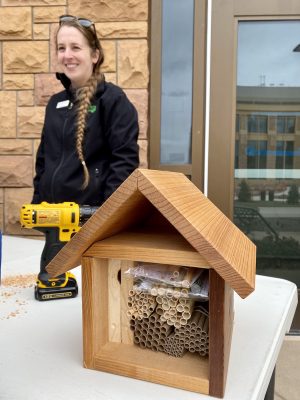
A small wood house with an open front, which is filled with two panels and bundles of large straw-like objects in various shades of tan, some of which are wrapped in plastic. The house is resting on a table. Behind the table, a woman with long blonde hair in a braid addresses the camera. There is a drill between the bee house and the woman.
Mason Lee, senior project coordinator for the Biodiversity Institute, poses with a bee house during the inaugural Bee Jubilee in 2022. The Bee Jubilee, hosted by the UW Biodiversity Institute, is scheduled Saturday, June 29, from 10 a.m.-noon. (UW Biodiversity Institute Photo)

“There will be displays of vertebrate and invertebrate pollinator specimens, as well as opportunities to learn about native gardens; observe and identify, up close, pollinators in the ‘Berry Prairie’ garden; build a bee house to take home; and purchase native bee and plant guides,” says Mason Lee, senior project coordinator for the UW Biodiversity Institute, which will host the event.

Additionally, there will be a pollinator yoga class led by a UW group fitness yoga instructor from 10-10:30 a.m. on the tree deck outside the Berry Center. Yoga mats will be provided. A Habitat Hero workshop, led by Carol Bilbrough, a Wyoming Naturalist Program volunteer, is scheduled from 11-11:40 a.m. in the Berry Center auditorium.

“Worldwide, over 75 percent of our major crop species benefit from invertebrate and vertebrate pollination,” Lee says. “Even crops that don’t need an animal pollinator produce a higher yield if they’re visited by native bees.”

Bee Jubilee event partners are UW Extension, UW’s Half Acre Recreation and Wellness Center, the UW Museum of Vertebrates, the Laramie Audubon Society, and the Wyoming Naturalist Program.

For more information about the Bee Jubilee, call Lee at (307) 766-6240 or email mlee37@uwyo.edu.

About the University of Wyoming Biodiversity Institute

The UW Biodiversity Institute fosters conservation of biodiversity through scientific discovery, creative dissemination, education and public engagement. In this setting, scientists, citizens, students, and educators come together to share a wealth of perspectives on the study and appreciation of biodiversity—from microbes to poetry and ecosystems to economics. Learn more at www.wyomingbiodiversity.org.

This story was originally published on UW News.
Share the Post:

Related Posts

Artist booth at an Ag & Art Tour event, where a local artist displays watercolor paintings and handmade prints while engaging with a visitor; set outdoors with rural landscape, showcasing the connection between agriculture, creativity, and community.

UW Extension to Host Ag & Art Tour in Natrona County

For those interested in connecting with local artists and agriculturalists, the University of Wyoming Extension will lead a series of free self-guided Ag & Art tours from May through September.
The first Ag & Art event takes place in Natrona County Saturday, May 16, from 10 a.m. to 2 p.m.
“We had a great season last year and are excited to bring this event to five counties this summer, kicking things off [in] Natrona County,” says Hailey Sorg, Wyoming’s Jay Kemmerer Outdoor Recreation, Tourism and Hospitality (WORTH) Institute extension educator.

Read More
Amy Storey, a University of Wyoming third-year master’s student in zoology and physiology, completes a field survey for a collection site in Grand Teton National Park. This included taking habitat measurements about the floral and bee community as well as collecting environmental data, such as wind speed and land use. Storey’s presentation, titled “Parasites and Bumble Bee Decline in Wyoming,” was named the winning entry for a master’s student at the Wyoming Chapter of the Wildlife Society meeting in Sheridan April 8. (Rebecca Armentrout Photo)

UW’s Storey Makes Winning Presentation at Wyoming Chapter of Wildlife Society Meeting

Wild bumble bees are in decline, and various parasites may be a major cause. But there hasn’t been any data on whether Wyoming bees have parasites and to what degree—until now.
Amy Storey, a University of Wyoming third-year master’s student in zoology and physiology, shed light on her research when she took center stage at the recent Wyoming Chapter of the Wildlife Society meeting in Sheridan.

Read More

Help us improve this website!

We’re working to make AgNews easier to use and more useful for you. This quick survey takes about 1–2 minutes.