
A student higher education resource says the University of Wyoming offers one of the top blockchain education programs in the nation.
UW ranks second among the top five cryptocurrency and blockchain programs listed by SuccessfulStudent.org, a website founded in 2014 by educators, data scientists, and academics.
UW’s Center for Blockchain and Digital Innovation (CBDI) began offering an undergraduate minor degree in blockchain in 2021.
Steve Lupien, CBDI director, differentiates the UW blockchain program from others listed by SuccessfulStudent.org because of its experiential approach for undergraduate students.
“It’s that experiential nature, where our students are actually working on real-world problems,” Lupien says. “When a student enrolls in the blockchain minor, one of the things they do is choose a problem to solve using blockchain. And they work on that problem as they go through the program.”
The CBDI is interdisciplinary in its offering of the blockchain minor. The center is shared by the College of Business; College of Engineering and Physical Sciences; College of Agriculture, Life Sciences and Natural Resources; College of Law; and the School of Energy Resources. It also works with the state’s community colleges.
“We have business majors, computer science majors, psychology majors, marketing majors, and many others,” Lupien says.
Lupien says the minor, which is designed around 15 hours of required and elective courses, is for students to become knowledgeable about various blockchain systems, digital assets and cryptocurrencies; understand how this technology is used to solve real-world problems; recognize how blockchain technology disrupts legacy systems; and comprehend the competitive applications and opportunities of blockchain in various industries.
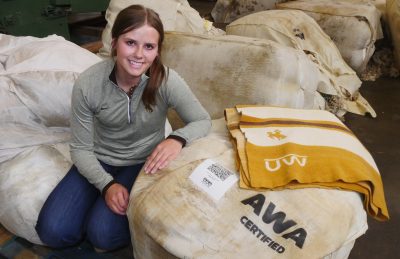
As a graduate student in UW’s animal science program, Courtney Newman researched the use of blockchain technology in the sheep industry. Newman says, “I have a unique interdisciplinary background of economics and animal science, so Dr. Stewart approached me with the idea of this project. It was a great combination of some of my undergraduate coursework and so we decided to run with it!”
As a result of Newman’s project, customers can enter their blanket’s number on sheepchain.org to follow their purchase’s production journey and watch videos showcasing each processing stage the wool went through.
Newman adds, “Blockchain technology has the potential to allow for increased transparency between parties in the supply chain. We are focused in on finding where the value is for producers and how much value there is as it compares to the costs of utilizing this technology. We began this project with the goal of bringing more value back to the farmgate so that producer can see the return on all their hard work raising American lamb and wool.”
To learn more about the blockchain minor degree program and the CBDI, visit www.uwyo.edu/cbdi.
For information about the criteria used to evaluate and rank blockchain and cryptocurrency programs, go to www.successfulstudent.org/the-best-colleges-blockchain-education.
The original version of this article was edited to highlight a student within the College of Agriculture, Life Sciences and Natural Resources. Reposted with permission from UW News.