
After a successful first year, Wyoming Wool Initiative seeks donations for its second annual Lamb-a-Year program.
While steer-a-year programs are common across the U.S., the Lamb-a-Year program is one of the first of its kind. The program connects donors with UW students, allowing students to gain hands-on industry experience while providing producers with valuable lamb quality data.
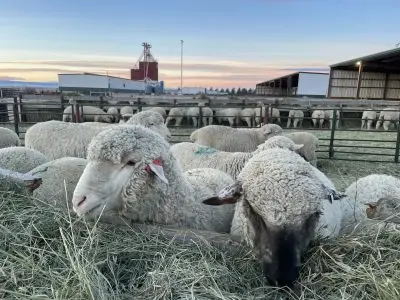
Producers are asked to donate a minimum of two feeder lambs, each weighing 70–90 pounds. In exchange, they receive data on the average daily gains and meat quality of their lambs as well as a detailed performance report.
“Some producers have shared data from Lamb-a-Year with potential buyers as a means of marketing the genetic potential of their lambs,” says Whit Stewart, UW Extension sheep specialist. “Others have used the lamb quality information to better understand the optimal finishing weight of their lambs.”
Lamb drop-off and pick-up dates are coordinated across the state in September and October. The lambs are then transported to the Laramie Research and Extension Center where UW students help with receiving protocols, including vaccination and EID tagging. Students enrolled in the program are responsible for data collection and feeding lambs.
Once the lambs reach finishing weight, they are transported to regional processing plants for harvest. A team of UW faculty and students travel to the plants to collect lamb quality data, including dressing percentage, loin-eye area, leg scores, and boneless closely trimmed retail cuts.
“The donation of lambs provides one-of-a-kind learning experiences for students in our sheep program while providing valuable proceeds to enhance the products we deliver in extension and teaching,” Stewart comments.
Lamb sales help support student and producer field study trips, educational events at the annual Wyoming Sheep and Wool Festival, meat science curriculum, lamb quality research, and more. Producers receive a tax-deductible charitable gift receipt based on the market value of their lambs.
If interested in donating lambs or hosting a lamb pickup, contact Stewart at (307) 766-5374 or whit.stewart@uwyo.edu by Sept. 25.
Cash and feed donations are also welcome. “We’re grateful for any and all support for the program and welcome any inquiries,” says Stewart.