
In fall 2022, the University of Wyoming Department of Animal Science reported record enrollment in its introductory meat, wool, and livestock judging courses. Engagement has skyrocketed, with many students planning to compete as members of the UW College of Agriculture, Life Sciences and Natural Resources collegiate judging teams next season.
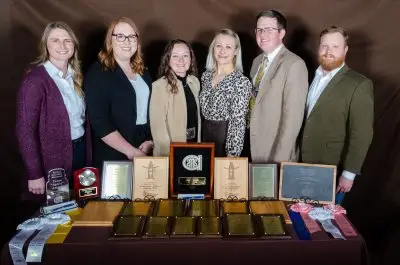
“Collectively, we are training about 30 percent of the entire animal science student population to become skilled evaluators of our products and livestock,” says McKensie Phillips, coordinator of the meat judging program and an instructor in the UW Department of Animal Science. “Most importantly, we are developing professional skills necessary for career success after college.”
The three-credit intro classes are open to all students, regardless of experience. Classes meet once to twice a week, typically at the meat lab, wool lab, or UW farm in Laramie. Upon completing an introductory course, students are eligible to join the judging team in that focus area.
Practices, including “workouts” in a lab or field setting, require a 10- to 20-hour per week time commitment. Teams also travel extensively for competitions, often holding practices at other universities or industry sites along the way.
Students are only permitted to judge for one year in each discipline.
Phillips says there are three main benefits to participating in the judging program. “First, you get skill development,” she says. “We are training you in a field that has lots of career options.” Equally important is the opportunity for students to build communication and interpersonal skills.
Judging also offers students an opportunity to gain industry experience and network with professionals across the country. The meat judging team, for example, travels to eight national contests annually in locations ranging from Texas to Pennsylvania.
“Students who are on judging teams are highly sought after for jobs. They know what time commitment looks like, know that it takes a lot of effort to reach goals, and that early mornings are a fact of life,” Phillips observes.
Ashlynn Manuel, of Montrose, Colo., is a junior majoring in animal science with a concentration in meat science and a minor in ag business. She is one of 22 students taking the Intro to Meat Judging class this fall.
“I feel like in meat judging there is always something new and interesting! I am very excited for the competitions coming next year and can’t wait for practices to start,” she shares.
To learn more about UW’s collegiate judging program, contact McKensie Phillips at mckensie.phillips@uwyo.edu or (307) 766-2334.