


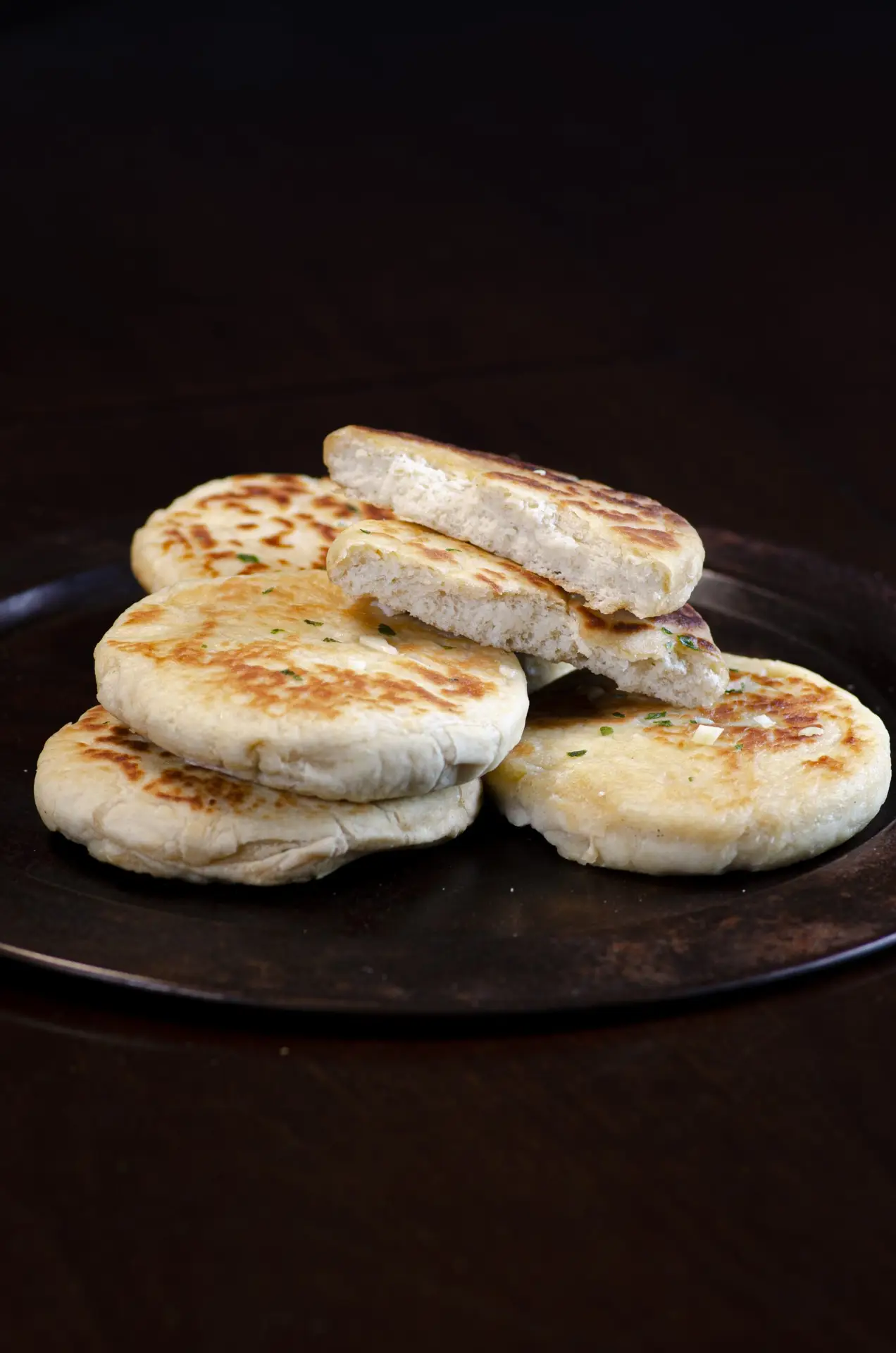
High-altitude baking: Garlic Naan

small round breads with chopped garlic on metal plate
Garlic naan. Recipe from UW Extension's High-Altitude Baking book.

Prep: 20 minutes

small round breads with chopped garlic on metal plate
Garlic naan. Recipe from UW Extension’s High-Altitude Baking book.

Inactive: 1 hour

Cook: 5 minutes

Total: 1 hour 25 minutes

Servings: 6 to 8 breads

Ingredients

  • ½ cup (114 g) warm water (105°F–115°F)
  • 1 teaspoon sugar
  • 2¼ teaspoons or one ¼‑ounce packet active dry yeast
  • ½ cup (140 g) plain Greek yogurt
  • 2 teaspoons finely minced garlic, blanched or roasted
  • 2 tablespoons (25 g) flavorless cooking oil
  • 2 cups (240 g) all‑purpose flour (spoon and level to measure) 
  • 1½ teaspoons salt, or to taste
  • ¼ cup (29 g) butter or ghee, melted
  • 1 teaspoon garlic, minced
  • Parchment paper
  • Nonstick spray
  • Food processor
  • Grill, grill pan, or cast-iron skillet

Directions

  1. In a medium bowl, stir together the water and sugar. Stir in yeast and let it rest for 5 minutes. 
  2. Mix in the yogurt, garlic, and oil. 
  3. Place the flour and salt in the food processor and process until mixed. With the motor running, pour the yeast mixture into the work bowl in a thin stream and process until the flour gathers into a ball and the sides of the processor are clean. If the dough seems too sticky, add more flour 1 tablespoon at a time through the feeder tube, or add more yogurt 1 tablespoon at a time if the dough is dry and hard.
  4. Transfer the dough to a large bowl, cover with plastic wrap sprayed with nonstick spray, and place in a warm spot until it doubles in volume, about 1 hour.
  5. Place the dough on a lightly floured work surface. Divide the dough into 6 to 8 equal pieces. With oiled hands, press the dough or use rolling pin to roll balls into 6– to 8‑inch ovals, about ¼‑inch thick; set aside. 
  6. Heat a grill, grill pan, or cast‑iron skillet over medium heat. Brush the grill with oil, or if using a pan, spray it with oil. 
  7. Grill until dough is set on one side, 1–2 minutes, and shows grill marks. Use a spatula to flip the naan to cook the other side. Transfer the naan to a platter and brush garlic butter onto it and serve.
  8. Wrap cooled naan tightly in plastic wrap and store in the refrigerator. 
  9. Freeze for longer storage.

Excerpted from B-1366 High-Altitude Baking, anticipated release date Summer 2022.

Share the Post:

Related Posts

Amy Storey, a University of Wyoming third-year master’s student in zoology and physiology, completes a field survey for a collection site in Grand Teton National Park. This included taking habitat measurements about the floral and bee community as well as collecting environmental data, such as wind speed and land use. Storey’s presentation, titled “Parasites and Bumble Bee Decline in Wyoming,” was named the winning entry for a master’s student at the Wyoming Chapter of the Wildlife Society meeting in Sheridan April 8. (Rebecca Armentrout Photo)

UW’s Storey Makes Winning Presentation at Wyoming Chapter of Wildlife Society Meeting

Wild bumble bees are in decline, and various parasites may be a major cause. But there hasn’t been any data on whether Wyoming bees have parasites and to what degree—until now.
Amy Storey, a University of Wyoming third-year master’s student in zoology and physiology, shed light on her research when she took center stage at the recent Wyoming Chapter of the Wildlife Society meeting in Sheridan.

Read More
Collin Porter

Four UW Students Receive NSF Graduate Research Fellowships

Four University of Wyoming graduate students have been awarded prestigious National Science Foundation (NSF) Graduate Research Fellowships.
Alex Kurtt, Collin Porter, and Lena Wigger, all graduate students in the UW Department of Zoology and Physiology, and Josephine Walton, a UW master’s student in molecular biology, will each receive one of the nation’s most highly competitive awards for graduate studies. The fellowships are awarded to graduate students who are pursuing research-based degrees in science, technology, engineering, and mathematics (STEM).

Read More

Help us improve this website!

We’re working to make AgNews easier to use and more useful for you. This quick survey takes about 1–2 minutes.