
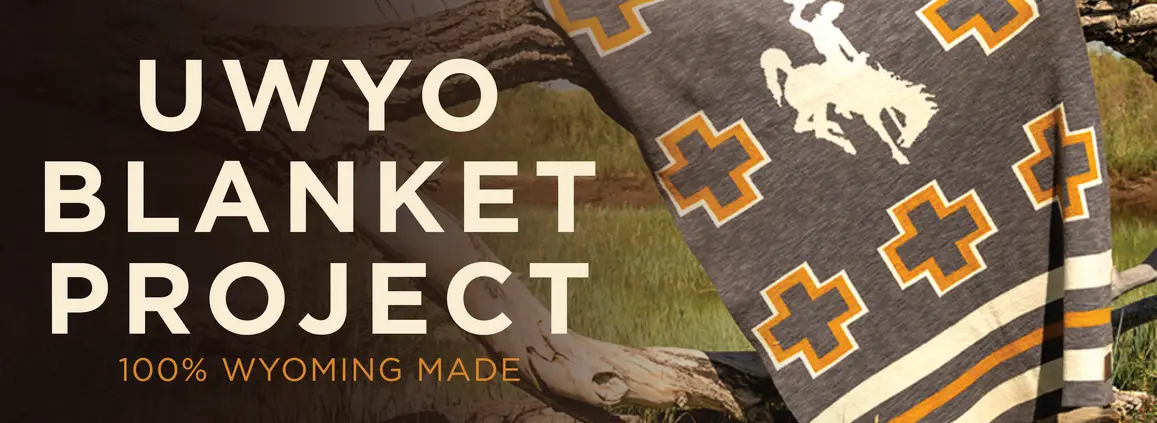

Sales from the University of Wyoming College of Agriculture and Natural Resources wool throw project will be sown back into the state’s sheep industry.
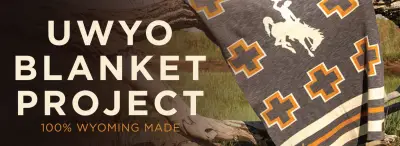
Wool shorn from sheep at the Laramie Research and Extension Center was processed and knitted into limited-edition, UW-themed throws at Mountain Meadow Wool in Buffalo. Each throw contains a certificate of authenticity with a QR code that documents the story behind the blanket from raw wool to finished throw, and a University of Wyoming Department of Wool canvas bag from the 1950s.
Pre-sales began this week for the first 20 blankets, which also includes non-fundable token (NFT) digital artwork tied to the blanket edition. The remaining blankets will be on sale Aug. 17.
The money will help expand research and training opportunities for students in the sheep industry, said Whit Stewart, UW associate professor and extension sheep specialist.
“It allows us to be really flexible to really solve problems of Wyoming sheep producers are experiencing and to help give them more opportunities,” he said.
Many of the broad research efforts to help the sheep industry are at the whim of various grants, which can be hindered by time, resources and determined by individuals far removed from the actual operation, shared Stewart.
“What we will be able to do with these monies, even though it will take a while to build those up, I think it is responsive to how things are changing,” said Stewart. “Not only does it create awareness for a college that’s always been working for Wyoming, but it just shows we are adopting to the changing dynamic of your institution and our state.”
Funds will go toward graduate students like Courtney Newman, who recently started her master’s in animal science at UW, said Stewart.
Her research is looking at the feasibility of blockchain technology in the sheep industry.
“Within that, we have three different components we are looking at, with the live animal side, the meat side and also the wool side,” said Newman, a Fort Collins, Colo., native.
Newman and Stewart hope to do some feasibility studies and then some application.
“On the basic level for the producers, we are hoping this will allow them new technology for recordkeeping,” said Newman. “But also, we are hoping to have source-verified and provide that value-added component with it.”
 Previous research provided a surface-level look at using blockchain within the sheep industry, she said.
“There is a big need on the consumer side of being able to show them the processes that go into these products and agriculture as a whole and giving them increased confidence with the technology,” said Newman. “On the producer side and the state agriculture as an industry, it is giving them a new way to market their products with that value-added aspect that will give them more tangible evidence of what their processes are and the time and energy they invest into those.”
Funds will also provide undergraduate student opportunities to experience hands-on learning to potentially travel the state, see first-hand problems within the industry and help them begin to think with an entrepreneurial mindset on how to solve these issues, said Stewart.
“With changing budgets, the only thing I have any certainty in is if we raise resources to train our students in the way we know they need to be trained and not some distant dictate from a federal agency,” said Stewart, “we are going to be much more beneficial to our state and we are going to be training people who are sought after nationally and internationally.”
“It is not a slush fund,” said Stewart. “It is building capacity and expanding efforts, so we are being successful.”
To purchase, visit https://bit.ly/WYO-CROSS. For more information, visit www.sheepchain.org/blanket-project.