
Thirty-six University of Wyoming instructors who inspire excitement, inquiry, and autonomy in first-year courses are this year’s Promoting Intellectual Engagement (PIE) Award recipients, including four instructors from the College of Agriculture, Life Sciences and Natural Resources.
PIE Award recipients were nominated online by first- and second-year students, and then they were selected by a committee based on the number of nominations and students’ comments. The committee reviewed nearly 400 nominations this year.
“She was an incredible first-year professor because she was always willing to answer any question,” one student commented regarding a nominee. “She also constantly reminded the class of events and resources available to us around campus that first-year students would not have known about. She introduced us to many clubs and told us when they were meeting and also was just a very friendly and kind person.”
“He made sure the class was always engaging and interactive. He answered student questions, listened to ideas and helped to show us various perspectives,” wrote another student about a nominee. “His class was intellectually stimulating, as I found myself thinking about the things discussed in random contexts. Everyone can tell that he is a professor who cares about his students and their education.”
Several programs within the Office of Academic Affairs and the Division of Student Affairs sponsor the PIE Award: Advising, Career and Exploratory Studies; the Dean of Students Office; the Ellbogen Center for Teaching and Learning; the LeaRN Program; and Residence Life and Dining Services.
Each PIE Award recipient will receive a pie from Residence Life and Dining Services, and five-time recipients each will receive a personalized pie plate. All recipients will be recognized at a reception from 4-5 p.m. Thursday, April 25, in the Wyoming Union Yellowstone Ballroom. The reception is open to faculty, staff, and students.
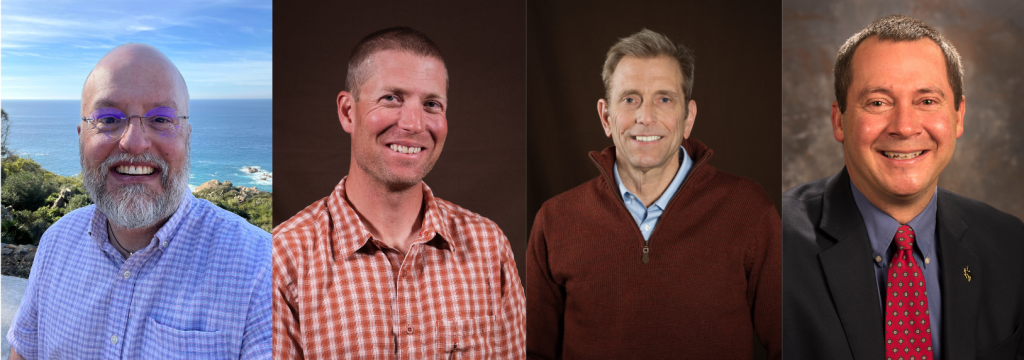
PIE Award recipients from the College of Agriculture, Life Sciences and Natural Resources are listed below by their programs or departments:
- Timothy Collier, Department of Ecosystem Science and Management
- Mark Lyford, Department of Botany
- Jonathan Prather, Life Sciences Program
- Brian Sebade, Department of Ecosystem Science and Management
These are UW’s 15th annual PIE awards. A list of all recipients from previous years may be found at www.uwyo.edu/learn/fac_resources_recognition/pie/index.html.
For a complete list of all awardees from this year’s PIE awards, see the original version of this article published on UW News.