
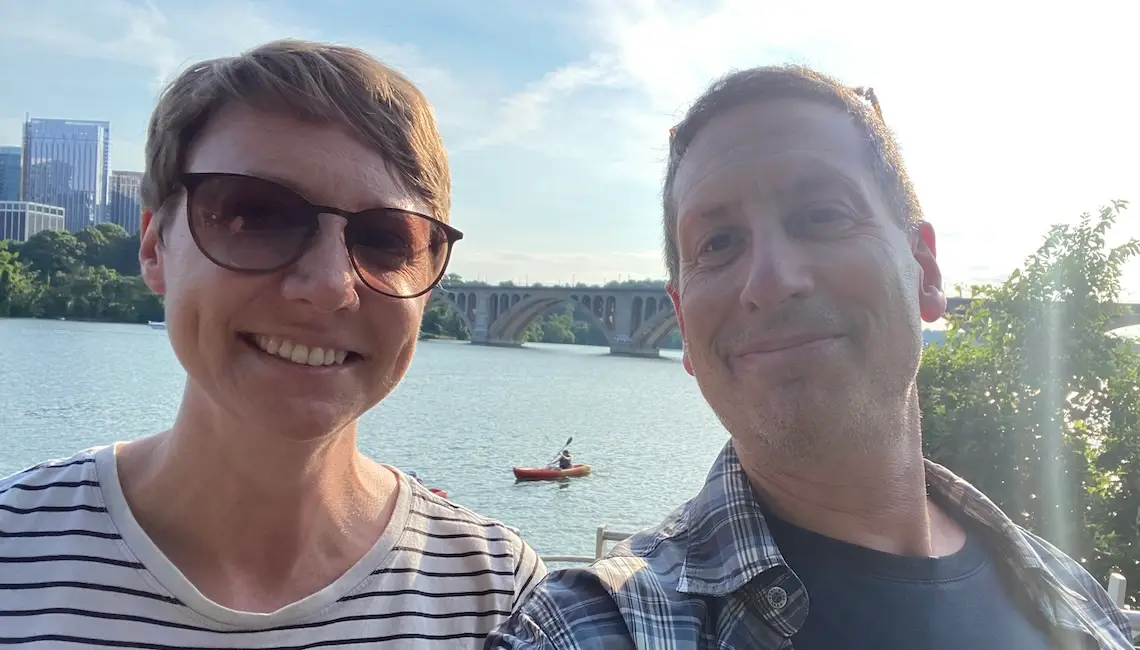
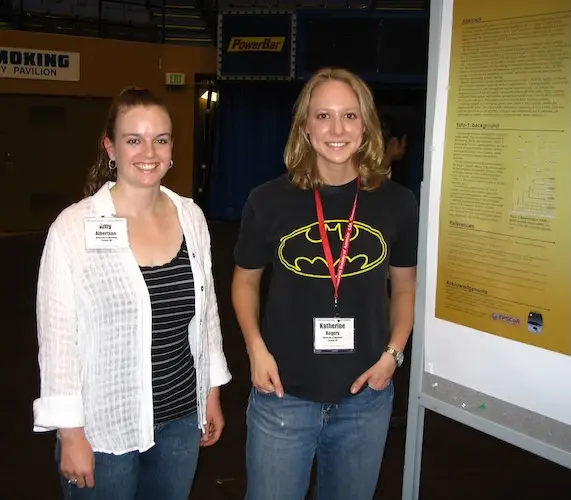
In 2004, Katherine Rogers, a student from Rock Springs, entered UW as an undergraduate. She had no experience with scientific research or academia, but during her freshman year, she developed an interest in the biomedical field.
Rogers told an adviser she wanted to wash dishes in a lab just to see what the scientific world was like. Her adviser immediately started reaching out to UW labs.
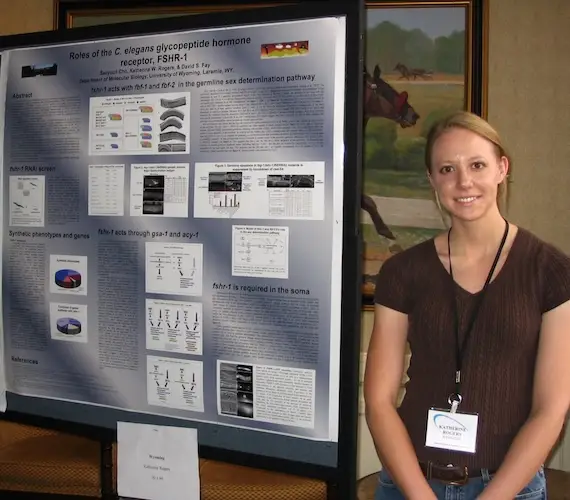
Rather than washing dishes, Rogers ended up participating in research funded by the American Cancer Society and the National Institutes of Health (NIH).
Her first mentor was David Fay, a professor of molecular biology at UW. Fay studies roundworms in order to understand fundamental biological processes that are associated with human diseases like cancer. Specifically, he examines the cellular machinery that moves proteins to their proper destinations; errors in this protein distribution process can lead to developmental defects and disease.
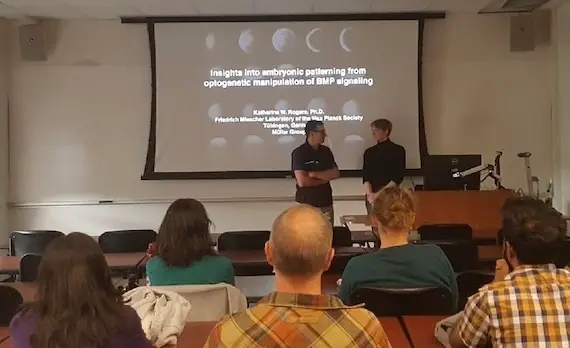
After graduating from UW with a degree in molecular biology, Rogers went on to earn a PhD from Harvard in the lab of Alexander Schier, where she studied biochemistry. She then completed her postdoctoral studies with Patrick Müller at the Friedrich Miescher Laboratory of the Max Planck Society in Tübingen, Germany.
Afterwards, she started her own lab at the NIH, the Unit on Developmental Signaling. Her research focuses on how zebrafish embryos develop from single cells into complex organisms.
As their careers have evolved, Rogers and Fay have kept in touch. Recently, they launched a new online resource hub together, designed to give scientists the tools they need to succeed, whether it’s info about choosing a good research topic or a guide to postdoctoral funding opportunities.
Illuminating the world of science
Fay first got the idea for a new website in 2023. As he has experienced firsthand, science is a powerful tool for understanding the world and creating practical solutions to real problems, but the pathway to becoming a scientist can be complex and intimidating to navigate.
“If I send students out into the world, I want them to be prepared,” he says. “It’s important to tell them the truth about the many challenges in science and equip them to succeed.”
Fay wanted to gather resources to make science more approachable for undergrads like Rogers who lacked research experience—and for researchers later on in their career paths, too. He envisioned an all-in-one website that could provide knowledge, resources, and connections for anyone interested in being a part of the scientific community.
Rogers was also passionate about helping other scientists and had recently been compiling some resources for her own lab. Together Fay and Rogers dreamed up a website they dubbed Help, I’m a Scientist! (HIAS).
The website was built by Yana Nightingale, administrative coordinator for the Wyoming IDeA Networks of Biomedical Research Excellence (INBRE) program, which supports statewide biomedical research developments in IDeA-eligible states, including Wyoming (#5P20GM103432).
HIAS is also supported by a five-year grant from the NIH’s National Institute of General Medical Science. The grant is designed to promote biomedical research, infrastructure, and student training within the state of Wyoming.
A one-stop shop
HIAS includes resources for scientists of all skill levels and career stages, from high school students curious about the scientific field to seasoned professors. It’s particularly useful for scientists in times of transition, whether they’re joining a new lab, applying to graduate school, or becoming a principal investigator for the first time.
“My goal is to always try and demystify things if I can,” says Fay. “I write it for someone who was basically as clueless as I was at that stage!”
Fay and Rogers have both created articles and gathered useful online resources. The site’s practical resources include information about securing funding, tools for analyzing DNA sequences, tips for reading a scientific paper—and more.
In addition to technical resources and career advice, HIAS includes some light-hearted material, like poetry and jokes.
While comedy or poems might seem frivolous, Fay sees humor as a vital opportunity for scientists to bond. “You have to have a sense of humor to survive in science,” he comments.
He and Rogers welcome submissions from any interested scientists, as long as the contributions are constructive.
“Our job is to help people do science,” Rogers explains. “If I have access to a nice compilation of resources, it’s easier to help people do science.”
The site also features a collection of “origin stories,” which are personal reflections from researchers about their journey within the scientific community. Rogers highlights, “Personal history is a very important thing that doesn’t get talked about in courses, but you need to be able to understand scientists as humans to picture yourself as a scientist.”
HIAS aims to equip young researchers with as many resources as possible—and so far, readers report they’ve found the site helpful.
One site user, Chen Wang, manager of scientific programs at the Mortimer B. Zuckerman Mind Brain Behavior Institute at Columbia University, comments, “The site is run by a team of scientists who do great science and, more importantly, are also decent human beings doing their best to support people at every career stage…There’s a lot of honest, practical advice there!”
Building the community you want to see
When Rogers first started out, she believed that science was an isolating career, but she soon found that the scientific world is deeply interconnected and interdependent. Research progresses when scientists talk to each other and build on each other’s ideas and knowledge.
Like science itself, HIAS is born from interconnection. It gathers resources from scientists all over the world and maintains those resources as a gift for the entire scientific community.
And, like UW as an institution, HIAS gives students from rural areas more access to the scientific world.
Whether you’re an undergrad at an Ivy League college, a master’s student at a public university, or a mid-career scientist working at an international research institution, the basic requirements for scientific research are the same. Good scientists can come from anywhere—if they’re given a chance to learn and grow. The website makes those opportunities available to a wider audience.
“If we can help people navigate the challenges of science, then that means I get really great people to work with,” says Rogers. “You build up the community that you want by putting the resources out there.”
As she and Fay know from firsthand experience, connections made in science can last a lifetime. By creating Help! I’m a Scientist, they hope to support the next generations of scientists for decades to come.
To learn more, or contribute to the site, contact Fay at DavidFay@uwyo.edu.