

University of Wyoming Extension has released a bulletin publication titled “RD2H Migration Corridor Landowner Benefits” that outlines the benefits of wildlife migration corridors to landowners and Wyoming.
“This publication aims to educate Wyoming landowners, as well as inform policymakers and the public, about the economic benefits of migration corridors by quantifying specific, direct benefits related to one wildlife migration corridor designation,” says Amy Nagler, a research scientist in the UW Department of Agricultural and Applied Economics, and one of the publication’s authors. “While the publication is not aimed specifically at assisting landowners within this or another migration corridor, it does describe direct benefits realized by Wyoming landowners as well as landowner experiences in participating in conservation projects related to the RD2H migration corridor.”
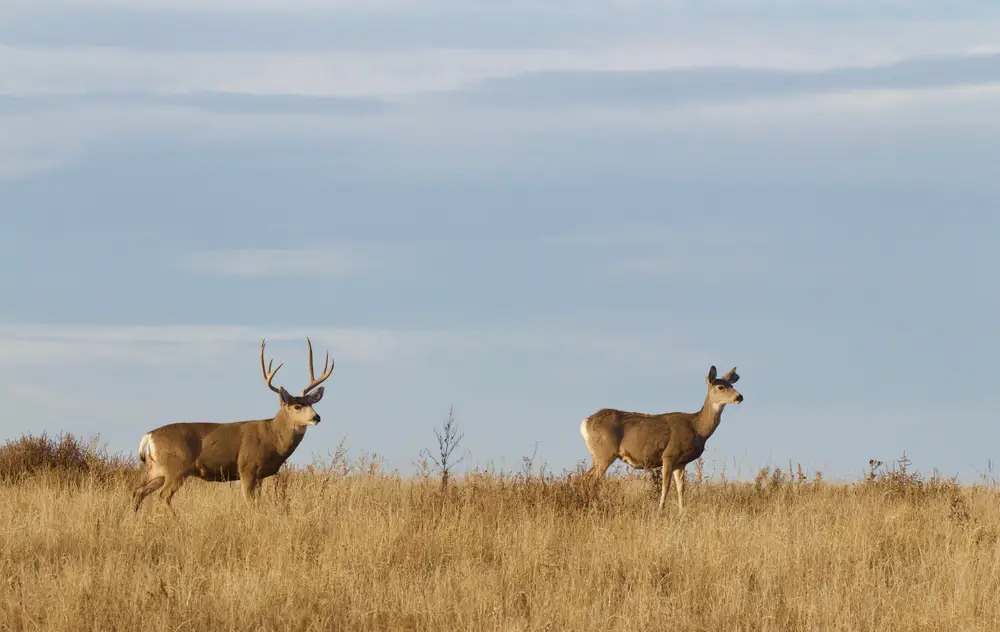
Known as RD2H for “Red Desert to Hoback Basin,” the Sublette mule deer migration corridor stretches 160 miles, from the Red Desert’s Leucite Hills, along the west flank of the Wind River Range to the Hoback Basin. The corridor consists of migratory paths that are defined by observed deer movements. Pronghorn, moose and elk also use winter and summer ranges linked by these ancient pathways.
Since state designation of the RD2H corridor by the Wyoming Game and Fish Commission in 2016, direct benefits to landowners have included improvements to ranch infrastructure and assets such as fencing and forage, as well as property value adjustments that reflect both conservation and landowner values, according to the publication.
According to the Extension bulletin, benefits to landowners related to the RD2H designation have included 482 miles of wildlife-friendly fencing; $7.6 million in fence project funding; and 86-plus landowners participating. Another $718,000 in habitat and forage project funding was used for invasive species control, fire adaptation, and rangeland and forage improvements. Under conservation easements, 74,447 acres have been conserved, with 50-plus landowners participating.
Over 30 project partners, funding sources and cooperating agencies — at the county, state and federal levels — are identified as participating in conservation projects related to the RD2H designation, Nagler says.
“Resources available to a landowner for assistance — for example, with funding for wildlife-friendly fence modifications or conservation easements — would depend on local agency resources in a particular time and place,” Nagler explains. “The Wyoming Wildlife Federation would be one good contact for landowners who are interested in participating in migration corridor-related programs.”
Ben Rashford, an associate professor in the UW Department of Agricultural and Applied Economics, and Joy Bannon, policy director for the Wyoming Wildlife Federation, were other authors of the publication.