




Uinta County administrative assistant receives UW Extension high honor

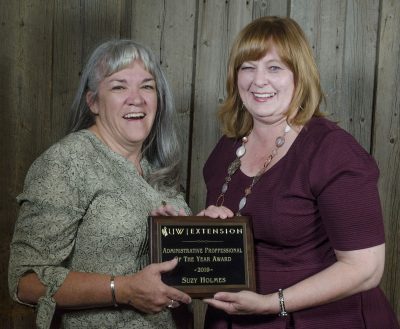
Two women hold a plaque
Suzy Holmes, left, receives the Administrative Professional of the Year Award from Ann Roberson, administrative associate based in the state University of Wyoming Extension office in Laramie.

A 38-year employee of the University of Wyoming Extension in Uinta County has received the organization’s Administrative Professional of the Year Award.

Suzy Holmes was presented the honor Thursday, Sept. 12, in Lander during the annual UW Extension training conference.

“Her institutional knowledge, her willingness to tackle difficult tasks and her commitment to clientele is unmatched,” her presentation announcement stated. “When the county faced being without a 4-H educator for over 18 months, this steadfast, resilient admin stepped up to lend her vast experience and knowledge to the continuation of the 4-H program in a professional and competent manner. The program continues today in large part due to her extraordinary efforts.”

Holmes was also a recipient of the Frances Freese Award, also recognizing administrative support excellence, in 1995.

Share the Post:

Related Posts

field containing a thick strip of yellow grass with mostly green grass to the right side

UW-Led Institute Releases Film Highlighting 10 Years of Collaborative Invasive Grass Management

The University of Wyoming’s Institute for Managing Annual Grasses Invading Natural Ecosystems (IMAGINE) has released a short film highlighting a decade of collaborative efforts to manage invasive grasses in northeast Wyoming.

The film, titled “Northeast Wyoming Holds the Line Against Ventenata & Medusahead,” features the Northeast Wyoming Invasive Grass Working Group (NEWIGWG), one of the largest invasive grass working groups in the U.S.

Read More
Four people stand in a field; Jahshua Sanchez is holding a bird.

UW’s WYOBIRD Contributes to Study on Climate Sensitivity Among Tree Swallows

Across the board, tree swallow populations have similar sensitivity to warming amid climate change, but different abilities to respond to change. Breeding dates have advanced about one day per degree of warming, but northern populations face tighter time constraints and greater exposure to warming, according to recent research that included University of Wyoming students and faculty in the Wyoming Bird Initiative for Resilience and Diversity (WYOBIRD).

Read More