
When it comes to University of Wyoming faculty recognition, it’s hard to beat the past two years for Department of Ecosystem Science and Management Professor Scott Shaw.
After receiving the 2025 John P. Ellbogen Lifetime Teaching Award that recognizes the long, distinguished, and exemplary career of one senior faculty member who has excelled as a teacher at UW, Shaw has been selected as the recipient of the 2026 George Duke Humphrey Distinguished Faculty Award, the university’s top faculty honor.
Named for UW’s 13th president, who served from 1945-1964, the Humphrey Award honors teaching effectiveness, distinction in scholarly work, and distinguished service to the university and state.
“This recognition is a great honor and deeply appreciated,” Shaw says. “I’m thankful to my colleagues both at home and around the world for their generous support, collegiality, and kind words.”
Shaw began teaching at UW in 1989 after helping manage Harvard University’s Museum of Comparative Zoology insect collections for five years. His career in entomology has included more than 200 scientific publications; discovering and naming more than 200 insect species from 29 different countries; and creating and curating UW’s Insect Gallery, which draws about 3,000 visitors annually.
Shaw has achieved international distinction in the field of entomology, including seeing 16 insect species named for him and writing an acclaimed book, Planet of the Bugs: Evolution and the Rise of Insects, which tells how insects shaped life on Earth. Colleagues from institutions in Canada, Colombia, Denmark, Egypt, France, Mississippi, New York, South Africa, and Sweden, in addition to Wyoming, wrote letters supporting his Humphrey Award nomination.
“Scott has made scientific contributions with truly global impact; he has engaged in consistent and effective science outreach through books and through his insect gallery, inspiring thousands of visitors of all ages; he has curated the UW Insect Museum in a way that has made it one of the most relevant collections worldwide, both for the local fauna and for globally important insect groups; and he has also devoted substantial time to administrative service…,” wrote Eduardo Shimbori, who studied under Shaw at UW and now works as a researcher at France’s Center for Population Biology and Management. “Together, these activities constitute sustained and high-impact service to the University of Wyoming, strengthening its role as a center of research, education, and public engagement with national and international recognition.”
“Professor Shaw is one of the most respected and admired world experts on parasitoid wasps,” wrote Jose Fernandez-Triana, a research scientist at Canada’s National Collection of Insects, Arachnids and Nematodes. Fernandez-Triana noted that Shaw has published more than 200 scientific papers on the wasps’ “biology, ecology, identification, and classification over his long and illustrious career.”
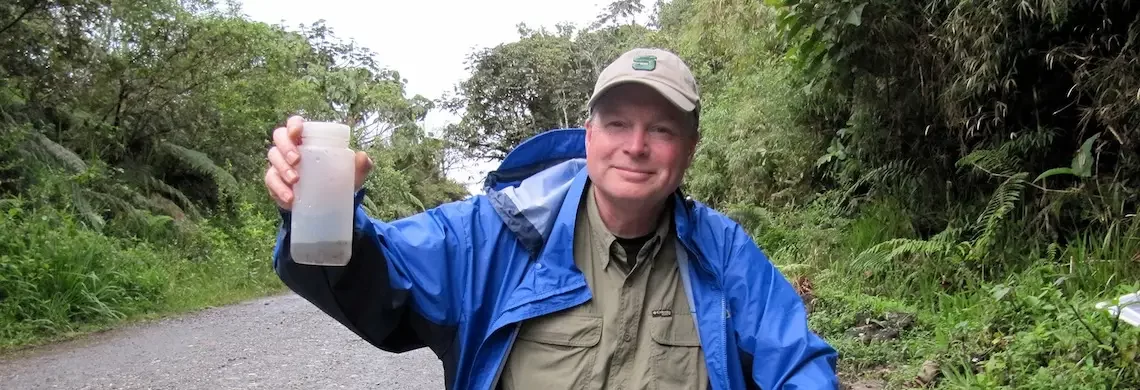
Shaw has taught a variety of courses during his 37 years at UW, ranging from “Insect Biology” to “The Biodiversity Crisis” to “Cosmology of Life.” He has mentored 21 graduate students and established an undergraduate honors course in tropical ecology that included opportunities to conduct research in the high-altitude cloud forest surrounding the Yanayacu Biological Station in Ecuador, where he has surveyed caterpillars and their associated parasitoid wasps and flies.
Outside his work in the field, the laboratory, and the classroom, Shaw was a multiterm UW faculty senator, including serving as chair of the Faculty Senate from 2016-17.
“Dr. Shaw offers an example of a holistic scholar who understands the role of academics developing new and significant knowledge; educating new generations of researchers; building and improving museum research collections and educational exhibits; promoting science to the public; and helping his university through institutional leadership,” wrote Carlos Sarmiento, a collaborator and faculty member at Colombia’s Instituto de Ciencias Naturales. “He stands as an example of a well-balanced researcher for future generations.”
Shaw received his undergraduate degree from Michigan State University and his master’s and doctorate at the University of Maryland, College Park. In addition to the John P. Ellbogen Lifetime Teaching Award last year, his UW honors include the College of Agriculture, Life Sciences and Natural Resources Outstanding Educator Award and the college’s Andrew Vanvig Distinguished Faculty Achievement Award.
“Dr. Shaw is a highly productive scientist, has provided exemplary service to the University of Wyoming and beyond, and is among the best teachers I have known,” wrote Tim Collier, head of the Department of Ecosystem Science and Management. “Through his exceptional teaching, productive research, and exemplary service, Dr. Shaw has achieved a remarkable level of distinction as a faculty member at the University of Wyoming. He is clearly deserving of this award.”
This story was originally published on UW News.