


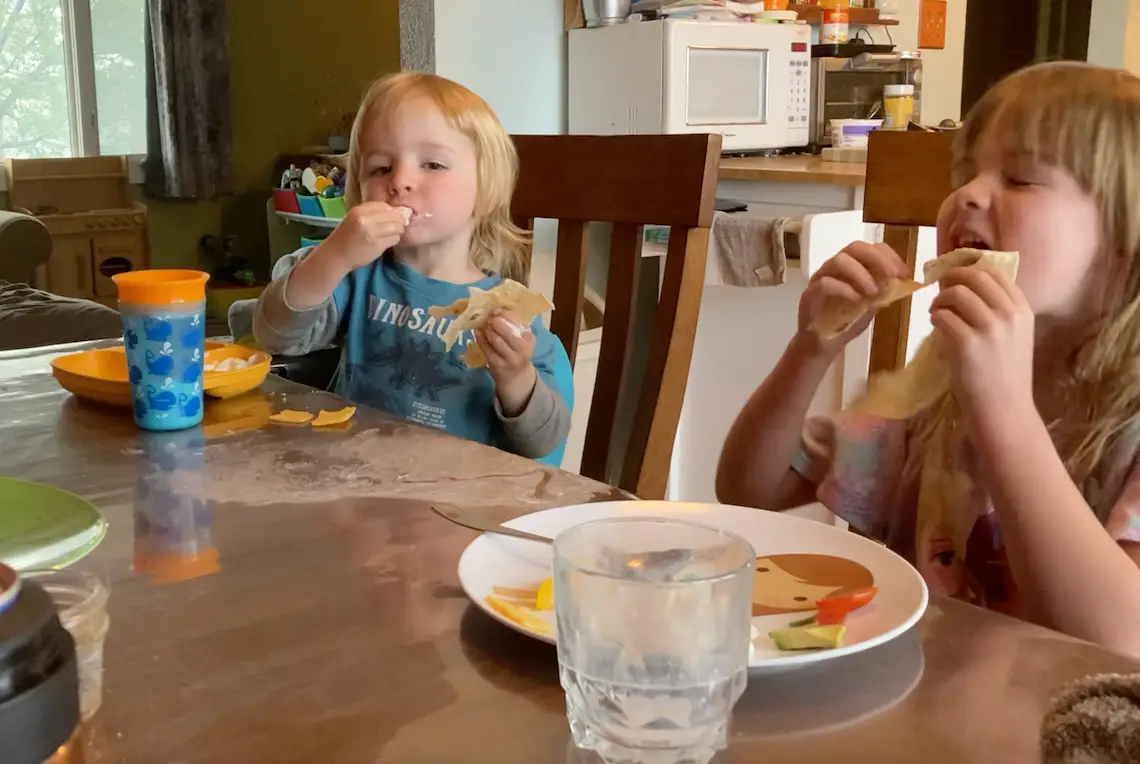
For families with young children, meals can be a battlefield. But what if it didn’t have to be a fight?
Grace Shearrer, assistant professor in the University of Wyoming Department of Family and Consumer Sciences, is investigating common toddler eating behaviors, parental feeding approaches, and ways to dismantle mealtime tug-of-wars.
Feeding and eating styles
Babies eat when they’re hungry, rather than eating in response to outside cues. But as they grow up, kids learn different eating behaviors based on how their parents approach food.
In a recent study, Shearrer examined five approaches to feeding young children (parental feeding styles).
In the controlling style, parents set hard rules about when, what, and how much children eat. They might demand that a child clean their plate.
Parents using an emotional style comfort their child with treats when the child is experiencing unpleasant emotions. For example, a parent might offer a child fast food after a bad day.
The instrumental approach uses food as a reward or a bribe. This could involve giving a child a candy bar to be quiet during a doctor’s visit.
Praising a child for practicing healthy habits is classified as an encouraging style. Parents might say, “Great job trying that broccoli! Look, you cleared your plate!”
Finally, parents using a prompting style will nudge a child to eat by saying something like, “You are really going to like this broccoli I made.”
Shearrer also examined eating styles. Unhealthy eating styles include picky eating, food responsivity, and emotional eating. A picky eater, for instance, refuses to eat certain foods.
Food responsivity is a response to a food cue. A toddler who demands fast food after driving past McDonald’s has a high level of food responsivity.
Emotional eating means that someone eats or avoids eating to cope with negative emotions. Eating a pint of ice cream after a breakup is an example of emotional eating.
How feeding styles affect eating habits
Shearrer’s lab recruited 89 families with young children from five Laramie preschools. The lab researchers used a specialized questionnaire to examine the connections between child eating behaviors and parental feeding styles, accounting for socioeconomic differences between families.
In previous research, controlling styles were associated with picky eating, although Shearrer’s study did not find this association.
On the other hand, the encouraging feeding style was associated with less picky eating in Shearrer’s study, suggesting that praising children for healthy choices can encourage them to try new foods.
She also found that the emotional feeding style was associated with emotional overeating and food responsivity in children. When food was treated as a way to calm negative emotions, kids tended to seek out that comfort.
Unfortunately, “when we start mixing up emotions and food, that’s when we get some disinhibited eating and some binge eating symptoms,” says Shearrer. Kids who eat because they’re sad or angry are not learning how to deal with the emotion productively. And emotional eaters rarely go for carrots or cucumbers—they often reach for comfort foods or processed snacks.
Food responsivity was also associated with the instrumental feeding style. If children are receiving candy when they behave, they’re more likely to seek that reward whenever they see a candy advertisement. While food can be a great way to reward a child on occasion, Shearrer suggests trying to mix it up. Maybe good behavior sometimes means a cool new sticker, or a trip to the park.
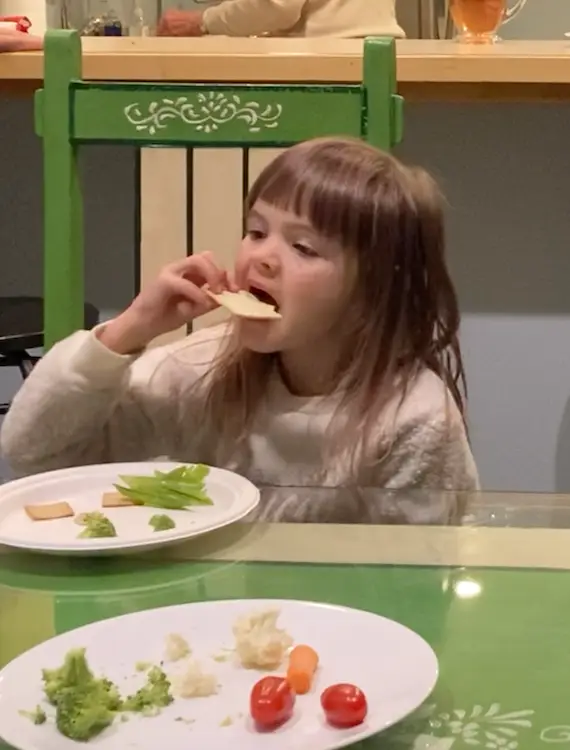
A universal problem
Across the socioeconomic spectrum, Shearrer’s study found that parents struggle with mealtimes in similar ways. Most parents are using similar feeding styles—and are experiencing similar negative behaviors as a result.
In a perfect world, toddlers would get hungry on a regular schedule, eat their fill of nutritious food during mealtime, and enjoy their food. They’d be open to trying new foods, and look forward to meals, but wouldn’t overeat. They would eat because they were hungry, not because they wanted a reward or wanted to feel less sad.
But the vast majority of people, let alone toddlers, can’t meet this standard. While the worst of mealtime strife resolves around age six for most kids, these habits don’t go away entirely. Many parents inadvertently teach their children an unhealthy eating style because it’s the style they use themselves.
“Most kids have unhealthy habits,” says Shearrer. But that may be a good thing: “We should be able to find interventions for both parents and kids that help a lot of people,” she adds.
For Shearrer, that’s the next step. Her lab group is currently working with Laramie parents to understand what kind of help they need and develop resources that address their concerns.

This article was originally published in the 2026 issue of Reflections, the annual research magazine published by the UW College of Agriculture, Life Sciences and Natural Resources.