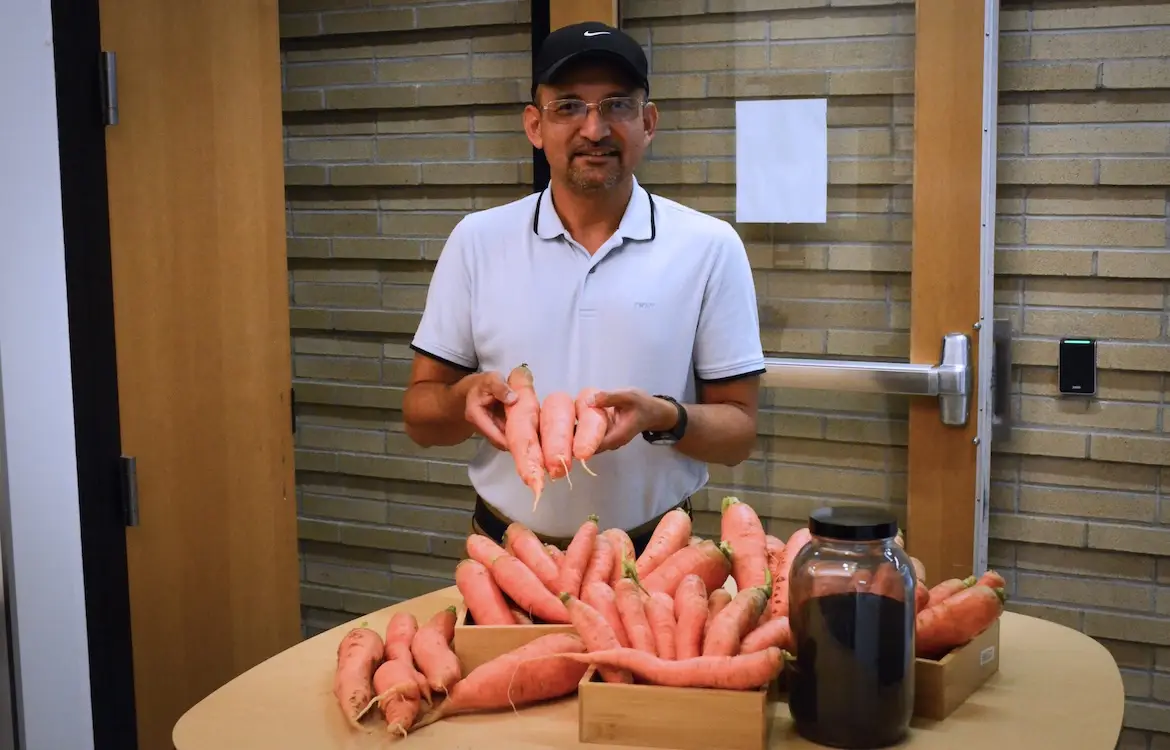


A new publication from researchers in the University of Wyoming School of Energy Resources (SER) delves into the potential of carbon-rich products to enhance agricultural productivity in challenging environments.
Published in the journal Sustainability, the study, “Effects of Char and Amendments on Soil Properties and Sugar Beet Yield in Sandy Clay Loam Soil,” was written by Resham Thapa, an assistant research professional in SER’s Center for Carbon Capture and Conversion (CCCC), which is focused on supporting the future of Wyoming coal by finding high-volume alternative uses.

This study is one of several publications to result from the multiyear effort evaluating coal char as a soil amendment in Wyoming.
“We’ve been working on utilizing coal char produced from the pyrolysis of Powder River Basin coal to use similar to biochar, which is often used in agriculture to enhance soil health, retain moisture, and prevent nutrient and fertilizer runoff,” Thapa says. “We believe that coal char—which is cheaper to produce—can be comparable to biochar.”
Several field studies have been ongoing in both the northwestern and southeastern corners of Wyoming, using different crops and soil types, since 2021.
For this publication, a two-year field study was conducted to assess the comparative impacts of coal char, biochar, inorganic fertilizer, and manure amendments on soil properties, plant growth indices, and soil and plant nutrient dynamics in a semiarid, sandy clay loam soil in Wyoming.
The research was conducted at UW’s Powell Research and Extension Center (PREC) in northwest Wyoming and tested on sugar beets.
“It’s critical to compare Wyoming coal char with the industry-standard biochar under a range of soil conditions and in combination with different fertilizers and manures,” Thapa says. “This approach helps us identify the most effective strategies to enhance soil health, improve nutrient efficiency, and maximize crop productivity in semi-arid systems.”
The study revealed that the amendments may not directly increase crop yield but, instead, work indirectly by significantly improving soil physical properties, such as increasing soil porosity and water holding capacity, thereby boosting plant growth and nutrient content in both the soil and the plants. For instance, certain application rates of coal char contributed to higher sugar beet yields, while fertilizer and manure were key to enhancing nutrient levels.
The results highlight coal char’s potential as an effective soil amendment for enhancing sugar beet productivity in semiarid soils, particularly when incorporated with an integrated nutrient management framework.
“We have developed an entire suite of products derived from Wyoming coal that are promising, high-volume alternative uses to burning it,” says Trina Pfeiffer, director of the CCCC. “This coal char soil amendment is a very exciting application, as it will have major benefits to both the extractive and agricultural sectors in Wyoming’s economy. We are so pleased to continue to see positive and consistent results on the project over the long term.”
The article can be downloaded directly from the open-access journal and can be found on the CCCC website along with other publications and information on the project.
This story was originally published on UW News.