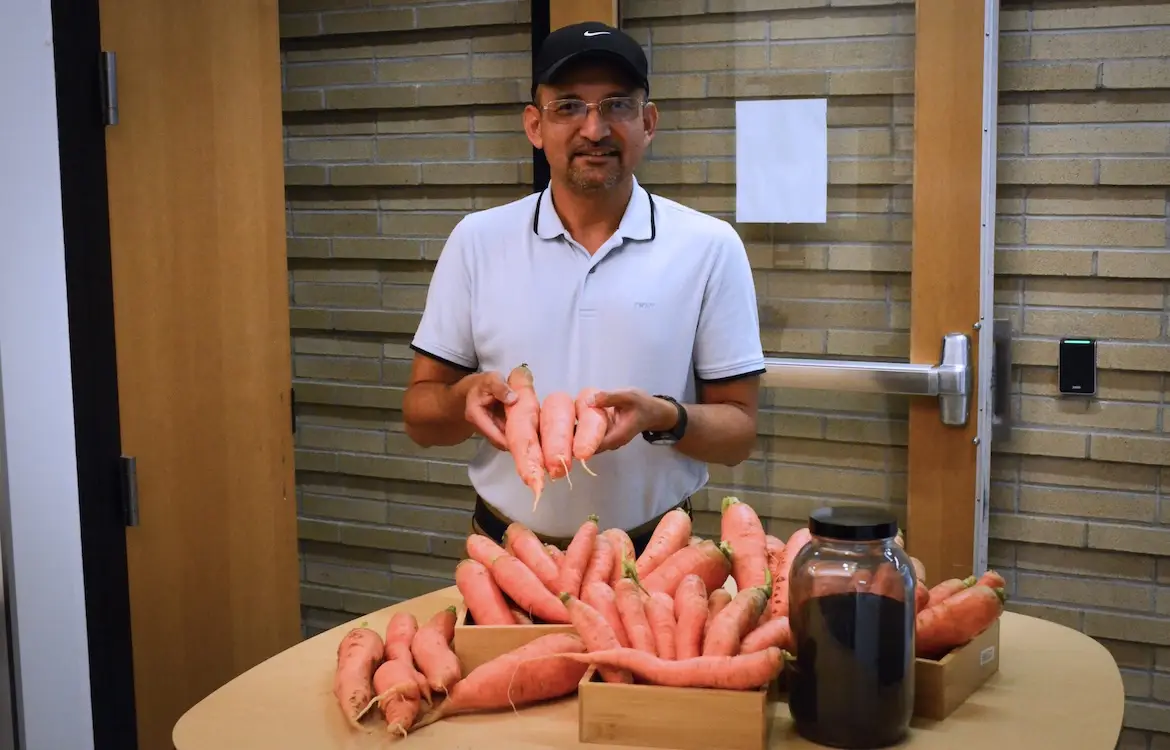


Two University of Wyoming researchers recently received National Science Foundation (NSF) funding to provide paid experiential learning opportunities in controlled environment agriculture, an emerging technology that aims to foster innovation and opportunity within the field of agriculture.

Liping Wang, an associate professor in the Department of Civil and Architectural Engineering and Construction Management, and Jill Keith, an associate professor and head of the Department of Family and Consumer Sciences, are launching a Research Experiences for Undergraduates (REU) NSF site at the university for providing a state-of-the-art experience to undergraduate students in controlled environment agriculture. NSF’s REU program supports intensive research by undergraduate students in an NSF-funded area. Such sites are designed to engage a cohort of students in research projects related to an area of study, such as Wang and Keith’s project.
The new REU site provides invaluable opportunities for students to engage in cutting-edge multidisciplinary scientific inquiry in controlled environment agriculture, which has garnered nationwide attention for its significant contributions to addressing global food production challenges.
Wang is principal investigator of the project, and Keith is co-principal investigator. The project team includes researchers, mentors and undergraduate students from diverse backgrounds, including Native American, female and first-generation students, and students from other underrepresented groups. Their collaborative efforts highlight the importance of inclusivity and diversity in driving scientific progress.
“We are thrilled to announce that our team has been awarded a prestigious REU grant from the National Science Foundation to broaden the participation of underrepresented students in STEM fields,” Wang says. “UW is launching a new REU site—controlled environment agriculture—focusing on integration of plant sciences, systems engineering, computing and computer science, and supply chain analytics to address global food challenges.”

With the world’s population projected to reach nearly 10 billion by 2050, the demand for food production will rise significantly. Controlled environment agriculture offers a promising solution by enhancing crop yields and promoting sustainable practices. The REU program provides students with hands-on experience in controlled environment agriculture research, technical skills development, and professional training. Participants gain valuable insights into interdisciplinary approaches to complex agricultural issues.
Academic institutions, such as UW, play a crucial role in advancing research and education in controlled environment agriculture. The university is committed to enabling students with the tools and knowledge needed to succeed in this rapidly evolving field.
“Controlled environment agriculture is an emerging knowledge-driven industry critical for providing food while decreasing resource inputs,” says Parag Chitnis, UW’s vice president for research and economic development. “It provides an exciting opportunity for bolstering research and cluster development in Wyoming through industry-university partnerships. This NSF grant will help us prepare a trained workforce for research as well as industry needs.”
The recognition of the UW researchers for their contributions to controlled environment agriculture highlights the importance of interdisciplinary collaboration and innovation in addressing complex societal challenges. UW is committed to ongoing efforts to promote excellence in agricultural research and education.
This story was originally published on UW News.