

Bob Finley sometimes jokes that if he had known how hard it was going back to school, he might not have attempted it.
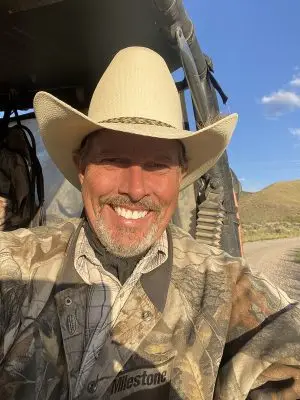
And yet, he has persevered and earned a master’s degree in plant sciences from the University of Wyoming College of Agriculture, Life Sciences and Natural Resources—35 years after he first graduated from UW.
At age 63, Finley, a grandfather, will march with his fellow graduates Saturday, May 11, in the UW Arena-Auditorium at 12:15 p.m.
“I am pleased to have had the opportunity to obtain this degree, and I am thankful to all of the grad students who have inspired me over the years to want to take this step to improve myself in this manner,” Finley says.
The personable Finley was raised in Dubois, coming from a ranching family. He graduated from Dubois High School in 1979 and worked in the logging industry for two years. He then moved onto his next job as a ranch hand on a bigger spread near the family ranch.
By 1983, Finley decided to enroll at UW and, in between class studies and working to support himself, he graduated with a bachelor’s degree in farm and ranch management in 1989.
The year before, he married his wife, Janna, and the couple later moved to Sheridan County, where Finley worked on a ranch before returning home. He worked various jobs during that time in Dubois, mostly in construction. The couple added to their family, raising two daughters. Bob and Janna have been married 35 years and have four grandchildren.
His Weed and Pest Career
By 2002, Finley secured a job with Fremont County Weed and Pest as an assistant supervisor, a position he still holds today. He works the Dubois/Crowheart weed management area, which is nearly 1.5 million acres in northwest Fremont County. His duties include spraying weeds, mostly on agency land, such as county roads, and Wyoming Game and Fish Department, Bureau of Indian Affairs, and U.S. Forest Service land.
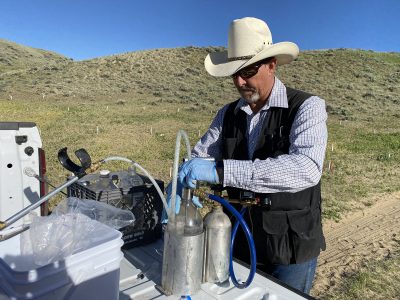
As part of his duties, Finley has attended various meetings, such as the annual Western Society of Weed Science meeting, which is a collaboration of weed scientists from throughout the western U.S. to present and to discuss new research in the weed science field.
It was at one of the annual meetings where Finley first became inspired to receive more education in the field. By then, UW’s College of Agriculture, Life Sciences and Natural Resources offered an online master’s degree program to provide more education for Wyoming’s county weed managers. Finley took advantage of the coursework, beginning his degree program in fall 2020.
“The challenge, besides relearning how to take notes and study, was having time both for classes and study, but particularly for research,” Finley says. “My job is very demanding in the summer and, because research on weeds also needed to be conducted in the summer, it only added to the time challenges.”
As with a lot of research, Finley was at the mercy of weather conditions, plus other issues that forced him to attempt his research three different years before he got results that were satisfactory for analysis and presentation.
All of the hard work has paid off—Finley will join the many UW graduates with their families celebrating the end of their degree work this weekend.
Benefits of Going Back to School
Finley says the support of his family has gotten him this far in his professional career, but he gives most of the credit to Janna, who has been there every step of the way. He also credits his adviser, Brian Mealor, the UW Research and Extension Center director in Sheridan.
“He encouraged me before there was even an online program and continued to do that until I finished my thesis and defense at the end of March,” Finley says.
Already, Finley can see the benefits of receiving an advanced degree.
“This degree and what I have learned are already helping me be a more effective weed manager and a resource to the county land managers,” he says. “I have been able to help more with restoration and reclamation on Game and Fish lands and, particularly, more accurate education and instruction during landowner/manager consultations.”
Going back, he knows the satisfaction of earning an advanced degree after raising a family and working a full-time job.
“The truth is, knowing how rewarding it has been to learn what I did and to have had all of the interaction with both students and faculty that I’ve had, I would absolutely recommend it to anyone, at any time of their life,” he says.
Even at an age when some are already retiring.
This story was originally published on UW News.