

The federal government’s management of wild horses is doomed to fail without fundamental changes in policy and the law, according to a new paper led by researchers at the University of Wyoming and Oklahoma State University.
Because contrasting societal views have created an approach that simultaneously manages horses on the range as wildlife, livestock, and pets, current government programs are incapable of succeeding, the researchers argue in the article that appears in the journal BioScience.
“For the federal government to sustain healthy populations, ecosystem health and fiscal responsibility, lawmakers must properly define how feral equids should be labeled,” the scientists wrote. “Each label (wild, livestock, pet) has validity, and management plans can be implemented to optimize equid populations with other land uses. Furthermore, providing a clear definition of feral equids will determine the legal tools that can be applied for their management.”
The lead author of the paper is Jacob Hennig, a former UW Ph.D. student who is now a postdoctoral researcher at Oklahoma State. Hennig’s advisers at UW — Professor Jeff Beck and Associate Professor Derek Scasta, both in the Department of Ecosystem Science and Management — are co-authors of the paper. So are Oklahoma State Professor Sam Fuhlendorf and Assistant Professor Courtney Duchardt, who is a former UW Ph.D. student; Colorado State University research scientist Saeideh Esmaeili, also a former UW Ph.D. student; and Tolani Francisco, of Native Healing LLC in New Mexico.
The researchers note that, while the fossil record shows there were horses in North America previously, they went extinct about 10,000 years ago.
“The equids currently inhabiting North America did not coevolve there; they are descendants of livestock that underwent millennia of domestication and artificial selection,” the paper says. “Most large predators that would help limit their population growth went extinct at the end of the Pleistocene (epoch), and the Anthropocene (current epoch) has led to further predator reductions.”
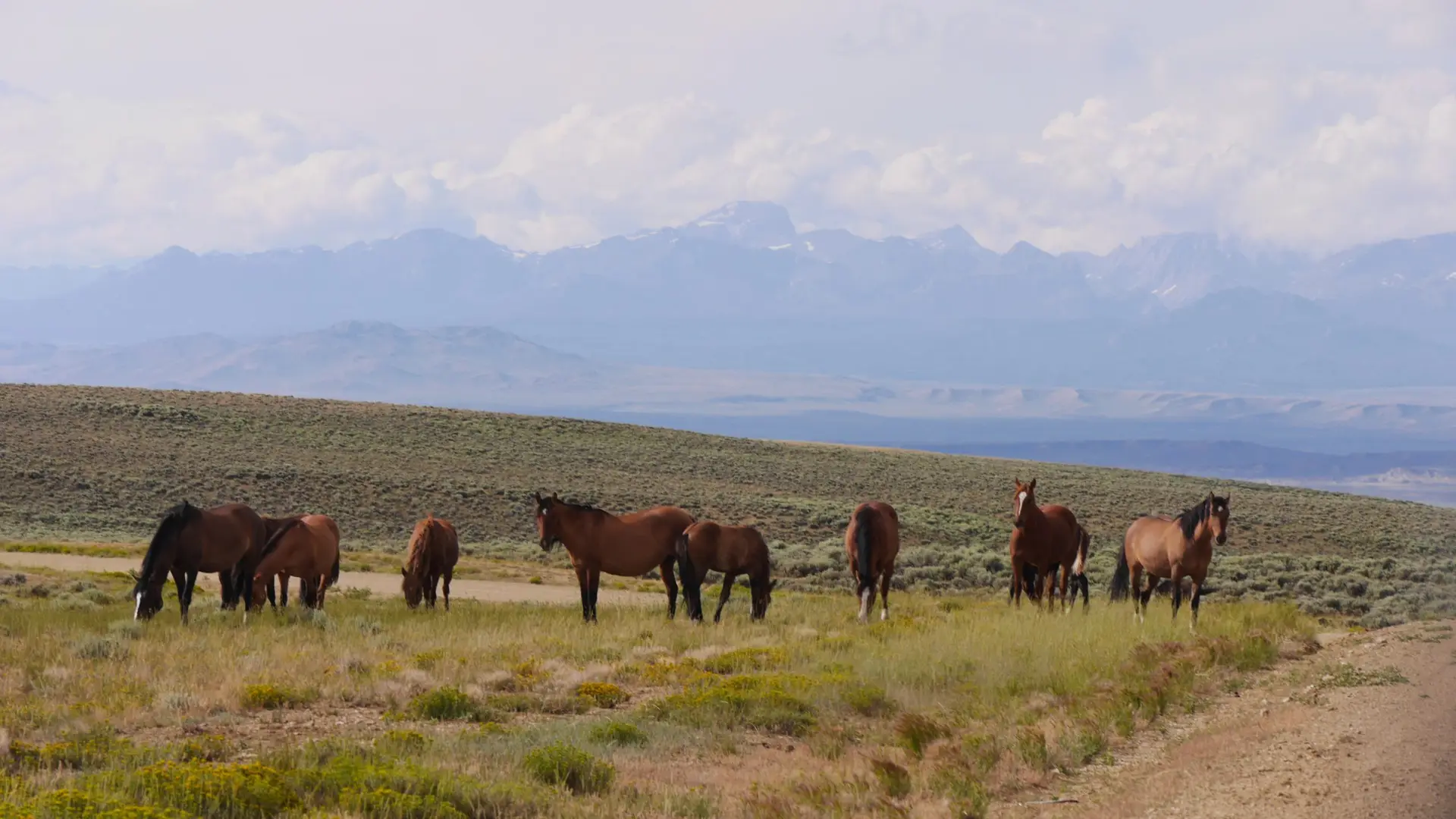
Because wild horses have no natural predators, cannot be legally hunted under federal law, and are no longer slaughtered as livestock in the United States, their numbers on the range have more than doubled in the last decade, the researchers say. They also note that horses removed from the range by the Bureau of Land Management (BLM) and held in government facilities and private lands have grown in number by 33 percent during that time, with the BLM spending over $550 million since 2013 supporting the captive animals.
“The BLM has increased the number of individuals removed from the wild in each of the past four years, leading to decreases in the on-range population,” the paper acknowledges. “However, the total on-range population is still approximately 50,000 individuals above the maximum (appropriate management level), and the recent moderate decrease in on-range individuals is directly correlated with an increase in the off-range population and subsequent expenditures.”
Removing wild horses from Western rangelands and placing them in long-term holding is not a solution, the researchers say. Doing so “simply exports the issue elsewhere — including the imperiled tallgrass prairie ecosystem — with unknown ecological effects,” they wrote, noting that there are now about 23,500 wild horses on private lands in Oklahoma, five times more than the number on open range in Wyoming.
Additionally, the paper contends that wild horses have a comparatively large impact on the range, as they consume more forage and water than ruminants such as cattle, per capita.
The scientists credit the BLM for basing recent management on science, including better population estimates of wild horses and deploying measures to keep them from reproducing. But there are too many animals on the range for this approach to work.
“Although the BLM has admirably increased fertility control research and application, if they are unable to also remove tens of thousands of equids, this process is doomed to be a Sisyphean task,” the researchers wrote.
The federal Wild and Free-Roaming Horses and Burros Act of 1971 essentially calls for wild horses to freely roam like wild animals, but they are treated differently from wild animals because the act prohibits hunting. At the same time, the BLM’s practice of gathering and removing wild horses from the range “more closely resemble livestock operations than wildlife management, whereas adoption programs, sales restrictions, and the abolition of slaughter have resulted in feral equids effectively serving as society’s pets,” the paper says.
Choosing one of the labels — wild, livestock, or pets — offers the best hope for the federal government to succeed in wild horse management, the scientists wrote.
“As a wild species that lacks sufficient predation to keep most populations in check, a hunting or culling program, like those for other wild ungulates, could slow their population growth,” the paper states. “As livestock, gathers and removals that lead to sale or slaughter would limit growth and give the animals the monetary value they currently lack. As pets, simultaneously conducting large-scale removals and administering fertility control, including permanent sterilization (and potentially euthanasia), could reduce population sizes and slow growth.”
The researchers’ conclusion?
“The current state of feral horse and burro management in the United States is unsustainable and will continue to be a painful resource sink without fundamental changes to the law. We recommend that the U.S. federal government should officially declare the status of feral equids as either wild, livestock, or pets and should provide the BLM and (U.S. Forest Service) the legal latitude and funding to develop and implement respective management options.”
This story was originally published on UW News.