


Agricultural Experiment Stations always important to Legacy Award recipient
Pinedale native Kurt Feltner’s career may have passed through Arizona, Montana, New Hampshire, and Kansas, but his fondness remains for Wyoming and the institution to which he devoted most of his career – the Agricultural Experiment Station.
The College of Agriculture and Natural Resources alumnus earlier provided for an annual young researcher award and has now established an endowment in honor of his late wife, Lynn, to create an award for the best student paper in Reflections, the research magazine of the college published annually by the Wyoming Agricultural Experiment Station (WAES).
Kurt “Cub” Feltner worked with Pepper Jo Six in the UW Foundation to create the endowment. Lynn died 10 years ago from Alzheimer’s. Feltner met Lynn in Louisiana while he was in the U.S. Air Force during the Korean War. “Three months later, we were married,” he notes. They celebrated 58 years.
“I said to Pepper I’d like to do something to honor my wife because she was a willing partner my entire professional life, and Pepper came up with the idea of the Lynn Feltner Student Paper Award,” he says. “Undergraduates and graduate students play a big role in research at UW but are kind of unheralded, just like my wife was unheralded although a full partner in everything I did.”
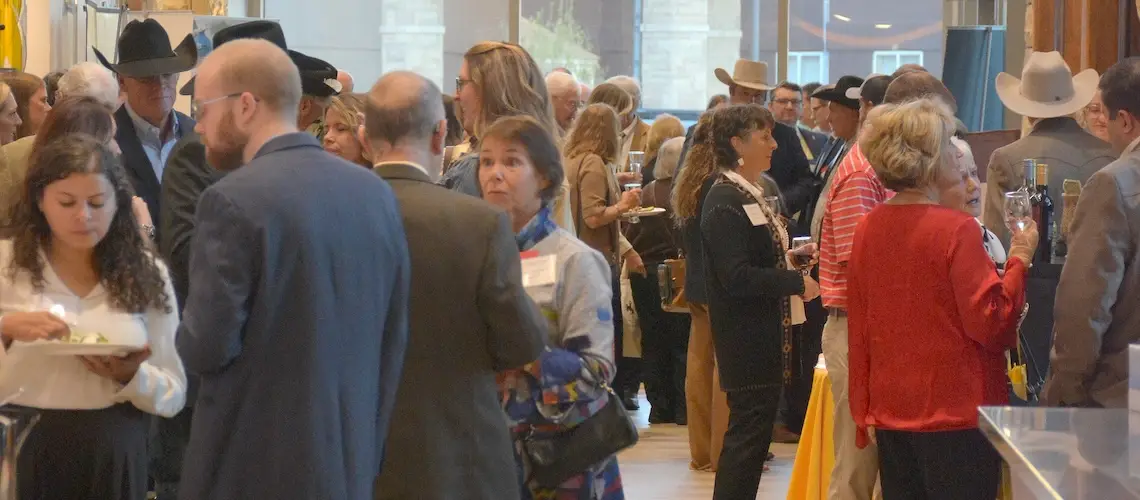
Feltner presented the first award to Jessica Windh during the WAES research award reception in February. Windh, of Reedley, California, is an undergraduate student in rangeland ecology and watershed management.
WAES director Bret Hess expressed his appreciation.
“Cub is one of the most gracious and generous persons I have had the privilege to know,” says Hess.
“Recognizing Lynn’s unwavering support in this manner is a testament to his commitment to honor those who truly deserve recognition.”
Feltner received his bachelor’s and master’s degrees at UW and earned his Ph.D. from the University of Arizona in 1963.
He worked at UW after his Ph.D., then joined Kansas State University as an associate professor of agronomy. He then accepted the position of head of the plant and soil science division position at Montana State University. Nine years later, he became dean and experiment station director at the University of New Hampshire.
He returned to KSU in 1983 to become director of the KSU Agricultural Experiment Station and finished his career as executive director of the North Central Association of Agricultural Experiment Station Directors, retiring in 1994.
“Most of my contributions over the years have been to the WAES because I’m familiar with a number of major studies commissioned to determine the payoff to investment in agricultural research, and the answer is always the same,” says Feltner. “It’s a huge return. Having kept in touch with UW reasonably well over the years, I knew any help WAES received would be well used by capable scientists.”
Why ‘Cub’?
Kurt Feltner is known to many as Cub. Feltner relates his father had a World War I buddy named Cubby Culberston. The name eventually shortened to Cub, and he inherited the nickname.
Agricultural Experiment Station origins
The Hatch Act of 1887 created agricultural experiment stations at land-grant universities in the 50 states, the District of Columbia, and in other U.S. areas (for example, Guam).
The Wyoming Agricultural Experiment Station was created in 1891, and is housed in the College of Agriculture and Natural Resources. The station directs activities at research and extension centers in Laramie, Powell, Sheridan, and near Lingle.