


New research led by a University of Wyoming graduate student shows that invasive ants in a Kenyan savanna have caused lions to change their predatory behavior.
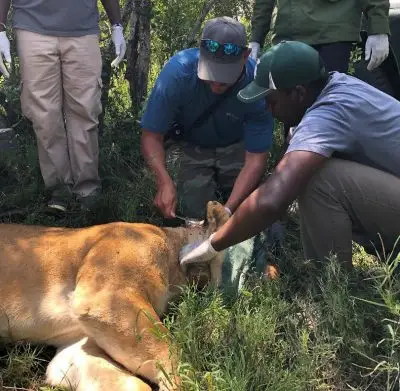
As detailed today in the journal Science, the researchers found that the invasion of big-headed ants at Kenya’s Ol Pejeta Conservancy makes lions less effective at killing zebras, their primary prey. That’s because the invasive insects kill native acacia ants that protect the whistling-thorn tree from elephants and other herbivores, resulting in less tree cover for lions to ambush zebras.
“We show that a tiny invader reconfigured predator-prey dynamics among iconic species,” wrote the researchers, led by UW Ph.D. student Douglas Kamaru, who’s part of Professor Jacob Goheen’s research group in the UW Department of Zoology and Physiology.
The good news is that the lion population hasn’t declined since the insect invasion, likely because lions have switched their diets from zebras to African buffalo, which are equally at risk of lion predation in invaded areas.
Other members of the research team are from The Nature Conservancy, the University of British Columbia, the University of Florida, the University of Nairobi, Duke University, the University of Glasgow, Karatina University, the University of Nevada-Reno, and the U.S. Geological Survey.
Whistling-thorn trees, the dominant tree species in much of East Africa, provide nectar and shelter for native ants. In exchange, the ants defend the trees against browsers by biting them and emitting formic acid. The native ants are particularly effective at defending the trees against elephants, “thereby stabilizing savanna tree cover across entire landscapes,” the researchers wrote.
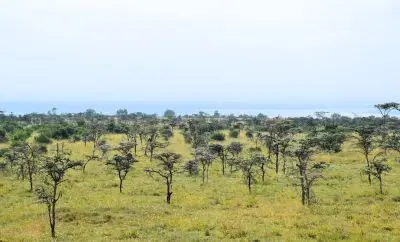
Over the past two decades, invasion of the big-headed ant—thought to have originated on an island in the Indian Ocean—has disrupted the symbiotic relationship between whistling-thorn trees and native ants. Big-headed ants kill the native ants but don’t protect the trees from elephants, allowing the massive herbivores to browse and break trees at five to seven times the rate of uninvaded areas.
The researchers hypothesized that the loss of tree cover would affect the interactions of lions and their primary prey species, zebras. Using a number of study plots—some invaded by big-headed ants, some not—and studying zebra and lion activity, the scientists found that the big-headed ant invasion indeed reduced the occurrence of zebra kills by lions by increasing openness across the landscape.
“We show that the spread of the big-headed ant, one of the globe’s most widespread and ecologically impactful invaders, has sparked an ecological chain reaction that reduces the success by which lions can hunt their primary prey,” the researchers wrote.
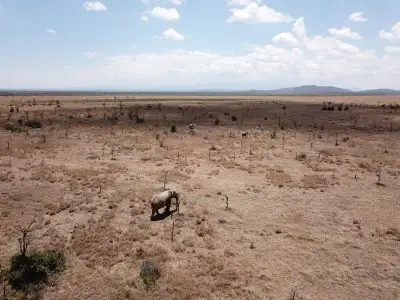
The scientists believe the Ol Pejeta Conservancy lions have maintained their numbers by killing more African buffalo, which are larger and more difficult to kill than zebras. Elsewhere in East Africa, larger groups of lions are required to kill buffalo, which may eventually lead to changes in the size and composition of lion prides at the Ol Pejeta Conservancy.
“Although the invasion of big-headed ants has shaped the spatial distribution of zebra kills, and the frequency of zebra kills has declined over time, prey switching by lions to more formidable prey seems to have, thus far, prevented any cascading effects on lion numbers,” the researchers concluded. “The role of behavioral adjustments in underlying the population stability of lions, plus the degree to which such stability can be maintained as big-headed ants advance across the landscape, remain open questions for future investigation.”
This story was originally published on UW News.