



Don’t underestimate a mother’s influence. Especially when it comes to the microbiomes of her reproductive tract and rumen.

A new study in the UW Department of Animal Science suggests that investigation of maternal microbiomes in cattle may yield promising results for producers looking to improve herd health, reproductive efficiency, and even feed efficiency.
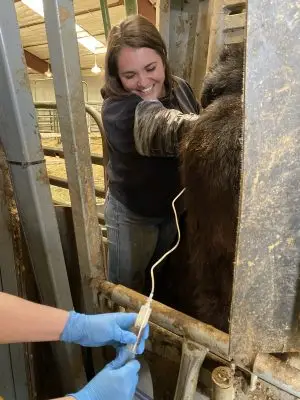
In November 2020, graduate student Madison Shults and assistant professor Hannah Cunningham-Hollinger took vaginal swabs and rumen fluid samples from a group of cows and heifers at the Laramie Research and Extension Center. Open (not bred) cows also received uterine swabs.
This was the first step in a study targeting two questions:
- Does the reproductive tract microbiome differ based on parity (heifer versus cow) and pregnancy status (bred versus open)?
- Are there measurable changes in the reproductive tract microbiome and rumen microbiome based on parity, pregnancy status, or stage of gestation (early, middle, late)?
Shults and Cunningham-Hollinger observed minor differences between bred and open cows in the initial comparison.
Bred females were also monitored throughout gestation, with vaginal swab and rumen fluid samples taken monthly. Differences in the microbiomes of heifers and cows were also tracked throughout pregnancy.
The uterine environment of open cows appeared to have a closely related group of microbes that were different from those present in the vaginal canal of both bred and open cows, Shults reports. This finding was consistent with previous studies and may indicate that specific groups of bacteria interfere with or promote the establishment and maintenance of a pregnancy.
Shults and Cunningham-Hollinger also observed shifts in both the rumen and reproductive tract microbiomes throughout pregnancy. Their results showed an increase in the abundance and diversity of microbes present through late gestation, at which point a significant decrease in both abundance and diversity occurred. The reduced microbial abundance and diversity persisted until calving.
It’s not clear why this was the case or what mechanisms caused the shift, says Shults, but it may be an important step in preparation for healthy calving. Understanding the role of microbiomes in a healthy pregnancy could ultimately improve herd health and reproductive efficiency.
So could investigating the relationship between a mother’s microbiomes and the microbiomes of her developing calf. Researchers in Cunningham-Hollinger’s lab have already identified a close connection between maternal microbiomes and the microbiomes of calves in utero. The long-term goal is to determine how to positively influence a developing calf’s microbiome by influencing its mother’s microbiomes during gestation.
“If we could truly link a more desirable maternal microbiome to the developing rumen microbiome in the calf and then see if that more advantageous microbiome helps calves be more efficient at the bunk, we could produce cattle that convert feed more efficiently, finish faster, and go to the line with less days consuming feed,” says Shults.
To learn more, contact Cunningham-Hollinger at hcunnin6@uwyo.edu or (307) 766-6530.
This article was originally published in the 2023 issue of Reflections, the annual research magazine of the UW College of Agriculture, Life Sciences and Natural Resources.