


Examining the correlation between low-energy diets and stress responses
Vegetarian bears are stressed?
Well, it’s not quite that simple, but a study led by associate professor David Christianson suggests a positive correlation between stress hormones and herbivory in Yellowstone bears.
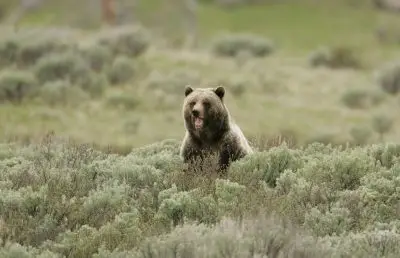
Researchers already knew that the number one food source for grizzlies in Yellowstone is grass. But how does grazing correlate to stress levels?
Christianson has discovered that for grizzlies and black bears in Yellowstone, higher stress levels coincide with increased grazing.
In Christianson’s study, stress is defined by cortisol levels, as measured in fecal samples. All mammals secrete cortisol in response to triggers that threaten their growth, reproduction, and survival. Stress isn’t necessarily a bad thing, Christianson notes—in fact, physiological responses to stress benefit bears (and people) in the long run by inspiring more effective solutions to tricky situations.
Higher concentrations of chlorophyll in fecal samples indicate that a greater proportion of the bear’s recent diet included grasses, sedges, and wildflowers. These food sources, while more widespread, do not provide the nutrient-dense calories found in berries, seeds, and meat.
Through analysis of fecal chlorophyll concentration, Christianson determined that diets higher in graminoids and forbs (grasses) generally correlated to higher fecal cortisol levels. However, these results don’t fully explain why consumption of lower-energy herbivorous food coincides with stress.
“What we don’t know yet is whether the reason we find more stress hormones in fecal samples from bears that are doing more grazing is because the grass is the least nutritious thing they’re eating and their body is exhibiting a stress response to reduced calorie intake—or whether the act of grazing itself is associated with something else we’re not measuring,” Christianson explains.
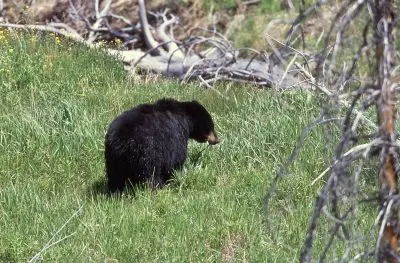
For example, if the most desirable grazing sites are located near roads or trails, bears with a higher proportion of grass in their diet may experience increased cortisol levels in response to their proximity to human activity. However, without a more robust data set clearly showing differences in cortisol levels based on grazing location, it’s impossible to rule out other potential explanations.
Interestingly, Christianson’s results also suggest that in Yellowstone, the correlation between grazing behavior and fecal cortisol levels is much greater than differences in cortisol levels between grizzlies and black bears. “What we found is when you take into account how much grazing the bear is doing, the differences between species become insignificant,” he explains.
Other studies have detected significant differences in dietary habits and stress levels between the two species, but Yellowstone bears appear to defy the trend.
Christianson notes that in the future, Yellowstone bears may shift to a greater reliance on herbivory due to the loss of traditional food sources, such as whitebark pine seeds. While green vegetation remains readily available, it may not provide adequate nutrition.
“Whether it’s a suitable replacement or not is still an open question,” he explains. “If foods like grasses and sedges and flowers become a bigger part of their diet in the future, we want to know whether they can actually survive on those things.”
To learn more, contact Christianson at david.christrianson@uwyo.edu.
This article was originally published in the 2023 issue of Reflections, the annual research magazine of the UW College of Agriculture, Life Sciences and Natural Resources.