


Edible dry bean production in Wyoming typically relies on the use of herbicides to fight pesky weeds. However, cover crops may allow producers to both reduce the application of herbicides and ultimately save money.
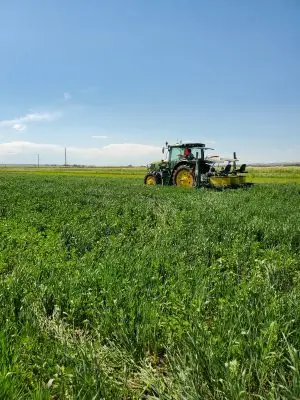
Cover crops may prove especially valuable to producers who have encountered Roundup®-resistant weeds in their fields, a phenomenon that is becoming more prevalent. These herbicide-resistant weeds are the result of repeated application of the same or similar herbicides and a lack of crop rotation.
Using different chemicals with different modes of action and rotating crops can help break up the life cycle of weeds, says Ryan Johnson, UW graduate student in plant sciences. Cover crops can provide direct competition to weed seedlings, hindering their emergence.
Johnson’s research shows that cover crops may be a viable option for weed suppression in edible dry bean production. “I would suggest producers could possibly consider using cover crops as an alternative for weed control rather than dumping more herbicides, which could cost them more money in the long run,” he says. Producers can also consider implementing mechanical control methods, such as plowing and discing.
In a comparison of weed management strategies, Johnson and Andrew Kniss, UW professor of plant sciences, applied various pre- and post-herbicide treatments to winter wheat cover crops in Lingle and Powell. The winter wheat crops were planted in research plots used for edible dry bean production and examined over the course of two growing seasons in 2021 and 2022.
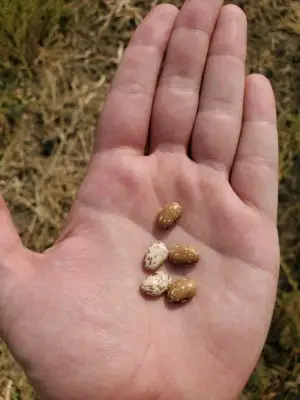
Each site, one in Lingle and one in Powell, was divided into 72 plots. At least three times during the growing season, Johnson and others counted individual weeds by species in a square meter quadrant in each plot to determine the effectiveness of the different application methods.
Researchers also used visual weed control to give ratings to each plot. Ratings were given on a scale of 0–100, with 100 indicating there was 100% control (no weeds remained) and 0 representing zero control (many weeds were present).
Cover crop biomass, which helps with weed suppression, was measured once in each site before it was terminated to allow for planting of the edible dry bean crop. Johnson and Kniss noticed less cover crop biomass in Powell, which has a drier climate than the study area in Lingle. They are not entirely certain that the differences in climate were responsible for the differences in biomass.
“The best results produced were when we had a cover crop treatment and then pre- and post- herbicide application,” Johnson reports. “But I would say at least having the cover crop and then one herbicide application, whether it is pre- or post-emergence, would work well.”
To learn more, contact Kniss at akniss@uwyo.edu or (307) 766-3104.
This article was originally published in the 2023 issue of Reflections, the annual research magazine published by the UW College of Agriculture, Life Sciences and Natural Resources.