
Six research projects in the College of Agriculture and Natural Resources are among 13 receiving funding through $1 million in Science Initiative Faculty Innovation Grants at the University of Wyoming.
Projects are interdisciplinary teams of faculty members. The 13 were selected from 41 projects submitted. The most competitive proposals address the interdisciplinary nature of the research and involve faculty members from multiple departments, colleges, fields or disciplines at UW.
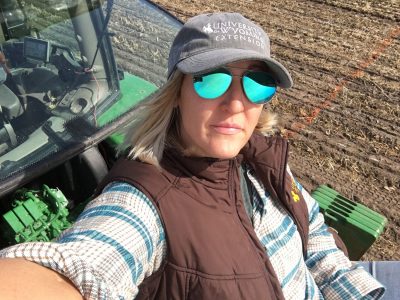
Carrie Eberle, an assistant professor of plant sciences, was awarded $89,992 for “Establishing Crotalaria juncea as a New Forage Crop for the Sustainable Intensification of the Wyoming Agricultural Industry.” Eberle is the lead scientist (principal investigator [PI]).
She will look at whether the plant Crotalaria juncea, also known as sunn hemp (not to be confused with the recently legalized industrial hemp) could fit into Wyoming’s short summer growing window, improve soil health, increase soil nitrogen and be used as a high-quality, low-cost alternative to alfalfa hay. Steve Paisley, an associate professor in the Department of Animal Science and interim director of the James C. Hageman Sustainable Agriculture Research and Extension Center near Lingle, is the project’s co-PI. An explanation of sunn hemp is here https://youtu.be/p__a_Ig5wiU.
Don Jarvis, a professor of molecular biology, is the PI for “Assessing the Impact of a Viral Contaminant on the Biosafety Profile of the Baculovirus-Insect Cell System.” The project received $89,580. Jason Gigley, an associate professor of molecular biology, and Jonathan Fox, a professor of veterinary sciences, are co-PIs.
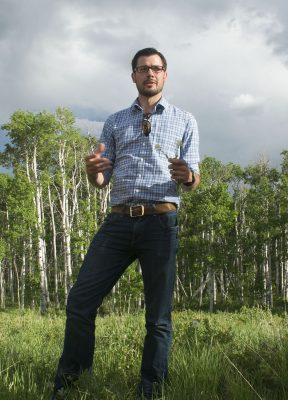
Jay Gatlin, an associate professor of molecular biology, is co-PI for “Understanding How the Tubulin Code Regulates Reproductive Function of Gonadotrope Cells.” Amy Navratil, an associate professor of zoology and physiology, is the PI. The project received $90,000. Gatlin discusses his research on spindle formation during cell division here https://youtu.be/h29QY4jhHHI.
Wei Guo, an assistant professor of animal science, is the PI for “Volumetric Muscle Loss Repair with Muscle Stem Cell-Seeded Synthetic Bioerodable Hydrogels.” John Oakey, an associate professor of chemical engineering, is the co-PI. The project received $90,000.
Ginger Paige, an associate professor of ecosystem science and management, is the PI for “Tracking Eco-Hydrologic Changes in the Hyporheic Zone to Improve Water Resource Management.” Melanie Murphy, an associate professor, and Fabian Nippgen, an assistant professor, both in the Department of Ecosystem Science and Management, and Bret Ewers, a professor of botany, are co-PIs. The grant totaled $88,740.
Dan Tekiela, an assistant professor of plant sciences, will serve as co-PI for “The First Experimental Test of a New Paradigm in Ecological Restoration.” Daniel Laughlin, an associate professor of botany, is the PI. USDA research stations in Cheyenne and Fort Collins, Colo., will serve as project collaborators. The project received $69,232.
Grants take effect July 1 and are either one- or two-year grants.
The goal of the seed grant program is to stimulate new, innovative and cutting-edge research projects in the sciences that have promise for successful, sustained and substantial external competitive funding.
More information is at bit.ly/UWseedgrants.