
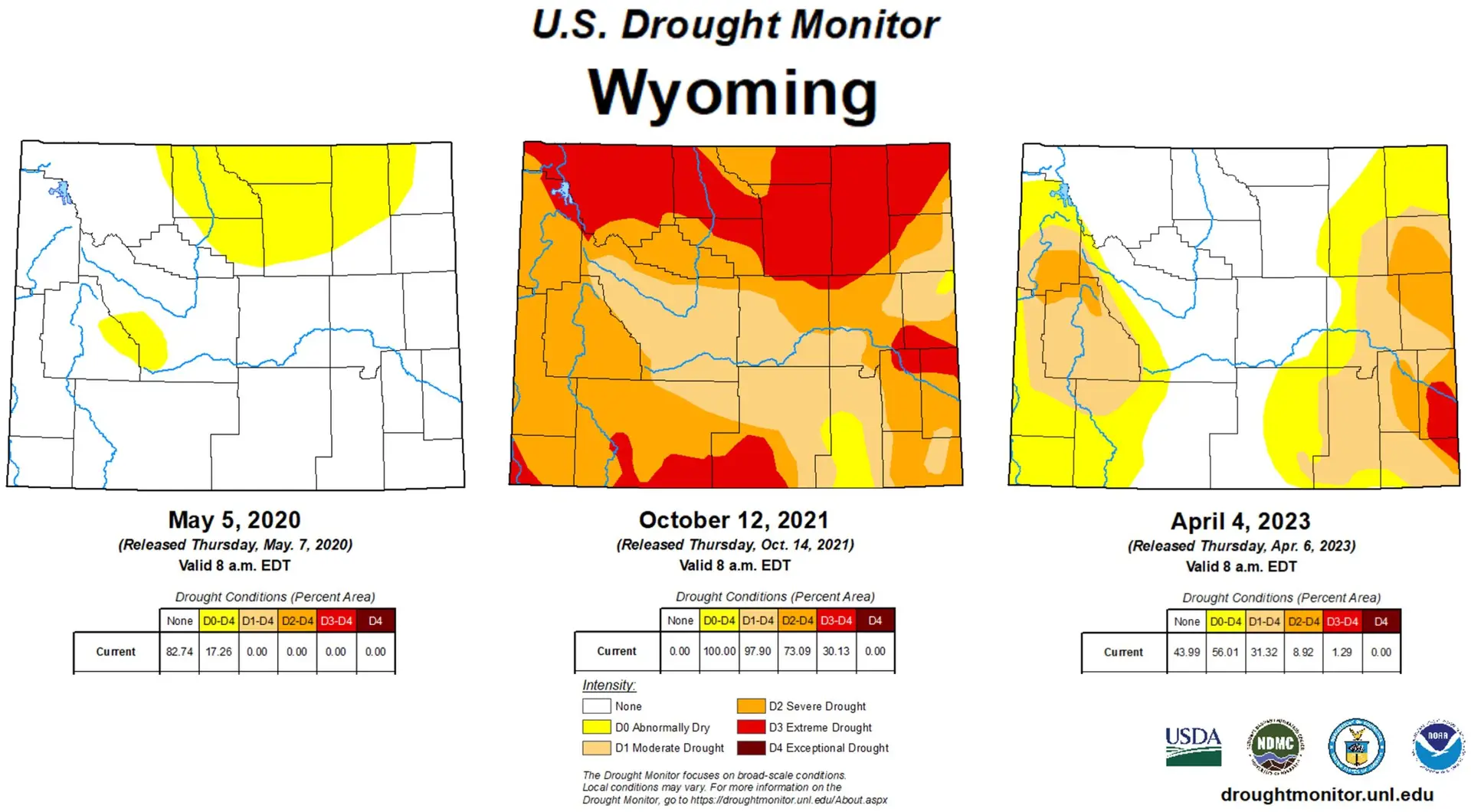
For Wyomingites interested in current and predicted drought status, temperatures and precipitation levels, the Wyoming Conditions and Monitoring Team (WCMT) facilitates monthly webinars open to the public.
Founded in response to an ongoing drought that emerged in 2020, the WCMT brings together state, federal, university, and tribal partners to monitor and report drought-related information to the people of Wyoming and U.S. Drought Monitor.
The WCMT’s monthly webinars address local and statewide precipitation, average temperatures, stream flow, reservoir levels, soil moisture, and more. In addition to reporting current conditions, experts compare data to historical trends and relay predictions for the coming weeks and months.
The webinars also address seasonally relevant topics, such as flooding outlooks, wildland fire potential, and snow water equivalent.
“We start with current conditions to help the audience understand why the U.S. Drought Monitor looks the way it does and then transition into discussing outlooks,” explains Windy Kelley, regional extension program coordinator for USDA Northern Plains Climate Hub and the University of Wyoming Extension weather variability and agricultural resiliency specialist.
The webinar series is organized by UW Extension in collaboration with local, state, regional and federal partners, including the USDA, NOAA, USGS, the Wyoming State Climate Office, the Water Resources Data System and the Wyoming State Engineer’s Office.
Webinars typically occur on the third Thursday of each month from 1-2 p.m. Webinar recordings and downloadable PDFs of the presentations are available at drought.wyo.gov. Recordings can also be found on UW Extension’s YouTube channel.
The next Wyoming Conditions and Outlooks webinar is scheduled for Thursday, April 20, at 1 p.m. To register, visit https://bit.ly/4014att.
To join the monthly WCMT webinar invite list or submit questions, contact Kelley at wkelley1@uwyo.edu.