


A new bulletin from University of Wyoming Extension provides information on how to combat an insect that damages an important forage grass seed crop for Wyoming farmers and ranchers.
Smooth bromegrass was brought to North America from Europe in the late 1800s and has become a key pasture grass in Wyoming and elsewhere, along with being used in vegetation restoration. But the introduction of the nonnative grass also brought with it the brome seed midge, which causes serious damage to smooth bromegrass — sometimes resulting in complete loss of the high-value seed crop.
The new bulletin, https://www.wyoextension.org/publications/Search_Details.php?pubid=2095&pub=B-1380, details the characteristics and life cycle of the midge, explaining how it attacks and damages smooth bromegrass seed production. Most importantly, the bulletin describes ways to manage the pest — through both chemical control and correctly timed burning of smooth bromegrass crop residue in fields.
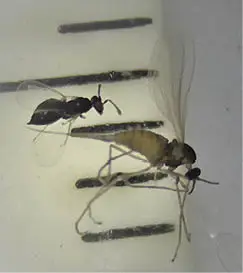
Interestingly, there is a predator, a tiny parasitoid wasp, whose larvae attack the larvae of the brome seed midge. However, those attacks take place after the midge larvae have severely damaged the developing seeds of smooth bromegrass. Despite wasp parasitism rates of up to 75 percent of the midge larvae observed in smooth bromegrass fields, seed production is still reduced to an unprofitable level.
The bulletin was produced by Scott Schell, UW Extension entomology specialist; Jeremiah Vardiman, UW Extension agriculture and horticulture educator; Gary White, retired from Allied Seed LLC; and Mike Moore, manager of UW’s Wyoming Seed Certification Service.