


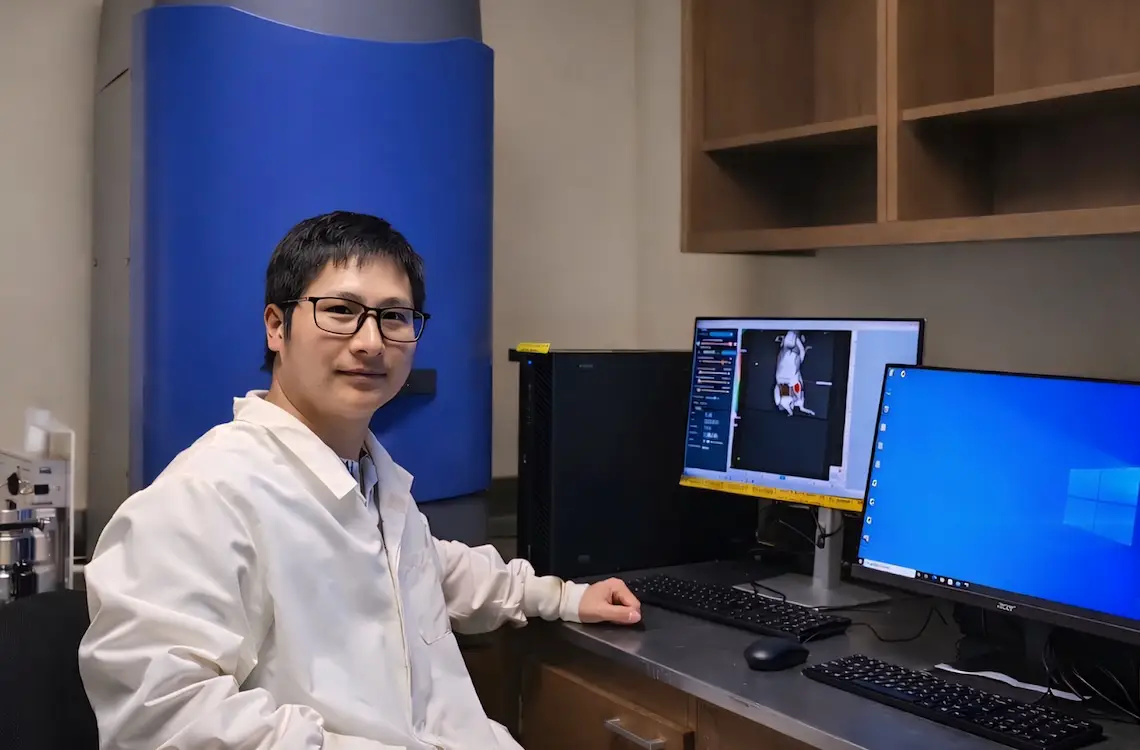
Listeria monocytogenes is best known as a deadly food-borne pathogen that clings to fresh produce and contaminates unpasteurized dairy products, processed meats, and seafood. But, thanks to researchers in the UW Department of Molecular Biology, this illness-causing scourge may become a cancer-fighting superhero.
Harnessing listeria's unique biology
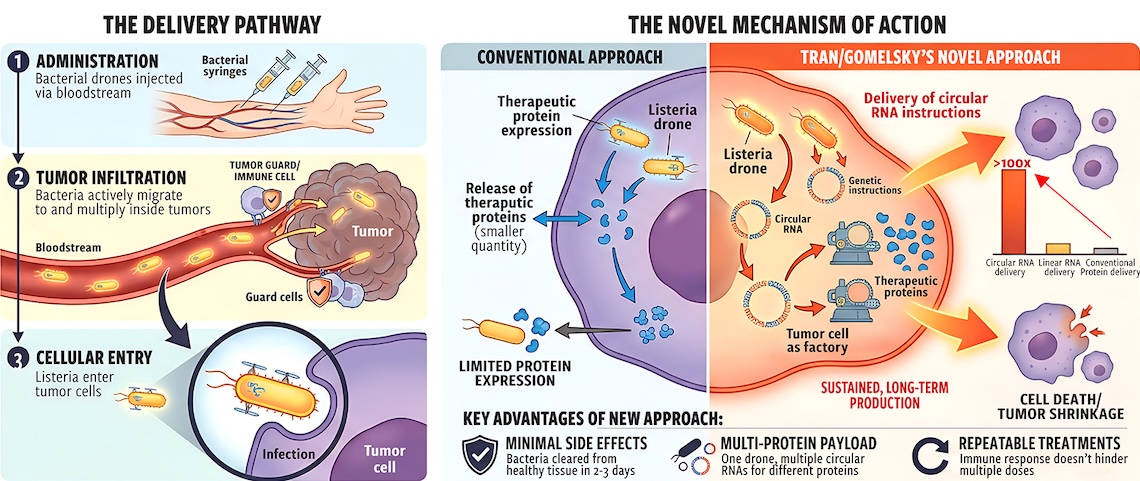
Upon entering the bloodstream, listeria can infect both healthy cells and cancer cells. However, tumors provide a more favorable environment because they suppress immune cells that would ordinarily destroy bacteria. For this reason, listeria thrive in tumor tissues and tend to accumulate there.
Listeria can reach tumors in several ways. While they can travel directly through the bloodstream, more often listeria hitch a ride by infecting specialized cells that act as “guards” of the tumors. These specialized cells then transport listeria into the tumor.This streamlined pathway is unique to listeria, helping them reach tumors more efficiently than other species of bacteria.
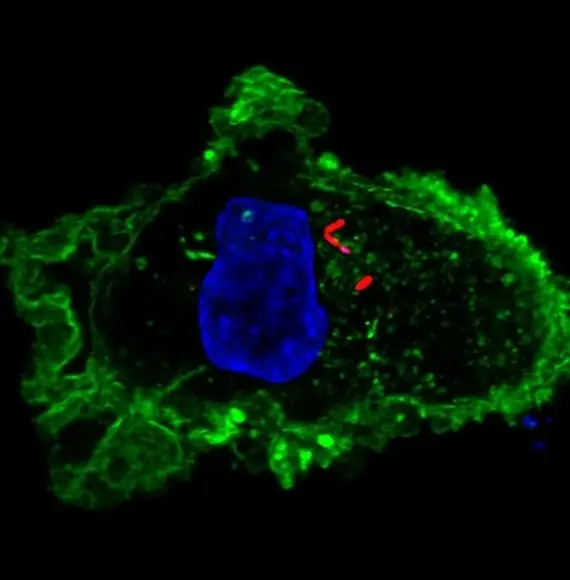
After arriving at their destination, listeria can enter tumor cells and replicate more efficiently in the tumor’s immune-suppressed environment than they would in healthy tissues.
Without the genes that allow listeria to cause severe illness, the bacteria’s growth in healthy tissues and organs is limited. The immune system flushes the unwanted invader out of healthy cells in two to three days, causing minimal side effects.
Microbial drone strikes
Tran’s novel approach to listeria-based therapy relies on a genetically modified bacterial strain that helps transform tumor cells into “factories” that produce anti-cancer agents.
In many ways, his genetically modified listeria can be compared to microscopic drones, Tran explains. The “drones” are remotely controlled by researchers via chemical signal, which helps minimize side effects that could occur if the drones entered healthy cells. This chemical signal also instructs the drones to self-destruct after they have completed their mission.
Conventional listeria-based treatments use the bacteria to deliver anti-cancer agents, but do not enable remote chemical control, Tran notes.
His microbial “drones” also carry an innovative new cargo, carefully designed to boost cancer-fighting capacity.
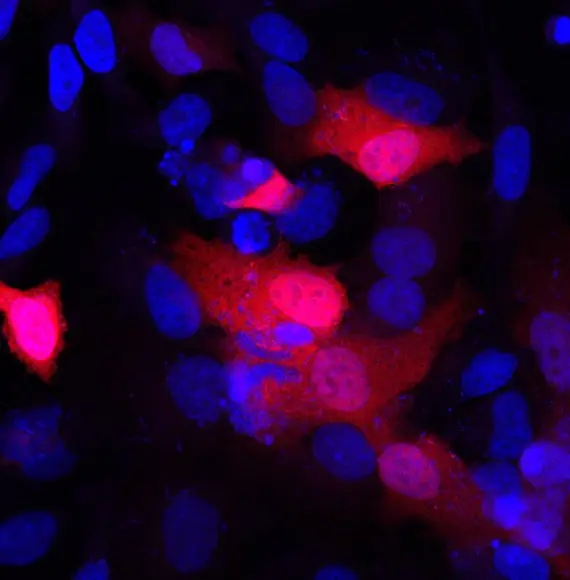
In conventional treatments, the bacteria release a load of therapeutic cancer-fighting proteins inside cancer cells. In contrast, Tran’s drones deliver not the proteins themselves, but the genetic instructions used to produce those proteins. Inside the tumor cells, these instructions direct the cells to produce therapeutic proteins, transforming the tumor cells into “factories” that continuously generate anti-cancer agents.
The genetic instructions for therapeutic protein production are delivered in the form of circular RNA, a special type of RNA shaped like a closed loop. Initially, Tran’s drones used linear RNA molecules, which are similar to those used in COVID-19 mRNA vaccines. The linear RNA approach was more effective than conventional listeria-based treatments, Tran found, but not by much. The linear molecules degraded quickly inside cancer cells, limiting the lifespan of the protein factories.
In comparison, circular RNA proved to be far more stable, allowing it to sustain long-term protein production. Tran’s experiments show that his circular RNA treatment can produce more than 100 times as much therapeutic protein as conventional listeria-based cancer therapies that rely on a protein delivery.
Engineering more effective attacks
In lab tests, Tran has shown that the new approach is effective in 10 different cancer cell types, including cervical cancer cells and breast cancer cells. Now, he’s testing the concept in tumor models in animals.
He’s also investigating whether a single bacterial “drone” can deliver instructions for producing multiple therapeutic proteins at once.
Cancer cells mutate quickly and become resistant to single therapies, so typically patients undergo a combination of different treatments to eliminate tumors. But Tran’s listeria drones may make it possible to deliver multiple anti-cancer agents at once, something that researchers have struggled to implement in other bacteria-based cancer treatments.
Tran hypothesizes that a listeria drone can be programmed to release a single circular RNA payload that produces multiple types of therapeutic proteins. In other words, he could engineer drones that use circular RNA to build several different types of protein factories.
On top of that, thanks to another one of listeria’s unique properties, Tran is hopeful that multiple rounds of drone strikes may be effective.
Many bacteria-based therapies lose effectiveness after just one exposure to the treatment. In response to the initial dose, the immune system produces neutralizing antibodies that decrease the efficacy of subsequent treatments.
But the immune system doesn’t make neutralizing antibodies to fight listeria, which means patients could benefit from multiple rounds of treatment. Rather than dodging antibodies, subsequent fleets of listeria drones should be able to continue infiltrating tumor cells.
A new biotech company
Tran’s innovative approach to cancer therapy may also pave the way to a wide variety of other new medical treatments.
“This innovation not only transforms tumors into self-sabotaging protein factories but also opens doors to gene therapy, vaccines, and regenerative medicine, building on the global success of RNA technologies like the COVID-19 vaccines,” he comments.
In 2025, he and Gomelsky co-founded a biotechnology company they dubbed βDrones, short for bacterial drones. When Tran graduates from UW, he will take the helm as CEO and lead researcher.
While cancer treatment remains the primary focus, Tran looks forward to seeing the many ways that his listeria drones may be harnessed to treat other diseases or create future vaccines.
“It’s not easy and we know there are a lot of challenges ahead, but we believe in our technology,” he says. “We don’t want to stop at the research stage, we want to do more.”
To learn more, contact faculty adviser Mark Gomelsky at gomelsky@uwyo.edu.
This article was originally published in the 2026 issue of Reflections, the annual research magazine published by the UW College of Agriculture, Life Sciences and Natural Resources.