

Insects as a class of organisms are known for having some very unusual lifecycles that differ dramatically from mammals.
The snailcase bagworm (Apterona helix) is a perfect example.
I had the first submission last year of a snailcase bagworm from Wyoming since I started my position in 2003. I had two more submissions of the snailcase bagworms before the year ended. They all came from towns along the I-80 corridor. Not surprising, considering the pests were reported causing damage to alfalfa in Idaho back in 1958. In Utah, they caused damage to multiple species of fruit trees starting in 1961, and by 1996 they were known to be present in all of Colorado’s West Slope counties.
First detected in 1940
These moths are tiny and wingless for the short period they are adults. The subspecies of snailcase bagworm, accidentally brought to North America and first detected in 1940 in California, are all females. They spend their lives in a spiral-shaped case made of their own feces and soil particles glued together with sticky silk. The insects only leave the cases they have made once. After they deposit their eggs in it, the adults crawl out to die. Over 40 eggs can be produced by a single female.
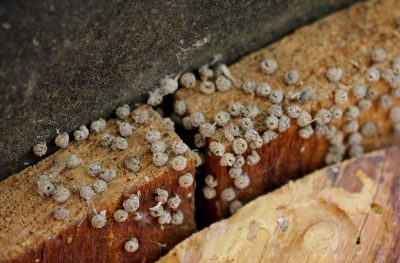
The spiraled cases look like ¼-inch diameter mud balls from a distance. The cases become so securely glued by the insects to the final location chosen before producing eggs that painted surfaces, such house siding, can be damaged in efforts to remove them.
Their migration and case attachment period starts in late June. The eggs will hatch inside the case, but the miniscule larvae won’t leave the protection of the case to start to feed and form their own cases until early the following spring.
Snailcase bagworms will feed on a very wide variety of plants. Individually, they do little damage because they are quite small; however, they can cause economic damage at high population densities on crops and ornamental plants. Certainly nobody I know would be pleased to find these dirt- and feces-encrusted caterpillars stuck to the leaves of their dinner salad.
Difficult to remove from surfaces
The most frequent complaint this insect provokes from the public is when they gather on the sides of buildings in large numbers. It is surprising no one has developed and published a method to easily remove the snailcases once they are permanently attached to a surface.
As usual, an ounce of prevention is worth a pound of cure.
If you find these insects in the active feeding stage on plants near your house, they are susceptible to many conventional and organic insecticides labeled for foliage feeding insects. They belong to insect order Lepidoptera, so they are susceptible to products that contain Bacillus thuringiensis var. kurstaki. Products with this active ingredient are very specific to leaf-feeding caterpillars and harmless to most beneficial insects.
Larval control of the pest will reduce populations that would eventually migrate to your buildings. If you still end up with some of the pests attaching where you can’t tolerate them, you can try to intercept them on their slow journey from their host plants to their final destination on your house’s siding. Use barrier treatments of labeled contact insecticides applied around building foundations.
Scott Schell is the University of Wyoming Extension entomologist and can be reached at (307) 766-2508 or at sschell@uwyo.edu.