

The University of Wyoming’s Institute for Managing Annual Grasses Invading Natural Ecosystems (IMAGINE) has released two short films highlighting cheatgrass management efforts in Carbon and Sublette counties.
These films are the latest installments in an ongoing seven-part series highlighting collaborative efforts to “defend the core” from invasive annual grasses like cheatgrass, medusahead, and ventenata.
Invasive annual grasses are a leading cause of land degradation in the sagebrush biome, suppressing native plant communities, fueling wildfires, and reducing forage availability for livestock and wildlife.
IMAGINE works with local, state, and regional partners to prevent and manage the spread of these plants through scientific research, outreach education, and the development of practical resources for land managers and landowners.
The institute’s new educational film series shares successes, challenges, and insights from regional collaborators involved in invasive grass management. Contributors include university researchers, county weed and pest districts, private landowners, government agencies, and conservation groups.
The first film, “Defend Your Core: An Invasive Annual Grasses Story,” introduces viewers to the urgent and widespread challenges posed by invasive annual grass infestation—then offers solutions, presenting new management and treatment options.
Subsequent films highlight site-specific efforts in Wyoming, Nevada, Colorado, and Idaho, starting in Wyoming’s Carbon and Sublette counties. All episodes can be viewed at www.invasivegrasses.com/films.
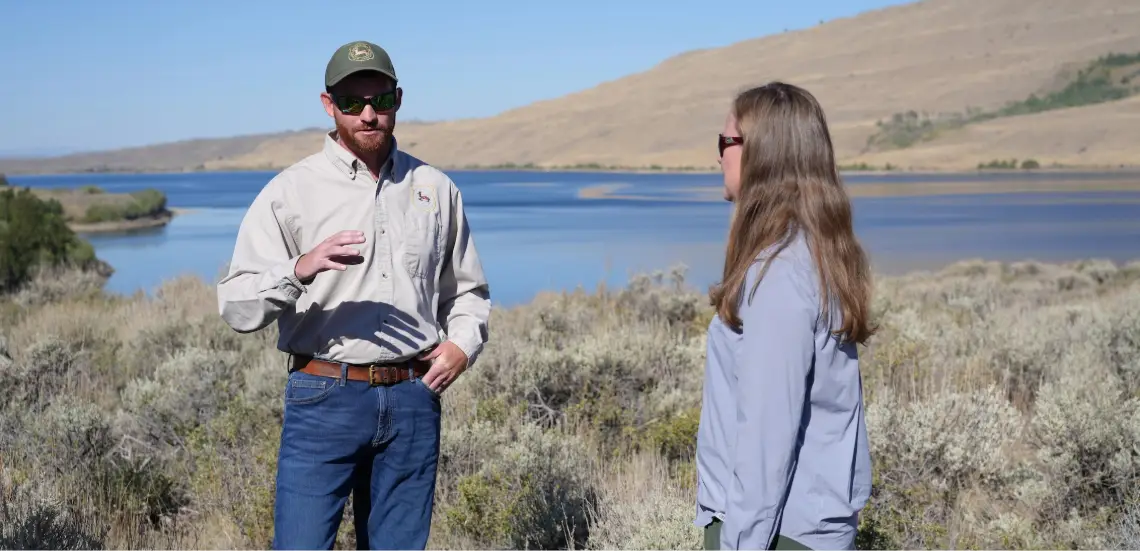
In the second film, “Cheatgrass in Carbon County: Everything to Gain and Everything to Lose,” Reese Irvine, Carbon County Weed & Pest District supervisor, describes monitoring efforts and targeted herbicide treatments he has helped implement. He is joined by colleagues Katie Cheesbrough, executive director of the Wyoming Wild Sheep Foundation, and Chris Otto, fire management specialist with the Bureau of Land Management.
“We are losing more acres of sagebrush to cheatgrass every year than to any other cause,” Irvine says. “Wyoming is in a unique spot where we have everything to gain and also everything to lose if we do nothing.”
Like Irvine, Sublette County Weed & Pest Supervisor Julie Kraft has helped lead ongoing invasive grass management efforts in her county. IMAGINE’s third film, “Cheatgrass Control in Sublette County: Safeguarding Our Lands for the Future,” chronicles those efforts.
Fifteen years of monitoring data offers promising evidence for the efficacy of long-term collaborative approaches that “work across fences,” bringing together ranchers, scientists, oil and gas companies, government agencies, and non-governmental organizations.
“You’ve got to start someplace,” Kraft notes in the film. “The results we’ve seen and the difference we’ve made on the habitat has been very rewarding.”
Funding partners for the Sublette and Carbon County films include the Bureau of Land Management, U.S. Fish and Wildlife Service, Intermountain West Joint Venture (IWJV), National Park Service, Natural Resources Conservation Service’s Working Lands for Wildlife (WLFW), and the Watt Foundation.
Collaborators include the Carbon County Weed & Pest District, Sublette County Weed & Pest District, Wyoming Game and Fish Department, and Wyoming Wild Sheep Foundation.
Films featuring invasive annual grass management efforts in Elko, Nevada; Gunnison, Colorado; and Craters of the Moon National Monument and Preserve in Idaho will be released later this year.
To learn more about IMAGINE and view the latest episodes of the film series, visit www.invasivegrasses.com.