


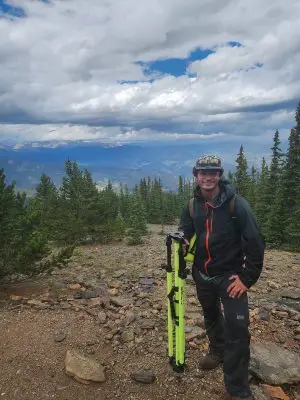
A University of Wyoming master’s student studying botany, Tanner Gordon of Des Moines, Iowa, earned a first-place recognition for his poster focused on work done by him and his adviser in Colorado’s Front Range.
Gordon’s entry into the fire congress student poster contest was selected from over 100 at the Association for Fire Ecology’s 11th annual International Fire Ecology and Management Congress in New Orleans Dec. 2-8. Nearly 700 participants were in attendance.
Gordon’s poster, “A LiDAR-based inventory of forest fuels and structure on the Colorado Front Range Priority Landscape,” focused on his work leveraging LiDAR remote sensing data and forest field plot measurements to develop wall-to-wall maps of forest structure and fuels across Colorado’s Front Range.
Gordon and his primary adviser, Paige Copenhaver-Parry, ecology program manager for the Wyoming Natural Diversity Database at UW, inventoried the forest conditions of 450 field plots on the Colorado Front Range. Gordon and Copenhaver-Parry worked closely with the USDA Forest Service Rocky Mountain Region under the USDA Wildfire Crisis Strategy; the area they inventoried is a priority landscape for wildfire crisis strategy. They also modeled and mapped critical forest substructure metrics—canopy fuels, biomass, and stand age at a 20-meter spatial resolution—across the study area.
The maps created by Gordon and Copenhaver-Parry will be used by forest managers to plan and prioritize fuel reduction treatments intended to minimize wildfire risk to communities along the front range.