

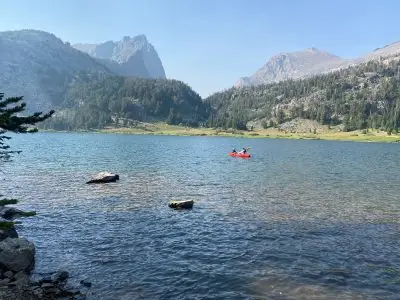
University of Wyoming research regarding the impact of trout introductions in the high-elevation lakes of Wyoming’s Wind River Range is continuing with the support of the National Science Foundation (NSF).
Amy Krist, an associate professor in UW’s Department of Zoology and Physiology and Program in Ecology and Evolution, recently received a $307,731 NSF grant for a three-year project to examine how evolutionary change of zooplankton driven by trout introductions affects ecosystem function of the lakes.
Previous UW research found that the introduction of fish in the lakes of the Wind Rivers starting in the early 1900s has driven a decrease in the size of zooplankton, the small aquatic organisms on which the trout feed. UW researchers also have found that the fish themselves have adapted to their environment by growing higher numbers of gill rakers, which are bony or cartilage structures in the gullets of fish that act as sieves to retain zooplankton and nourish the trout.
Krist’s new project aims to dive into the evolutionary changes in zooplankton in more depth and detail.
“Although some of the ecological consequences of introducing trout into alpine lakes are diverse and well studied, we have much to learn about the ecological consequences of trout-driven evolutionary change,” Krist says. “A deeper understanding can help us determine the potential for further ecological changes.”
The lakes of the Wind Rivers historically didn’t contain fish, but trout stocking that began in the early 1900s has created an environment in which hundreds of those lakes now have strong fish populations — some carried on by natural reproduction for decades. This environment has provided a laboratory for researchers to study the ecosystem changes in the once-fishless alpine lakes, to which anglers today make long hikes to pursue cutthroat trout and relatively rare golden trout.
Krist intends to contrast the effects of zooplankton from lakes where they are adapted to trout to zooplankton from fishless lakes, where they are not adapted, to understand the effects of each type of zooplankton on lake productivity. Krist also will analyze zooplankton and algae in UW core facilities for carbon, nitrogen, phosphorous, and other biologically essential elements. These experiments and analyses are expected to provide insights into the differences in evolutionary dynamics of zooplankton in the two types of lakes.
“These results should demonstrate how trout introduction alters natural selection of other organisms, which can drive additional environmental change in the ecosystem,” Krist says.
This story was originally published on UW News.