


If you’ve ever stayed home sick, you’ve probably experienced the unpleasant temperature swings that accompany a fever. You may remember feeling chilled, then warming up as your fever spiked—a well-established process governed by the autonomic nervous system.
But maybe you also wrapped up in a blanket to keep warm. The science behind this kind of behavioral response is less well understood.
“Although it seems like the same thing, there are two different brain regions involved,” says Baizar Alamiri, a PhD student in the UW Department of Zoology and Physiology. “While we understand much about the body’s automatic responses, a major scientific gap is understanding how the brain influences behaviors that manage body temperature.”
Huddling mice
Thermoregulation, the ability to maintain a stable body temperature, allows humans and animals to adapt to changing environmental conditions.
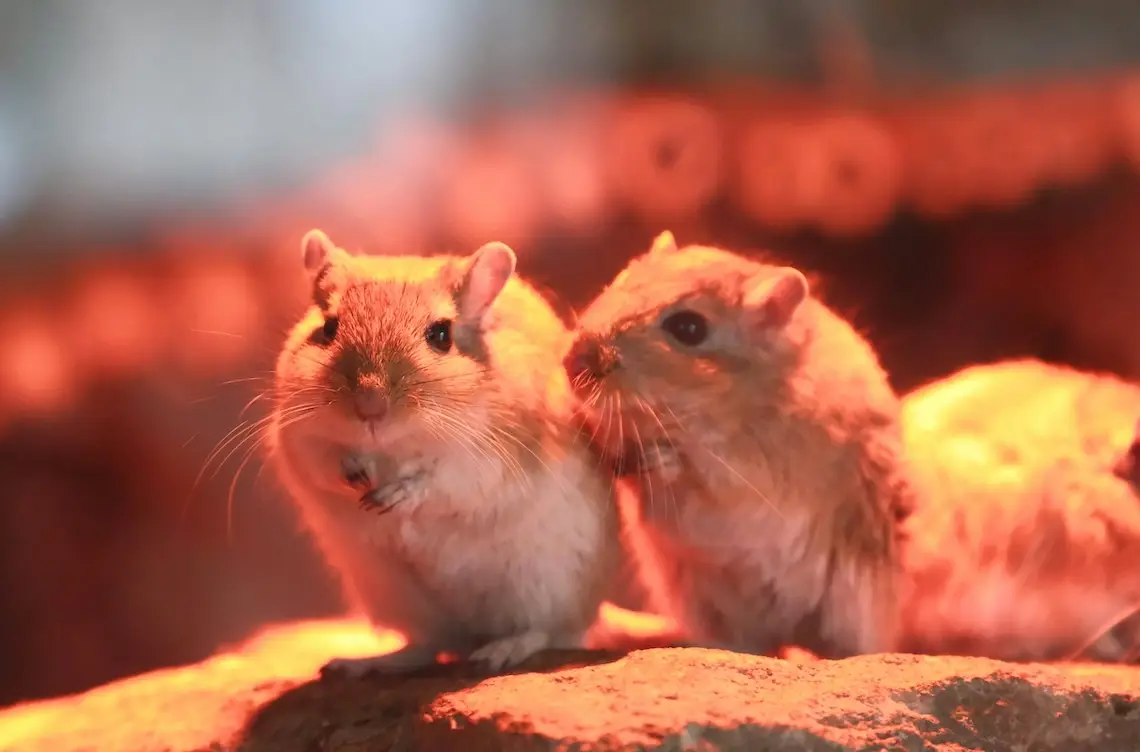
To better understand the behavioral component of this process, Alamiri conducted several experiments observing “huddling” in groups of mice. Huddling, in which mice snuggle together before and after sleep, is considered a social behavior, but may also play a role in thermoregulation.
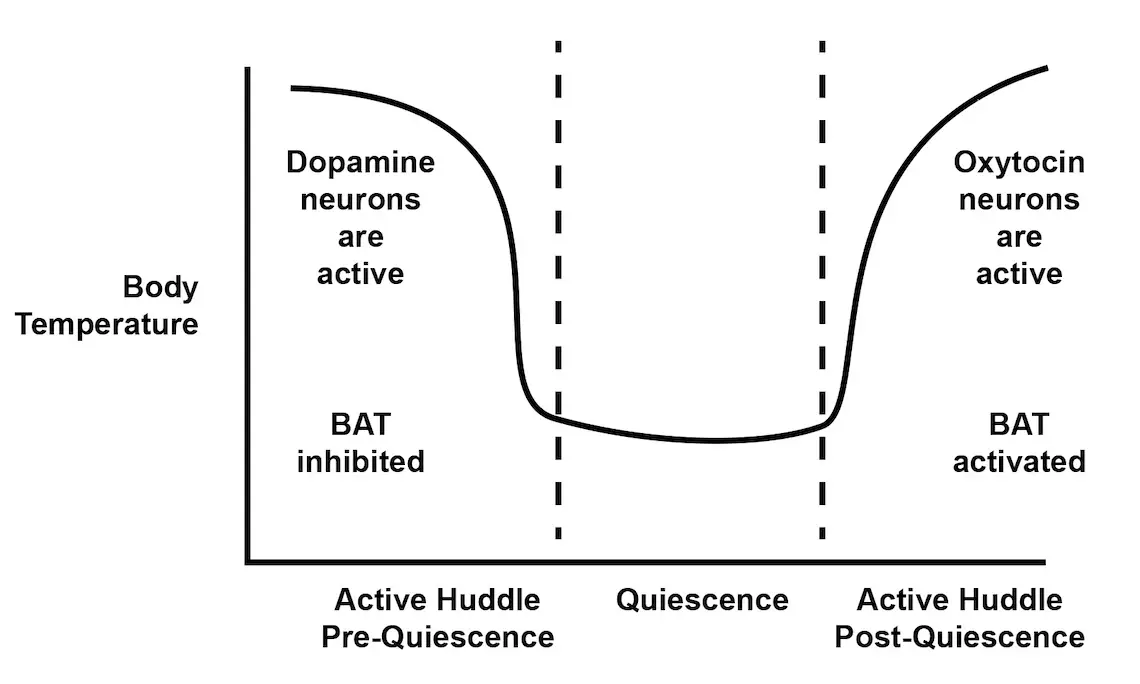
Jason Landen, another PhD student in the Department of Zoology and Physiology, had discovered an unexpected relationship between huddling and body temperature. He found that as mice snuggled together before sleep, their body temperature decreased. During periods of quiescence (sleep), their body temperature remained constant. As they woke up and began actively huddling again, their body temperatures rose.
Alamiri, who began her PhD program in 2023, was curious about the neural circuitry underlying these temperature changes. With a background in astrophysics, mathematics, and biomedical engineering, she brought a unique perspective to the puzzle.
Promising neural pathways
As Alamiri combed the scientific literature, two research papers on thermoregulation in rats caught her attention. The first study found that as body temperature increased, the neurotransmitter oxytocin sent signals from the hypothalamus to a specific area of the brainstem. The second study observed the neurotransmitter dopamine sending signals from the hypothalamus to the same region of the brainstem as body temperature decreased.
While the signals came from different areas of the hypothalamus, they both ultimately activated an area of the brainstem responsible for regulating heat production in brown adipose tissue (BAT). This fatty tissue, located in the upper back and other parts of the body, activates in cold environments to help maintain warmth.
The rat studies suggested that oxytocin raised body temperature by activating BAT, while dopamine lowered body temperature by inhibiting heat production in BAT.
Oxytocin and dopamine are most often studied in the context of social bonding and motivation respectively. But, given their connection to thermoregulation, Alamiri wondered what role they might play in behavioral responses to temperature change—such as huddling.
The brain, body, and social behavior
In a series of preliminary experiments, Alamiri showed that both oxytocin and dopamine interact with neurons responsible for thermoregulation in mice. She exposed mice to hotter and cooler environments, then analyzed their response using genetic, molecular, surgical, and brain imaging techniques.
Alamiri’s results were consistent with the research papers she’d read about thermoregulation in rats. Her data seemed to indicate that dopamine-related activity in the brainstem increased in warm conditions to prevent overheating and oxytocin-related activity increased during cold exposure to help maintain warmth.
Next, Alamiri set out to determine how these neural pathways might be connected to the huddling behaviors Landen had shown were correlated to temperature shifts. Specifically, she wanted to see if dopamine activity increased as the mice’s body temperature dropped during pre-quiescent huddling and if oxytocin activity increased during post-quiescent huddling.
As Alamiri suspected, the changes in temperature and neurotransmitter activity appeared to occur in tandem with changes in group behavior. When mice huddled together before sleep, dopamine pathways were activated; when the mice huddled together after sleep, oxytocin pathways were activated.
Alamiri’s results didn’t explain why the mice’s body temperatures dropped while huddling before sleep and rose while huddling after sleep. But her research provides a foundation for future studies examining the brain’s role in thermoregulatory behavior.
“This connection between brain chemistry and social behaviors shows how temperature control is more than a simple physical response,” Alamiri notes. “It is a complex process that integrates sensory information, brain activity, and social interaction.”
Applications to human health
That’s probably true for both mice and humans. “A lot of what’s been discovered in mice and rats is similar to what’s in human bodies, especially with hormones and the brain,” Alamiri comments. “Understanding these systems could have broader applications, such as managing temperature control in certain metabolic disorders.”
A wide variety of health conditions in humans, from diabetes to autism, are associated with imbalances in body temperature. “If we can get an idea of the correlation between brain and behavior—if we understand that very well like we do with automatic routes in the brain…then it could give us a route for some therapeutics to help find treatments for these patients,” Alamiri concludes.
This research was conducted in Adam Nelson’s lab. For inquiries about Alamiri’s work, contact her current faculty advisor, Brandon Roberts, at brandon.roberts@uwyo.edu.
This article was originally published in the 2025 issue of Reflections, the annual research magazine published by the UW College of Agriculture, Life Sciences and Natural Resources.