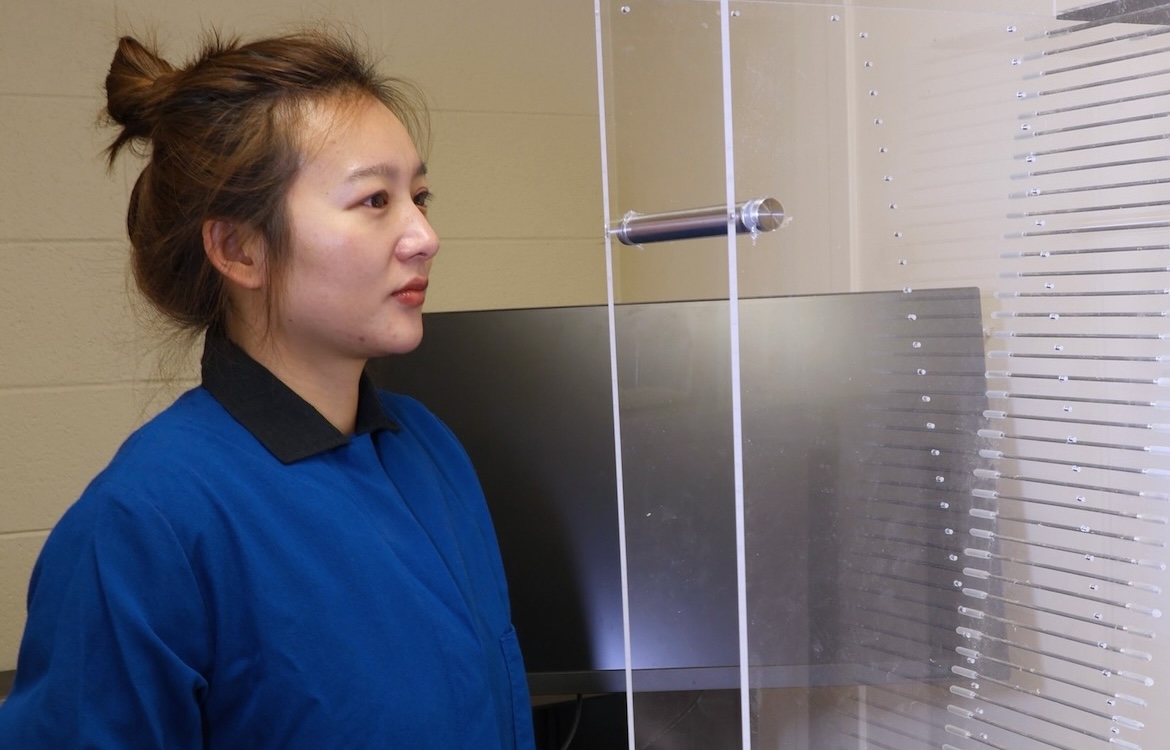


Have you ever wondered how a package of deli meat was made? In McKensie Phillips’s meat processing class, students learn what ingredients make up your favorite processed meats and how they’re cooked. Students even have the opportunity to make their own meat products.
“The meat processing class is one that gets students out of the traditional lecture classroom, allowing them to explore, create, and refine their skills as they attempt to make an outstanding meat product,” says Phillips, associate lecturer in the Department of Animal Science. “It asks students to blend science, creativity, and critical thinking together.”
Undergraduates Haley Rutsch, Sophie Fuhrmann, and Cheyenne Schisler were students in the most recent session of the meat processing class.
Ingredients for success
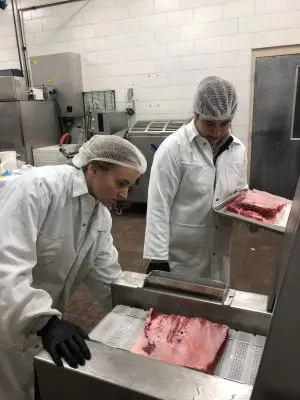
During the class, students learn about the foundations of meat processing, including food safety, meat curing, and thermal processing.
The meat processing class gives students tools to make informed choices about what they are eating. Phillips teaches students about specific ingredients and how each ingredient impacts the final product. Beyond meat, many other food items use similar ingredients, making this information broadly useful.
Rutsch comments, “McKensie’s just really good at getting you to use your own brain. It really makes you think about everything. I think it’s a great class to teach you about not just processing meats, but the meat industry in general.”
Phillips also examines common misconceptions and dives into the science behind popular beliefs about processed foods. For example, many people think that hot dogs are made of low-quality meat, but this isn’t true. Hot dogs use small trimmings from the same cuts you might use for a roast or a pork chop.
“I think if the general public was a lot more informed as to how food science works, the world would be a better place,” says Fuhrmann. “I really love being able to help with that and just making people realize, ‘Hey, this isn’t nearly as bad as you think it is.’”
Trust the process(ing)
The UW Meat Lab is a teaching, research, and extension facility designed to enable students, instructors, and researchers to practice meat sciences, from harvesting an animal to making a slice of bacon. Several classes on campus use the meat lab for hands-on animal science education.
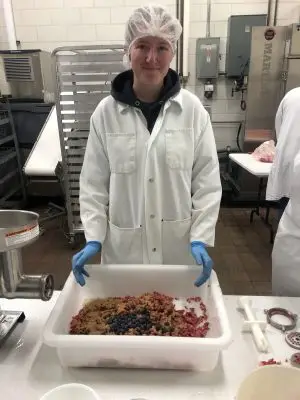
Schisler currently works as the meat lab manager at UW. Rutsch and Fuhrmann also worked in the meat lab as student employees before their graduation from UW.
Throughout the class, students developed new processed meat products in the lab. They also taste-tested the recipes created by their fellow students.
Fuhrmann and Rutsch worked together for this capstone project. Initially, they wanted to make a maple blueberry lamb bratwurst. For their first attempt, they mixed whole blueberries, maple extract, spices, and lamb meat into the grinder—creating an over-seasoned, bright-blue sausage that Schisler described as “appalling.”
After two more iterations, though, Fuhrmann and Rutsch’s product became Schisler’s favorite. They added real maple syrup and used a blueberry compote rather than fresh blueberries, creating a tasty breakfast sausage.
“I think that’s one of the glories of the class. You get a perspective that you really couldn’t get without actually eating [these products],” reflects Fuhrmann. “I think for me, the biggest thing I learned was the process and the work that goes into developing a recipe and the amount of science behind it. It’s got to be down to the most miniscule thing to get everything to taste right. And if you’re off by even a gram, then the whole thing can be completely off.”
Another group of students worked on a rosemary bacon product. Schisler challenged herself with a salami. Each of the projects required more than one try, but at the end of the day, all the students found a way to get the balance right. They ended up creating unique new products that tasted as good as—or better than—processed meat for sale at the grocery store.
Educational trajectories
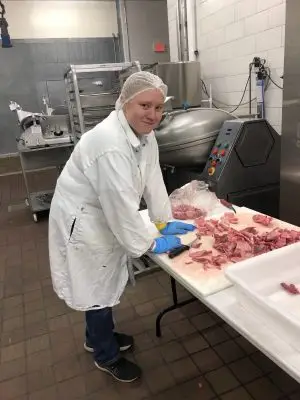
Rutsch didn’t intend to earn a meat science degree when she entered UW. Another class taught by Phillips inspired her to add a second concentration within her animal science major. “It’s definitely going to be a big part of my future plans,” she says. “I still want to run a ranch, but I also want to do stuff with meat.”
As an incoming UW student, Schisler already knew she wanted to open multiple butcher shops across Wyoming, but the meat processing class impacted how she plans to run her future businesses. She explains that processing meat can add value to small cuts of meat that you might not otherwise be able to use. “I wouldn’t say [the class] changed my trajectory, but it definitely gave me a higher respect for value-added products in general,” she says.
Fuhrmann entered the class with experience in the raw side of meat processing—harvesting animals and creating different cuts of meat, rather than transforming that meat into processed products. “I think if I ever get to that point in my life where I decide to open my own shop, this class will play a huge role in what I know and being able to take that into my own business and being able to grow from there.”
Meanwhile, Phillips will keep inspiring new animal science students—and keep working on her quest to make the perfect hot dog.
For more information, contact Phillips at McKensie.Phillips@uwyo.edu or (307) 766-2334.