
Astrid Vargas, a University of Wyoming alumna and conservation biologist, will host a public talk, reception, and book signing for her recently published book “On a Butterfly’s Wing: Lessons from Nature on Embracing Change” Tuesday, June 10.
The talk is scheduled at 5 p.m. in Room 310 of the Classroom Building, followed by a reception and book signing in Room 217 (Ninth Street lobby) of the Classroom Building. Co-sponsored by the UW Department of Zoology and Physiology, Wyoming INBRE (IDeA Networks for Biomedical Research Excellence), Berry Biodiversity Conservation Center, University Store, and UW Libraries, this event is free and open to the public.
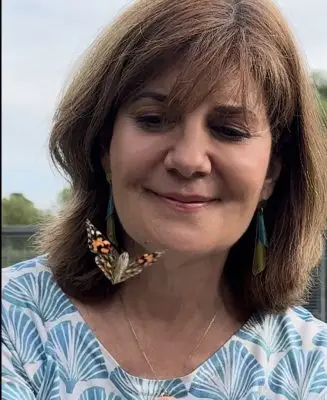
Additionally, UW students can attend a brown bag lunch earlier in the day to hear Vargas from noon-1 p.m. in the Science Initiative Sandbox, located in Room 4003 of the Science Initiative Building. Vargas will discuss her career path in conservation biology and the research and community collaboration in which she is involved. A lunch will be provided.
Described as an autobiography narrated by a butterfly, the book fuses science, art, philosophy, and conservation. “On a Butterfly’s Wing” follows the parallel lives of a flightless butterfly named La Reme from egg to death and beyond, and a beloved mother named Amatxi who is facing her own death.
A portion of the book’s synopsis reads: “’On a Butterfly’s Wing’ is a celebration of life and a tribute to our own constant process of transformation. It also is a call for action for the protection of butterflies, offering positive suggestions on how we can team up with pollinators to help each other create a better world for both.”
Vargas received he Ph.D. in zoology and physiology from UW in 1994 with her dissertation focused on preparing captive-bred black-footed ferrets for release into the wild. This work led her to direct the U.S. Fish and Wildlife Service’s National Black-Footed Ferret Conservation Center and coordinate the national ex-situ conservation program until 1998.
Since then, she has been a key figure in the recovery of three of the world’s most endangered species: the Iberian lynx in Spain; the black-footed ferret in North America; and the golden-crowned sifaka in Madagascar.
Vargas believes art and inspiration are powerful tools for social and environmental change. She is the founder of Inspiration 4 Action, an initiative that combines science and storytelling to engage communities to bring collective creativity into ecosystem restoration.
Coe Library will place two signed copies of her book in its collection, including a copy in UW Special Collections, says Annie Bergman, student research program director for INBRE who is coordinating the Vargas events on campus.
For more information about the book, go to https://www.onabutterflyswing.com. For a trailer about the book, view it at https://www.onabutterflyswing.com. Vargas donates all of her author royalties to butterfly conservation efforts in Europe.
For more information, email Bergman at abergman@uwyo.edu.
This story was originally published on UW News.