

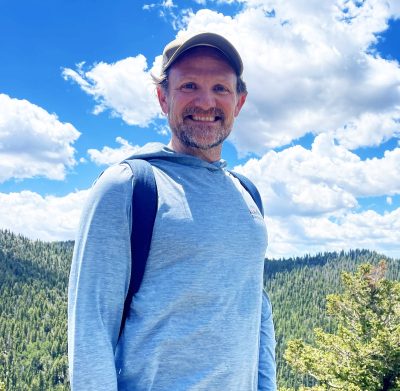
Daniel Laughlin, a University of Wyoming professor in the Department of Botany, has been selected as a Fellow of the Ecological Society of America (ESA).
The ESA is a nonprofit, nonpartisan organization of professional ecologists. Fellows are members who have made outstanding contributions to a wide range of fields served by ESA, including, but not restricted to, those that advance or apply ecological knowledge in academics, government, nonprofit organizations, and the broader society. Fellows are elected for life.
ESA established its Fellows program in 2012 with the goal of honoring its members and supporting their competitiveness and advancement to leadership positions in the society, at their institutions and in broader society. Laughlin was nominated for this award by a group of collaborators and colleagues from across the United States.
“Being elected an ESA Fellow is both a surprise and an honor. On a personal level, it affirms the persistent passion that I pour into my research every day — plants are a constant source of inspiration and remain deeply mysterious organisms,” Laughlin says. “This award also amplifies the gratitude I have for my wife, Kara, who I share this bright life with, and for my mother and father who have supported me unconditionally for nearly five decades.
“Professionally, it reminds me that I could not have achieved this without the support of my academic mentors, some of whom have recently passed away,” he continues. “I’m so grateful for my colleagues who make this work super fun, and I look forward every morning to keep pursuing the truth about plants with so many other remarkable ecologists. This recognition also is a helpful reminder during a dark era for scientists how important science is to society.”
Laughlin is a plant ecologist whose research links information about plant physiology and population models to improve our understanding of plant biology and enhance restoration of plant communities, according to an ESA press release.
The Laughlin Research Lab develops quantitative approaches to understand and predict how plant species and communities respond to global change. The lab develops trait-based models that translate ecological processes into statistical frameworks to predict how communities assemble along environmental gradients and how species interact at local scales. The goal for these models is not only to gain a deeper understanding of basic ecological processes, but also to inform the restoration of degraded ecosystems.
For more information about Laughlin’s research and his lab, go to www.plant-traits.net.
In addition to writing journal publications, Laughlin is the author and co-author of two textbooks on plant strategies and community ecology.
He received his Ph.D. in forest science at Northern Arizona University, his master’s degree in ecology from Penn State University and his bachelor’s degree in biology from Calvin College.
“It’s an honor to recognize this year’s Fellows and Early Career Fellows of ESA,” says ESA President Stephanie Hampton. “These individuals exemplify excellence in ecological science through their research, mentorship, and service. Their leadership in advancing both knowledge and application of ecology strengthens our field and supports communities and ecosystems around the world. We applaud this cohort’s accomplishments and look forward to the continued impact of their work.”
Laughlin and seven other Fellows, and also 10 Early Career Fellows, will be formally recognized during an awards ceremony at ESA’s annual meeting Aug. 10-15 in Baltimore, Md.
About the Ecological Society of America
The ESA, founded in 1915, is the world’s largest community of professional ecologists and a trusted source of ecological knowledge committed to advancing the understanding of life on Earth. The 8,000-member society publishes six journals and a membership bulletin, and broadly shares ecological information through policy, media outreach and education initiatives. The ESA’s annual meeting attracts 4,000 attendees and features the most recent advances in ecological science.
For more information, go to www.esa.org.
This story was originally published on UW News.