

For years, Ramesh Sivanpillai has been called upon to handle remote sensing analysis after major disasters that include fires, floods, and hurricanes. The University of Wyoming faculty member was recognized for his longtime work, which includes teaching and mentoring 200-plus students in remote sensing applications, when he recently received a Lifetime Achievement Award from AmericaView.
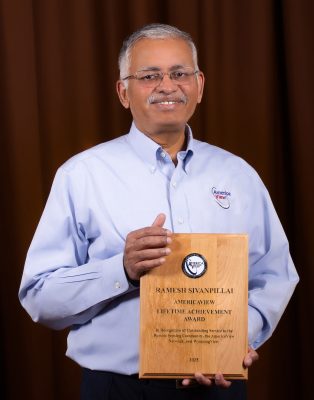
Sivanpillai, an instructional professor with UW’s School of Computing/Wyoming Geographic Information Science Center (WYGISC), received the honor during AmericaView’s annual meeting in Madison, Wis., April 15.
“It was a humbling experience to hear my name and receive the plaque in front of the remote sensing experts. I’m grateful and happy that all of the efforts I put in over these years — 1992-2025 — were recognized at the national level,” says Sivanpillai, who also is an adjunct in the UW Department of Botany and the Department of Ecosystem Science and Management. “When I attended the first AmericaView annual meeting in 2004, I never imagined that one day I would be receiving this award.”
AmericaView is a national program aimed at promoting remote sensing science and applications through educational outreach (grades K-16), applied research, workforce training, and technology transfer. AmericaView is organized by states, called state views, of which there are currently 42. Each is led by an academic institution from that state.
In December 2002, Sivanpillai was hired to head the WyomingView program at UW. Since that time, he has reached out to more than 4,000 K-8 students in Wyoming schools to introduce and promote remote sensing science and applications.
“Though I had 10 years of experience with remote sensing science and applications, problems and issues in Wyoming were so different from what I already knew,” Sivanpillai recalls. “I spent considerable amounts of time to establish new connections by visiting numerous federal, state, local, and tribal government offices; and farmers, ranchers, and K-12 teachers in the state. I conducted several workshops to train current and future workforce members in Wyoming.”
Through WyomingView, he has trained 114 interns and more than 250 college students on remote sensing applications, ranging from crop growth monitoring and water body mapping to disaster response.
Sivanpillai served on the AmericaView Board of Directors from 2004-2014. His time on the board included four years as its secretary, two as vice chair, and one year as the chair.
Sivanpillai says much of his recognition for this award came from his remote sensing and analysis work with the International Charter Space and Major Disasters Team. This includes:
- In December 2024, he received the call to help with mapping damaged homes, buildings, and other infrastructure in Florida caused by Hurricane Milton.
- In September 2022, Sivanpillai was named the project manager for hurricane response efforts after Hurricane Fiona rocked the Dominican Republic with heavy rains and extreme flooding.
- In 2018, he was called upon by the charter to serve as a project manager for the Camp Fire that engulfed the town of Paradise, a community located in northern California.
- In 2011, Sivanpillai was tapped by the charter to assist with major flooding along the Mississippi River that started in Illinois, an event that lasted roughly five months. Two years before that, Sivanpillai was selected by the U.S. Geological Survey for project manager training in Denver. While a student at Texas A&M University in 1999, he volunteered to help with relief efforts in Nicaragua.
“I have to thank my past and present students; the LAMP (Learning Actively Mentor Program) and Ellbogen Center for Teaching and Learning programs at UW for their mentoring on teaching and learning; teachers who invited me to their classrooms; personnel in government agencies and private companies who helped with organizing workshops; the American Society for Photogrammetry and Remote Sensing, my professional organization; and my family for their invaluable support,” Sivanpillai says. “Without them, I would not be where I am now, both personally and professionally.”
This story was originally published on UW News.