



UW Extension Welcomes Hannah Rodgers as New Research Scientist

The University of Wyoming Extension welcomes Hannah Rodgers as a research scientist in the Department of Agricultural and Applied Economics.
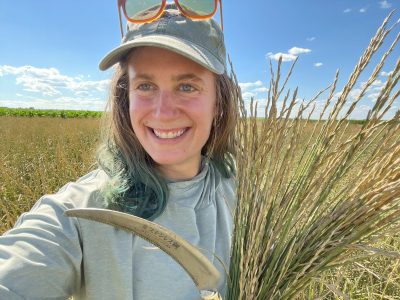
A woman wearing a baseball cap and holding a scythe and a bundle of wheat-like plants.
Hannah Rodgers.

As a research scientist, Rodgers will help producers navigate Wyoming’s harsh environmental conditions and access tools and resources to understand weather and climate-related issues. Rodgers will research drought-adaptation strategies for Wyoming and create educational materials on these practices.

Rodgers will also work with technical service providers (TSPs) that regularly assist Wyoming producers with extreme weather. These TSPs include staff from state and federal land management agencies, conservation districts, and the Farm Services Agency.

“I’m excited about the opportunity to work directly with Wyoming technical service providers and farmers on strategies to adapt to drought and other forms of extreme weather,” says Rodgers.

Rodgers graduated from UW in 2024 with a doctorate in soil sciences. After her graduation, Rodgers worked at the U.S. Department of Agriculture (USDA) Northern Plains Climate Hub, where she helped farmers across the Northern Plains region create economically secure, resilient agricultural systems. Rodgers looks forward to translating her experience with the Northern Plains Climate Hub to Wyoming producers.

Rodgers’ position is funded by a USDA National Institute of Food and Agriculture grant.

Rodgers started her new role with UW Extension on Tuesday, April 1. She can be reached at Hrodger3@uwyo.edu.

Share the Post:

Related Posts

Two deer in a sagebrush steppe landscape overlooking some houses.

New Research Shows How Much Space Between Houses Keeps Big Game Moving

Housing development is expanding, pushing homes into wild landscapes at an unprecedented pace.
Yet, as residential development moves into previously undeveloped areas, those same species face more than the direct loss of land under a building’s footprint—they also can lose access to the habitat surrounding those homes, multiplying the effective impact of each new structure. Without clear guidance on how much open space must be maintained between homes to conserve habitat for wildlife, new housing developments risk shrinking available habitat and fragmenting the movement pathways animals depend on to move between seasonal ranges.

Read More
Scott Shaw holds up a plastic bottle.

Shaw Receives UW’s George Duke Humphrey Award

When it comes to University of Wyoming faculty recognition, it’s hard to beat the past two years for Department of Ecosystem Science and Management Professor Scott Shaw.
After receiving the 2025 John P. Ellbogen Lifetime Teaching Award that recognizes the long, distinguished, and exemplary career of one senior faculty member who has excelled as a teacher at UW, Shaw has been selected as the recipient of the 2026 George Duke Humphrey Distinguished Faculty Award, the university’s top faculty honor.

Read More

Help us improve this website!

We’re working to make AgNews easier to use and more useful for you. This quick survey takes about 1–2 minutes.