

If Wyoming residents spent just 5% of their grocery budget on local foods, local food production could contribute an additional $36.3 million to the state’s GDP, according to a new study published by the University of Wyoming Extension.
Currently, the local food sector contributes $24.4 million to Wyoming’s GDP and generates $44.7 million in output each year—and those numbers are growing. That’s good news for both Wyoming producers and consumers, the UW study suggests.
Local food systems are key to maintaining a reliable—and resilient—supply chain, says Anders Van Sandt, assistant professor of regional economics and author of the new publication.
“As the United States’ food system continues to become more concentrated, comprising fewer yet larger producers, processors, and distributors, it has become brittle and susceptible to supply chain failures,” he states in the report. “A more resilient food system is one in which the large-scale global and U.S. food systems are not replaced, but instead overlaid with a web of smaller-scale regional and local food systems.”
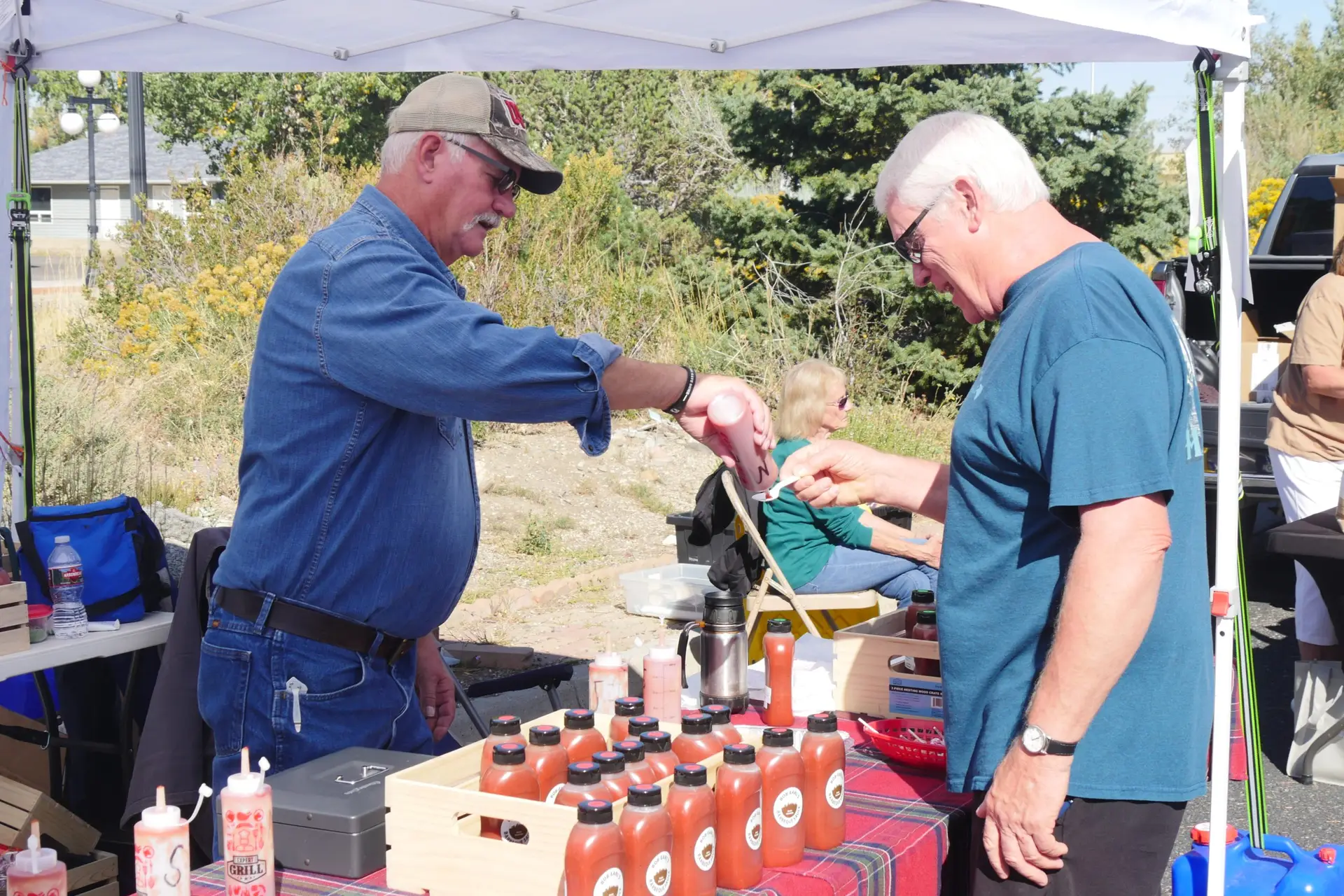
In Wyoming, expansion of local food systems has occurred through both direct-to-consumer and direct-to-retailer sales. Direct-to-consumer sales include food sales at farmers’ markets, farm stands, or herd shares, while direct-to-retailer sales include farm-to-school programs, farm-to-table restaurants, and other platforms that bypass wholesalers.
Using data from the USDA’s Census of Agriculture, Van Sandt calculated that from 2017 to 2022, direct-to-retailer sales in Wyoming increased 24%, while direct-to-consumer sales grew 35%. The average farm revenue for direct-to-consumer farms increased 56% in the same period. These are conservative estimates, Van Sandt notes, since some local food manufacturing businesses are not tied to a farm or ranch and therefore are not represented in the census data.
Although Wyoming’s local food systems are becoming more robust, the state faces unique challenges, including high transportation costs, insufficient cold storage facilities, and a lack of contract packaging, also known as co-packing, opportunities. These obstacles are often prohibitively expensive for individual producers, especially considering the large geographic distances between rural communities.
Nevertheless, Van Sandt is optimistic about the future of local food in Wyoming. While Wyoming food businesses face unique challenges, they also possess unique strengths, he points out.
Leveraging those strengths to initiate private and public partnerships could be key to finding solutions. New partnerships and programs might provide opportunities to create a network of cold storage facilities, devise innovative waste disposal methods for local meat processors, or allow small producers to cut costs by transporting their products on the same truck.
Several promising grant-supported programs are already underway statewide and regionally, Van Sandt notes. Initiatives include efforts to increase Wyoming’s meat-processing capacity, improve storage and distribution facilities, and develop a statewide “local foods brand” to raise awareness of Wyoming-made products.
“If there is one thing we can all do to support our small local economies, it is to support our local food producers — big or small,” says Van Sandt, who serves as a community vitality and health specialist for UW Extension. “When we purchase from our local producers, we are voting with our dollars for greater rural economic development, healthier communities, and stronger supply chains.”
In addition to ensuring dollars are spent locally rather than outside the community, research suggests that local food production tends to require more intensive labor, resulting in more job opportunities and larger economic impacts.
“In short, rather than spending time and money on attracting new industries to rural places, significant economic development can be achieved in rural Wyoming by promoting and investing in Wyoming’s oldest industry: agriculture,” the study concludes.
To view the full publication, titled “Growing Resiliency and Independence through Wyoming’s Local Food System,” visit https://bit.ly/wy-local-food-system. Contact Van Sandt at avansand@uwyo.edu with questions.