


When thinking of winter chores, the tasks of scooping snow, keeping animals fed, and breaking ice on water tanks come to mind. But there is another less obvious task that should be completed in the late winter months: pruning trees and shrubs.
Why prune?
Trees and shrubs are part of the green infrastructure of a property, which means they provide natural services. These woody plants offer protection from both summer sun and winter wind. They contribute to the water cycle. They increase energy savings when shading residences, and according to the Arbor Day Foundation, mature trees can increase the value of a residential property.
Pruning is considered essential maintenance for trees and shrubs, setting them up for long, healthy lives while also minimizing personal and property risk. Pruning can also help create defensible spaces around homes and outbuildings to reduce impacts during wildfires.
When to prune
Pruning during the late winter months is ideal. By this time, deciduous trees and shrubs are completely dormant; they are not actively moving water and nutrients between roots and the leaf canopy as they do during spring, summer, and fall months.
A pruning cut is an open wound that is susceptible to infection, and the tree or shrub’s only mechanism to heal is to seal it off over time. During the winter, it is much less likely that disease will be introduced to a fresh pruning cut because disease vectors are less abundant. Insects that transfer fungal spores and bacterial diseases are not active during the colder months.
Another advantage to pruning in February and March is that the branching structure is clearly visible on deciduous species. This makes it easier to identify problem spots that should be addressed. Problems in evergreen species can be less noticeable, but for the disease concerns listed above, winter is still an ideal time to prune.
Pruning while a tree is young and relatively small will reduce the need for more complex management after the tree matures.
How to prune
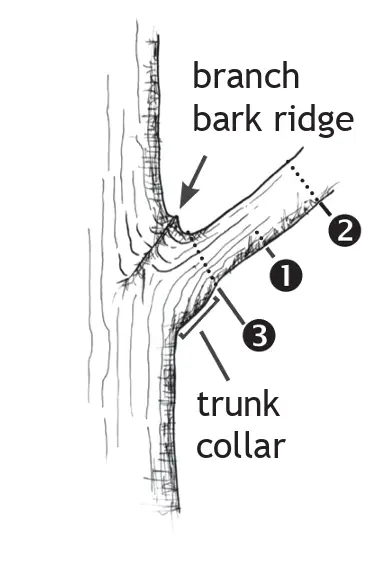
Pruning cuts should be made at the base of each branch just outside the point of attachment. This is technically referred to as the trunk collar, a swollen structure that marks the transition from main trunk to branch. Figure 1 illustrates this anatomy.
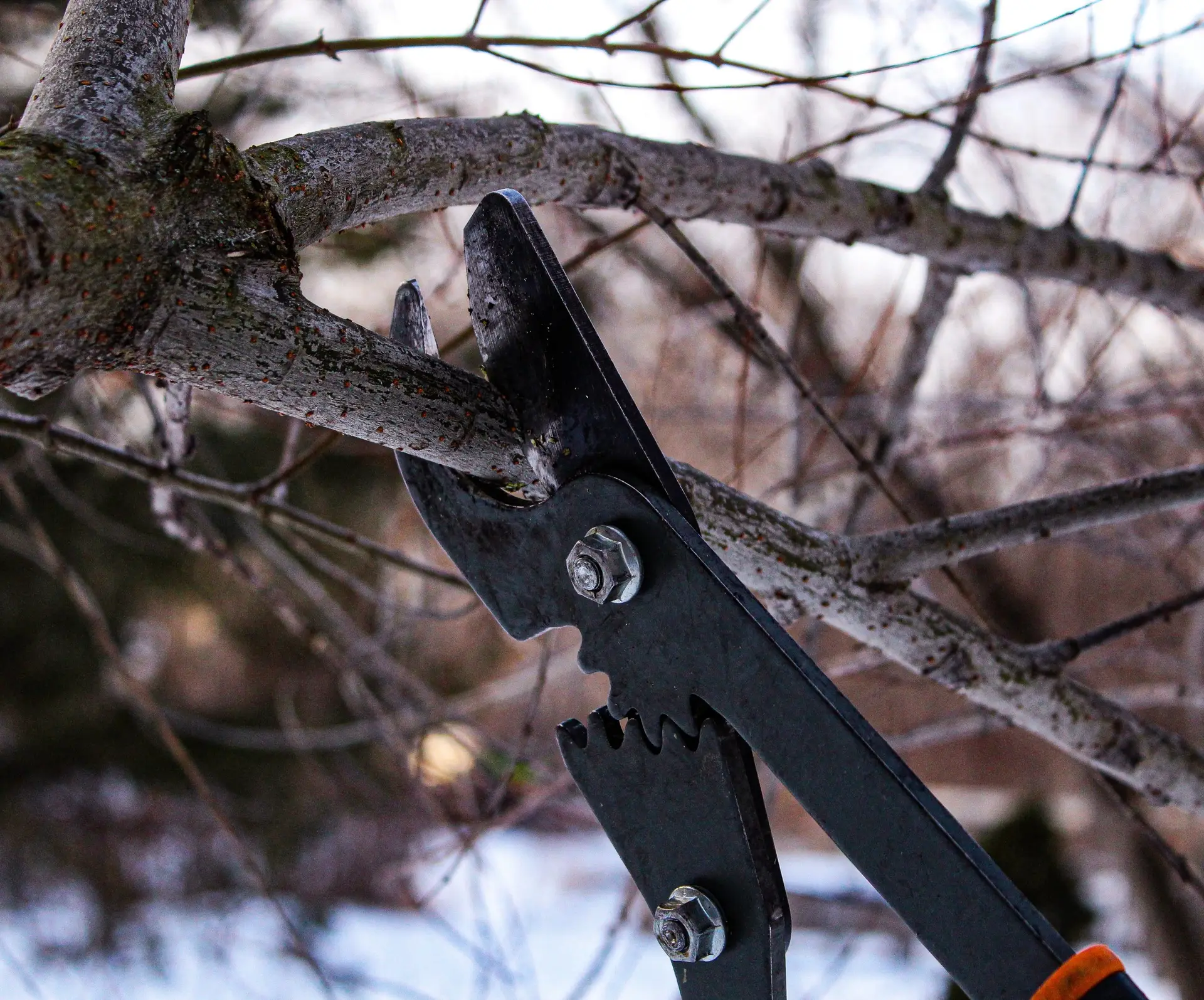
Branches less than half an inch in diameter can be pruned with hand pruners. Branches up to an inch and a half in diameter can be pruned with bypass loppers. Branches of a diameter larger than that should be cut with a saw. If disease is suspected, tools should be sanitized with rubbing alcohol between cuts.
Larger branches should be removed using the three-cut technique to reduce the risk of stripping bark off the trunk. First, an undercut is made partway through the branch. Second, an over cut is made farther out on the branch from the undercut; this cut removes the majority of the branch, and any bark tearing will stop at the undercut. Third, the stub is removed at the trunk collar. Figure 1 demonstrates the proper placing of these pruning cuts.
Post-pruning sealers or treatments are no longer recommended. The tree or shrub will undertake its own natural process to seal off the area of pruning-induced injury.
Pruning branches out of mature trees involves risk and can be very dangerous. This kind of work is best left to professionals. Arborists certified by the International Society for Arboriculture have advanced training and can help homeowners make tree care decisions.
What to prune
Pruning is for maintenance, not recreation. Every single cut induces injury and should be purposeful and justified. There is a lot more to the task than aesthetics alone.
First, clear out dead and broken branches. Note that dead wood can be cut out at any time of the year with no risk of introducing disease. Look for branches that are sloughing their bark or have turned a gray/black color, an indicator of dead tissue. No matter the time of year, broken branches should be removed with a clean cut—this reduces the surface area of the injury and the likelihood that disease can enter.
Next on the list to prune are branches with any structural faults. Branches that are crossing or rubbing against each other create a site where disease and rot can occur. Closely evaluate crossing branches and remove the less desirable of the two at its collar.
Young trees often have multiple branches competing to become the strong, central trunk, which is called a leader. The correct structure for most species of shade trees in Wyoming is a single central leader; multiple leaders can lead to trunk splitting from wind shear or snow loads as the tree matures—not good!
Identify the most central and most upright, vertically growing branch to be the leader. Other branches that appear to be competing leaders should be “tipped back” by reducing the height by 4–6 inches on a young tree. Make this cut at an outward-facing node to encourage lateral growth.
Beyond structural issues, pruning should be conducted to maintain visibility around corners and at intersections. Ensuring sufficient clearance for people and vehicles around sidewalks, driveways and lanes should be a priority. Trees and shrubs should not touch houses or outbuildings.
Note that shrubs like lilacs that bloom in early spring set their flowers in the year prior to bloom. Pruning these species during the winter can reduce the bloom display the next spring. They are best pruned in the two weeks immediately after the last blooms fade.
Tree resources
The University of Wyoming Extension maintains a list of tree-care resources at https://bit.ly/UWE-tree. The Wyoming State Forestry Tree Owner’s Manual is an excellent guide to all things tree care. View it online at https://bit.ly/tree-owners-manual or pick up a hard copy from any Wyoming State Forestry district office—the pruning section begins on page 18. Finally, the International Society of Arboriculture curates many useful resources at treesaregood.org.
Micah Most is the agriculture and natural resources educator with University of Wyoming Extension serving Johnson County and north-central Wyoming. He can be reached at mmost@uwyo.edu or 307-684-7522.