


From locked trash cans to diverse types of bird feeders, cities present urban wildlife like raccoons with novel challenges and opportunities to find food and resources. But do overcoming these challenges—and thriving and adapting in the face of them—make animals “smarter?”
A new study published in Proceedings of the Royal Society B adds to a growing body of evidence that raccoons, to the suspected chagrin of their human counterparts, demonstrate innovative problem-solving skills when faced with new foraging challenges. Lead author Lauren Stanton, a University of Wyoming Ph.D. graduate who’s now a postdoctoral researcher at the University of California-Berkeley, says understanding the behavior can help manage potential conflict between people and raccoons.
“Our findings serve as a reminder that raccoons and other animals are not going to engage in risky situations if they do not need to,” she says in a Cal-Berkeley media release. “So, it’s up to us as people to set humane boundaries with wildlife and make sure that our management strategies are strong from the get-go.”
This study was conducted as part of Stanton’s dissertation research at UW, where she studied raccoons in the lab of Assistant Professor Sarah Benson-Amram, now an associate professor at the University of British Columbia. Stanton and her colleagues used live traps baited with cat food to humanely capture raccoons in Laramie. The researchers assessed each captured raccoon’s age, sex, and body condition before marking them with a passive integrated transponder tag—similar to a microchip used with pets—to identify and monitor each raccoon.
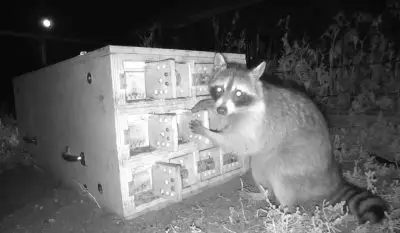
After releasing the raccoons back to their home territory, the researchers presented the animals with a medium-difficulty puzzle box baited with a food reward. While some raccoons were able to solve it by opening a latched door to retrieve the food reward, others were merely observed scrounging the leftover food rewards. Researchers later deployed a multisolution puzzle box with four different locking mechanisms—ranging in difficulty from easy to hard—to assess how raccoons would respond to a new set of challenges.
According to Stanton, the raccoons who were previously scroungers were able to learn the new, easy solution before solving the other, more difficult problems.
“We believe this illustrates how learning begets learning: Like us, animals can learn new, basic skills, then build motivation and knowledge that enable them to develop more complex skills,” she explains. “And, because we did this study in wild, backyard settings, it gives us an inside scoop on how innovative foraging behaviors develop naturally in urban environments.”
Roughly one in four raccoons the researchers tested were able to solve the puzzle boxes. Stanton notes that the majority of the successful raccoons were still juveniles, which suggests that older raccoons are more careful to avoid unnecessary risks.
“We think younger raccoons, who are more naive and in poorer body condition, are more likely to take greater risks to survive,” she says.
Tested raccoons also were observed employing different approaches to foraging, which Stanton believes could help raccoons avoid resource competition.
“Naturally occurring variables, like age or competition among urban animals, haven’t really been considered in this big question of whether cities are making animals ‘smarter,’” she says. “Our study has uncovered important factors that we need to consider when thinking about when and how animals are using their smarts to adapt to city life.”
Additional co-authors include UW students Carissa Cooley-Ackermann, Emily Davis, and Rachel Fanelli.
This story was originally published on UW News.