


While Wyoming is home to some of North America’s most abundant populations of pronghorn that have largely been stable in recent years, a new analysis shows that many herds are experiencing long-term declines in fawn production.
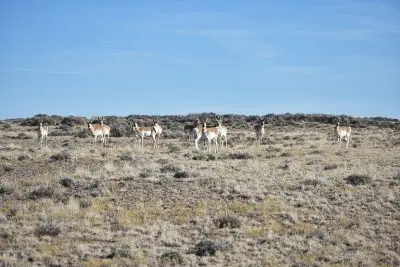
Those declines are primarily a result of oil and gas development and encroachment of trees, according to researchers from the University of Wyoming, the University of Florida, the University of Nebraska-Lincoln, the University of Arkansas, and the Northern Plains Agricultural Research Laboratory. Their findings have been published in the journal Global Ecology and Conservation.
The study included data collected by the Wyoming Game and Fish Department for 40 pronghorn herds covering much of Wyoming—home to about half of North America’s population of the iconic animal—over a 35-year period from 1984–2019. In addition to analyzing the Game and Fish Department’s extensive information from annual pronghorn population surveys, the researchers looked at region-specific data regarding oil and gas development, roads, fire, invasive plants, tree encroachment, and precipitation patterns.
“Long-term declines in (pronghorn) productivity were associated with increases in oil and gas development and woody encroachment,” wrote the research team, led by former University of Nebraska researcher Victoria Donovan, now with the University of Florida, and Professor Jeff Beck, of UW’s Department of Ecosystem Science and Management. They found that “both tree cover and oil and gas development have increased substantially across most herd units in Wyoming over the last 40 years.”
“Other drivers of global change viewed as threats to pronghorn—including nonnative annual grass invasions, wildfire, roads, and increased winter precipitation—were not prominent drivers of long-term declines in pronghorn productivity,” the scientists concluded.
While oil and gas development already is widely recognized as impacting Wyoming’s rangelands and the species on those lands, the researchers noted that tree encroachment is not generally viewed as a threat to the state’s sagebrush ecosystems. That’s likely because average tree cover ranged from less than 1 percent to 18 percent across the 40 pronghorn herd unit areas.
But even low levels of invading trees have been shown to have drastic impacts on sagebrush-dependent wildlife, the scientists wrote. For Wyoming’s pronghorn, the increase in trees could be providing cover for predators; driving loss of forage associated with sagebrush and grassland cover; and causing pronghorn to avoid those areas.
The researchers suggest that efforts to prevent and manage tree growth amid sagebrush ecosystems could be important for Wyoming pronghorn to maintain their numbers. This could include manual removal of trees and controlled burning.
“Our results contribute to the overwhelming evidence that early management of invading trees within sagebrush habitat will help protect iconic rangeland species like pronghorn,” they wrote. “Preventative management and management applied in the early phases of encroachment is, thus, the most impactful and cost-effective approach.”
This story was originally published on UW News.